AIOctober 7, 202611 min read
Mistral Large 4 is open weight, and your laptop can't run it
Mistral announced its biggest model on 6 October 2026 and said the weights arrive by the end of the month. This morning there was still no file, and Ollama offers it as a cloud model only.
Mistral Large 4 is the biggest model the French lab has built, it was announced on 6 October, and nobody can download it yet. Mistral says the weights arrive by the end of October, so the only way to use Mistral Large 4 today is to pay for it through an API, at $0.68 for every million tokens you send it.
The phrase Mistral used is open weight, and a reader hears that as a file they get to keep. This morning we checked the 3 places a model turns up the moment it becomes downloadable, and none of them had it. What follows is what exists today, what it costs, and what that download will ask of your computer when it finally lands.
Can you download Mistral Large 4 today?
No, there is no Mistral Large 4 file published anywhere yet. Mistral's announcement says "Weights drop end of this month", and the closing lines repeat that the company will release them by the end of the month, which leaves about 3 weeks of waiting from today.
The Hugging Face account where Mistral publishes its downloadable models is called mistralai, and we asked that account this morning for its newest uploads. Nothing has appeared on it since the middle of July. The most recent Mistral Large sitting there has been public since last November, and it is the one this launch replaces.
If you want to know the moment it lands rather than reading about it the next day, the account to watch is that same one, and Hugging Face will tell you when something new appears on it. That is also the only way to be certain, because an announcement can promise the end of the month while the file turns up on a different page or under a name nobody predicted.
Ollama says the same thing from the other direction. It is the app most people install when they want a model running on their own machine, and it already carries a page for the new model. That page offers exactly one tag, and the tag is cloud. The size column, which normally announces how many gigabytes you are about to pull down, shows a dash instead of a number.
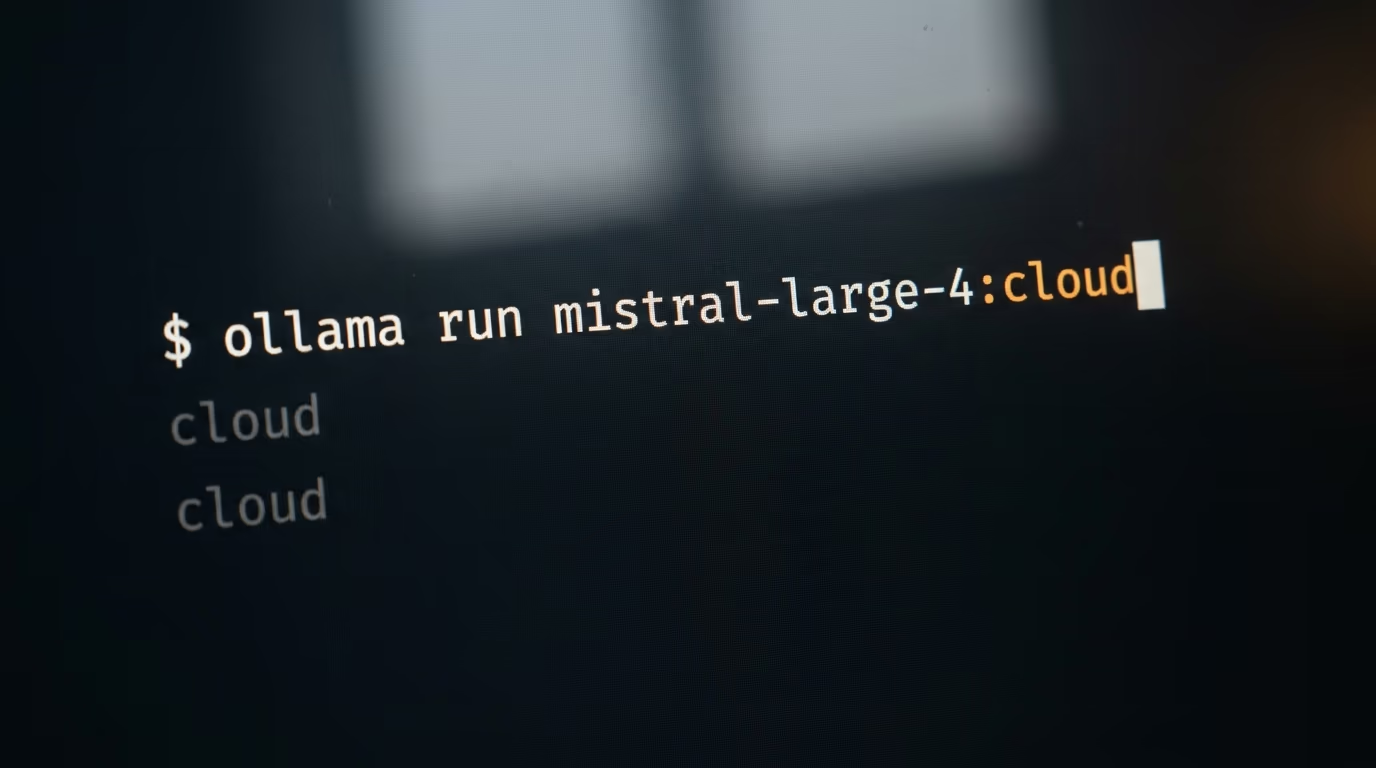
So the command below does work tonight, and it is worth understanding what it actually does before you type it.
ollama run mistral-large-4:cloudYour text leaves your computer, the model answers on Mistral's hardware, and you are billed by the token exactly as you would be through any other API. Ollama is acting as a convenient front door here rather than as the local runtime people installed it for. OpenRouter carries the model as well, and when we pulled its provider list this morning there was a single provider behind it, which is Mistral itself. If the difference between a model you rent and a model you own is fuzzy, our explainer on open weight AI models and what they cost walks through it without jargon.
What does Mistral Large 4 cost to use right now?
Mistral's own documentation page prices Mistral Large 4 at $0.68 for a million tokens of input, with a figure exactly double that printed beside it and struck through. The announcement page published the same day shows only that struck out figure, so Mistral's 2 official pages quote different money for the same model, and the cheaper rate is the one its documentation is charging.

A million tokens is roughly 700,000 words, which is about 7 novels, so that rate buys the model a small library of reading. What it writes back costs about 3 times as much, because output is always the expensive direction. Text you send over and over, a long document or a set of instructions the model sees on every call, drops to a tenth of the input rate once it has been cached.
The struck out numbers are a launch price behaving like a launch price, and Mistral has not said how long the lower rate lasts. Artificial Analysis, the independent tracker that measures these models, publishes the higher pair on its Mistral Large 4 page, which is a defensible choice for a service quoting list prices and a figure to ignore if you are working out a budget this week. We ranked the big context models by what one full window really costs in our breakdown of long context pricing, and the lesson there applies here too, since the advertised rate and the rate you pay often live on different pages.
The hosting arrangement got less attention than the benchmark tables and will outlast them. Mistral says the model will be available across several regions including a European deployment that it operates end to end, independently of other digital service providers and under European law. A business that cannot send customer records outside the European Union can use that, and it explains why a French lab keeps winning work that has nothing to do with topping a leaderboard.
No waiting list stands between you and the preview, and no commitment either, which is the argument for testing it now rather than after the file lands. The weights will arrive into a market that has already decided what it thinks, and the people who formed an opinion from their own prompts will be the ones worth listening to.
Will your own computer run Mistral Large 4 when the weights land?
Almost certainly not, and the sizes of the models you can already download are why. We measured 5 of them this morning by asking Hugging Face for the total weight of the model files in each repository, which is a number that rarely travels with the term open weight.
| Model | Lab | What the download weighs today | Licence on the files |
|---|---|---|---|
| Mistral Large 4 | Mistral, France | Nothing published yet | Not named yet |
| Mistral Large 3 | Mistral, France | 403 GB | Apache 2.0 |
| GLM-5.3 | Z.ai, China | 756 GB | Custom, listed as other |
| Kimi K3 | Moonshot, China | 1,561 GB | Custom, listed as other |
| MiMo V2.6 Pro | Xiaomi, China | 573 GB | MIT |
| DeepSeek V4.1 Flash | DeepSeek, China | 510 GB | MIT |
Mistral Large 3 is a download of 403 GB spread across hundreds of separate files. It is the model Mistral Large 4 replaces, and Mistral describes the new one as larger, so what arrives at the end of October will not be smaller than that. A laptop sold today commonly ships with a 512 GB disk, which means the older and smaller Mistral would fill it and leave almost nothing for the operating system, your documents and everything else.
That figure is already the compact edition. The repository we measured stores each number at a quarter of the precision the lab trained in, which is the shrinking trick we covered in our guide to quantisation and which model file to download. The full fat version of a model that size is several times larger again, so the number in the table is the friendly one.
Holding the file is only the first half of the problem anyway. A model has to sit in the fast memory attached to the chips doing the work rather than on a disk, so whoever runs it needs all those gigabytes of memory spread across several accelerators wired together. That is why organisations self hosting a model this size buy or rent servers rather than workstations, and why the decision lands on a budget line instead of a weekend.
Mistral Large 4 uses a mixture of experts design, which switches on only a slice of itself for each token it produces. That is why it can be served cheaply despite its size, and it is explained properly in what a mixture of experts model is. It changes nothing about the download, though, because every expert has to sit on the disk and in memory even while it is idle, waiting for the questions that wake it up.
None of this is a complaint aimed at Mistral specifically. Every frontier model in that table is in the same class, and open weight today means a company with a rack of accelerators can run it under its own roof, under its own rules, with no vendor able to switch it off. That is worth a great deal to such a company, and it is not a promise to the person reading this on a laptop. If you want a capable model running on your actual hardware tonight, the sizes that fit are an order of magnitude smaller, and we ranked them in the best local models for coding, sorted by the memory you have.
What does Mistral say Mistral Large 4 is better at?
Mistral puts cybersecurity first, and the specific claim is that on an independent index which asks a model to reproduce a real security flaw in open source software and then patch it, Mistral Large 4 scores higher than any other model tested. The company also reports that it solves the large majority of a public set of security competition exercises, which it says is among the highest results reported for a downloadable model.
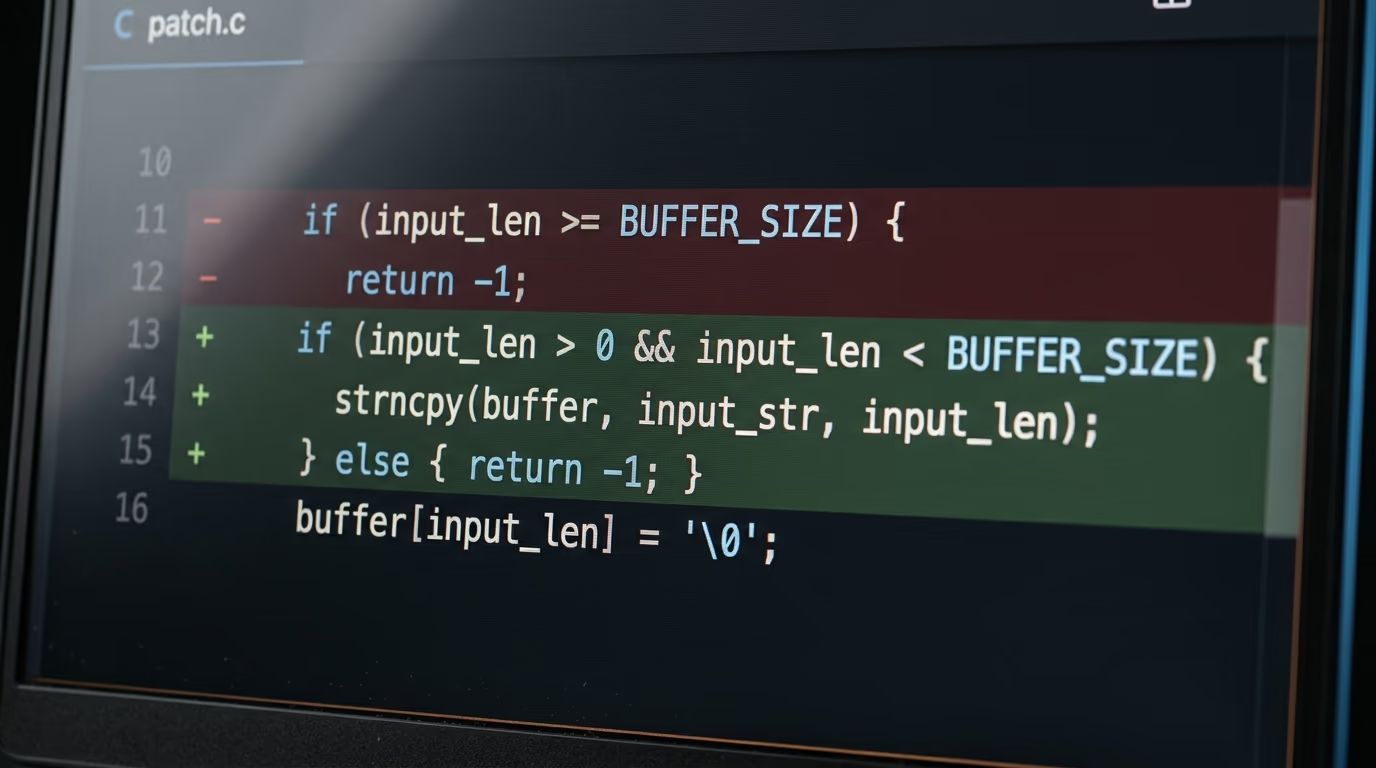
Mistral also makes an argument about its rivals. Its post says several leading closed models, naming Claude Opus 5.5 and GPT-6 Astra, score near zero on that same security exercise set because they refuse to perform the task. Refusing is a deliberate safety decision at those labs rather than a hole in what the models can do, and Mistral's own post acknowledges the other side of the argument by reporting that its model declines malicious security requests more often than any downloadable model it compared against.
On everyday coding, the result Mistral leads with comes from a blind comparison it commissioned from the annotation company Surge AI, where professional reviewers rated answers without being told which model produced them. Mistral Large 4 placed second out of the 5 models tested, behind Anthropic's Claude Opus. Mistral paid for that evaluation and chose the vendor, so it reports a model close to the leader rather than ahead of it.
One measurement in this story came from somebody other than Mistral. Artificial Analysis scored the preview on its own intelligence index, a composite of several separate tests, and the result sits below all 5 of the downloadable models at the top of that tracker's open board, every one of which comes from a Chinese lab. Mistral's own wording is careful about exactly this, claiming only to significantly outperform open weight models developed in the United States or Europe, which the independent board supports rather than contradicts.
Mistral also says the model reads images natively, works through documents and charts, and was trained on material covering every official language of the European Union and many more besides. Those are capability claims from the lab, published without an outside check, and they stay that way until the weights are out and anybody can test them.
What do we not know yet about Mistral Large 4?
The licence is the largest unknown, and Mistral has not named one for this release. Its documentation prints a licence against every model in the lineup, Apache 2.0 for the previous Mistral Large and for Mistral Small, and against the new model it prints the single term Open.
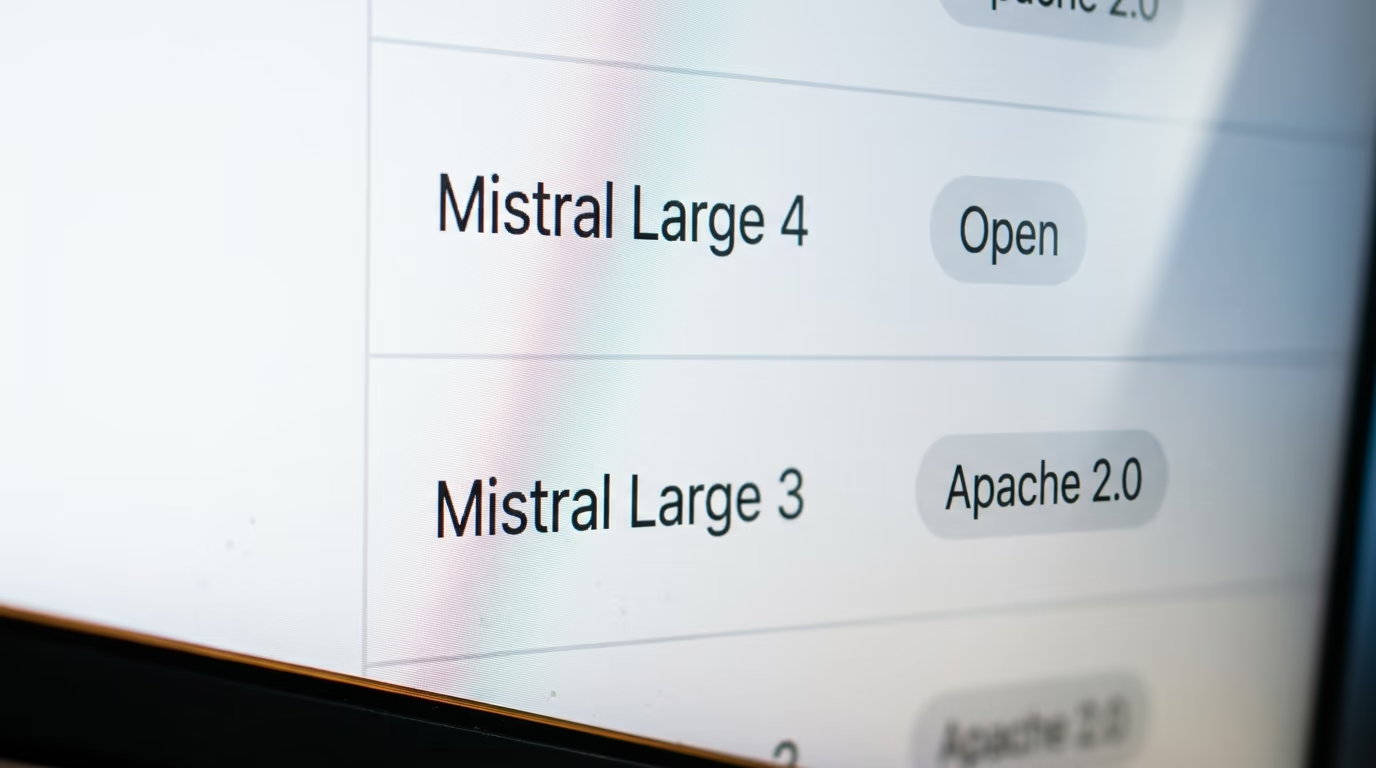
Open is a category, not a licence, and they are not the same promise. An Apache licence lets a business build a product on the model and sell it with no permission asked. A custom licence can forbid commercial use, cap the number of users, require attribution, or reserve rights the lab wants back later. Until Mistral publishes the text, nobody can tell you whether you may ship a product built on this model.
We have watched that gap open twice in recent weeks, and both times the download was real while the permission was not. Alibaba published an image model anyone can pull down and which is not yours to sell once you have it, and Google released its strongest forecasting model under terms that mean you cannot ship it in a product. Neither lab did anything dishonest, and in both cases the term open was carrying weight the licence underneath it did not support. That is the same gap Mistral has left sitting for 3 more weeks.
The release date is soft as well. End of the month is all Mistral has committed to in writing, with no day named on any of its pages. There is no technical report either, no architecture detail beyond a headline and no file list, so the download size we would most like to give you is the one number that does not exist yet.
Mistral's own pages also disagree with each other in 2 places. The announcement and the documentation give different counts for how much of the model switches on for each token, and the Ollama listing carries both of those counts on the same screen. The context window has the same problem, with Mistral's model page advertising a window roughly twice the size that the OpenRouter listing for Mistral's own endpoint publishes. Both were live this morning, and neither has been corrected.
Nobody outside Mistral has independently tested the thing that makes this announcement matter, which is the weights, for the simple reason that the weights do not exist publicly. Artificial Analysis measured the preview API, not a file. Until the download lands, every quality claim in circulation traces back to the lab that built the model.
The announcement also describes what is happening to the model between now and the release. Mistral says it is red teaming with cybersecurity leaders, vetted partners and state authorities, who get access to the same model with reduced moderation and expanded cyber capabilities. Those are Mistral's own terms, and the company has not said which authorities or which countries.
What should you do about Mistral Large 4 tonight?
Try it, because trying it is almost free, and do not reorganise your disk for it. The preview answers through Mistral's own API, through OpenRouter, and through the single Ollama cloud tag, and a serious session of testing will cost you less than lunch at the current rate. If the work you care about is reading long documents or reviewing code for security problems, that is where Mistral is pointing, so that is where a fair test belongs.
A fair test takes an afternoon and needs no plan. Give it a long document you already know well and ask for the thing you would normally ask a junior colleague to pull out of it, then hand it a piece of your own code and ask what could go wrong with it from a security point of view. Those 2 jobs are exactly where Mistral is pointing, and you will learn more from them than from any score, because you can check both answers yourself.
If what you actually wanted was a frontier model living on hardware you control, 4 of them are downloadable right now and 2 carry the plain MIT licence with no conditions attached. We ranked those by what their licences really permit in the best open source AI model, judged on its licence, and the ranking has not changed this morning, because a model nobody can download cannot enter it.
Then watch for 2 specific things at the end of October. The first is the licence text, because the single term Open covers everything from a permissive licence to a document that forbids the exact use you had in mind. The second is the file list, since that is the moment anybody can finally say what running Mistral Large 4 really demands, and it is the moment the benchmark claims become testable by people who do not work there.
Questions people ask
Can I download Mistral Large 4 right now?
No, the weights have not been published. Mistral announced the model on 6 October and said the weights would be released by the end of the month, and nothing new has appeared on Mistral's Hugging Face account since the middle of July. The only ways to reach the model today are Mistral's own API, OpenRouter, and Ollama's cloud tag, all of which run it on somebody else's hardware and bill you per token.
How much does Mistral Large 4 cost?
Mistral's documentation page prices it at $0.68 per million tokens of input, with a struck out figure of exactly double that beside it, and output costs about 3 times the input rate. Repeated text that gets cached drops to a tenth of the input rate, and A million tokens is roughly the length of several novels.
What licence will Mistral Large 4 use?
Mistral has not said, which makes this the open question of the launch. Its documentation names Apache for the previous Mistral Large and for Mistral Small, and against Mistral Large 4 it prints only the term Open, which is a category rather than a licence. Until the text is published, nobody can confirm whether you are allowed to build a commercial product on it.
Can my laptop run Mistral Large 4 once the weights are out?
Almost certainly not, and the sizes in the table above are why. The previous and smaller Mistral Large is a download measured in hundreds of gigabytes even in its already shrunken form, and the comparable models from other labs are larger still. A laptop disk cannot hold any of them, so this class of model belongs on servers with many accelerators rather than on personal machines.
Is Mistral Large 4 better than GLM or Kimi K3?
Not according to the one independent measurement available today. Artificial Analysis scored the Mistral Large 4 preview below all 5 of the downloadable models at the top of its own open board, each of which comes from a Chinese lab. Mistral claims only to significantly outperform open weight models built in the United States or Europe, which is consistent with those rankings.
What is Mistral Large 4 actually good at?
Mistral leads with cybersecurity, reporting that its model tops an independent index on reproducing and then patching a real software flaw. It also commissioned a blind human comparison on coding quality where its model placed second of the 5 tested, behind Anthropic's Claude Opus. Both results are reported by Mistral, and no outside group has tested the weights because the weights have not been released.
Why is Mistral Large 4 called le Chonk?
Mistral gave it the nickname itself in the announcement, writing that the model is unofficially ML4 and very officially le Chonk. It is a joke about size, since the company describes a model of around a trillion parameters that activates only a fraction of itself for each token it writes.