AIAugust 25, 202611 min read
Open weight AI models explained, and what they cost
The weights are the finished model, not the recipe that made it. What open weight AI models give you, which licenses come with strings attached, and what running one really costs.
Open weight AI models are models whose trained parameters have been published as files anyone can download, so you can run them on your own hardware, look inside them and fine tune them without asking permission. The Open Source Initiative defines open weights as the final weights and biases of a trained neural network, and says directly that they do not include the training code or the training data that produced them.
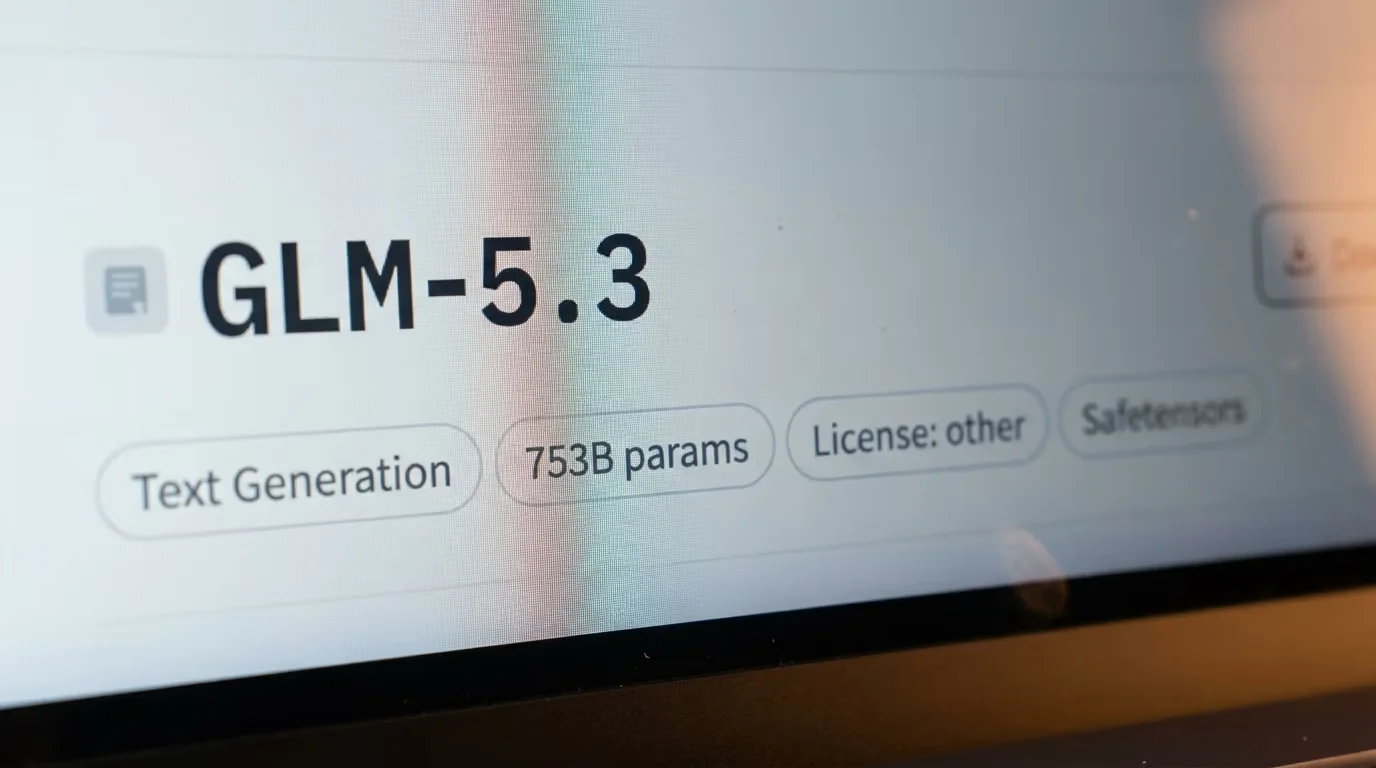
That missing half is why an open weight model is not an open source model, and why the license file matters more than the announcement. Z.ai uploaded GLM-5.3 and GLM-5.3 Flash to Hugging Face on 25 August 2026, seconds apart. Flash ships under MIT, and the larger model ships under a custom license the lab wrote itself. Both arrived under the same open weight banner, and only one of them lets a very large company use it without asking first.
What are open weight AI models?
An open weight AI model is a trained model whose parameter files have been published for download, most often on Hugging Face, so anyone can run it locally or on rented hardware. The weights are the finished product of training, and publishing them is the entire meaning of the term.
A weight is a single number that decides how strongly one internal signal pushes on another. Training is the slow process of nudging billions of those numbers until the output becomes useful. When training stops, the numbers stop moving, and what is left is an enormous table of them. That table is the model, and everything else in the repository is packaging around it.
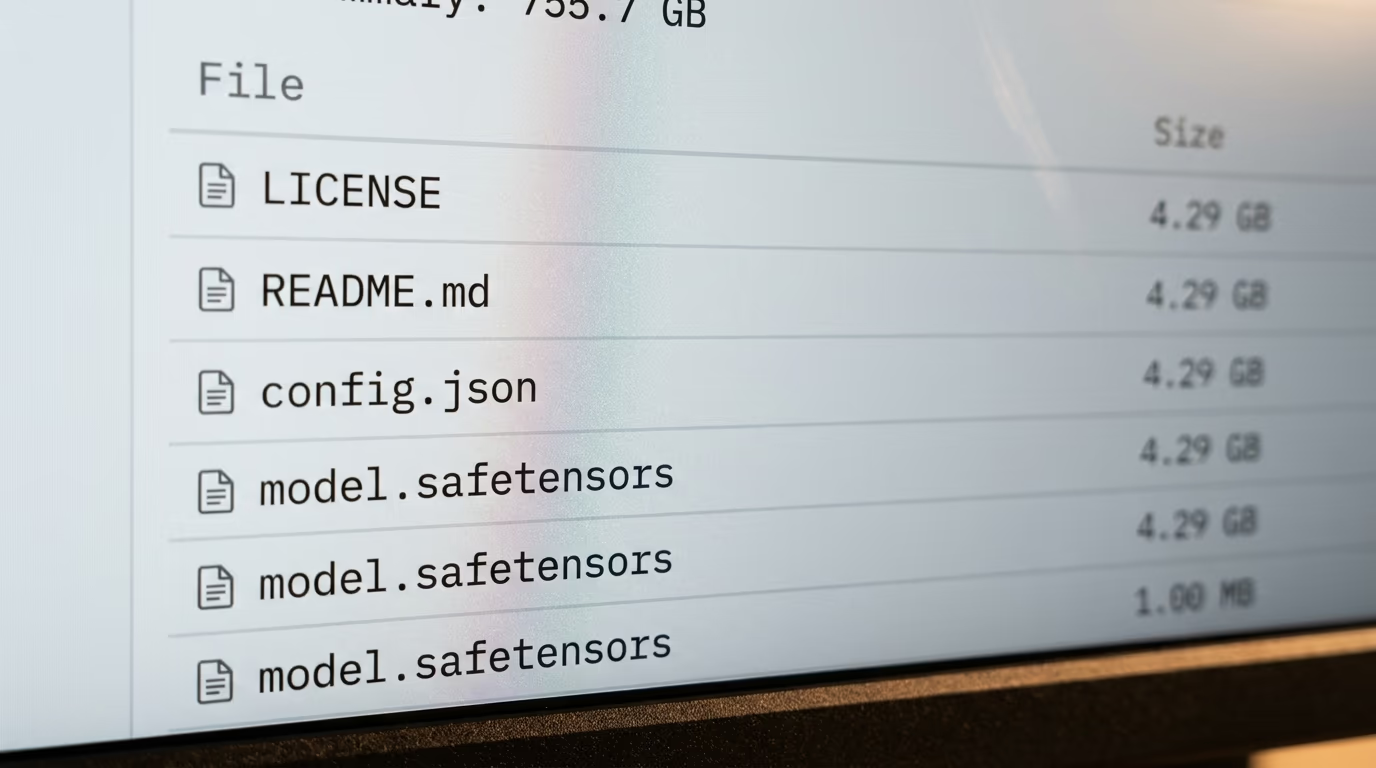
The sizes are easier to picture as files on a disk. GLM-5.3 carries 753,329,940,480 parameters, and its repository on Hugging Face holds 755.7 GB of files, because those weights are stored in an 8 bit float format that spends roughly one byte per parameter. At the small end, gpt-oss-20b from OpenAI has 20,914,757,184 parameters in a repository of 41.4 GB. Downloading a model means pulling that folder onto your own storage.
What you receive is the trained result and nothing that explains how it got there. There is no dataset, no cleaning code, no evaluation setup and no record of what was discarded along the way. You can measure how the model behaves, and you cannot reconstruct it from scratch. Everything else in this article follows from that one gap.
What the weights do buy you is a set of abilities no API offers at any price. The model runs with no network connection and no request logged by somebody else's server. You can freeze a version and keep serving it long after the vendor has moved on to the next release. You can fine tune it on your own examples until it does one narrow job better than a general model manages, and you can watch what happens inside it while it answers, which is how these systems get studied seriously.
How are open weight models different from open source AI?
An open weight model hands you the finished parameters, while open source AI, as the Open Source Initiative defines it, requires enough material for someone else to study and rebuild the system. The Initiative's Open Source AI Definition 1.0 grants 4 freedoms, to use, to study, to modify and to share, and it treats access to the means of making modifications as the condition underneath all of them.
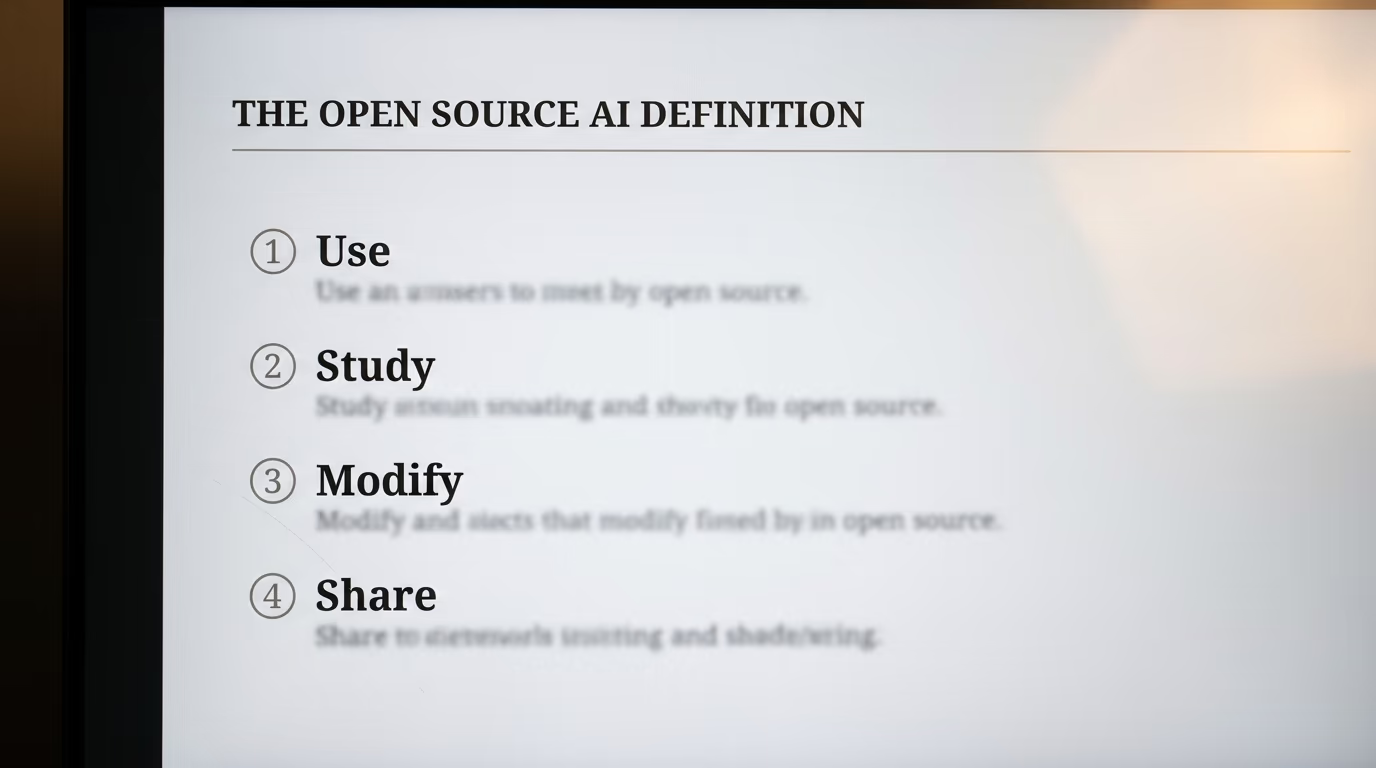
Open weights clear the first freedom easily and then stumble. You can use the model for whatever the license allows, you can share it, and you can modify it by fine tuning on your own examples. Studying how it came to behave the way it does is where the material runs out, because the data and the process that shaped those numbers were never published alongside them.
The Open Source Initiative names 3 things that are missing from every open weight release.
- The training code that produced the weights
- The dataset the model learned from
- Full transparency about where that data came from
That absence stops being academic the moment a model reaches production. You cannot audit what the model memorized during training, because the material it memorized was never shown to you. You cannot rebuild it from scratch to check a claim about it, so every benchmark figure you read is somebody else's measurement of their own work. And you inherit whatever habits the data left behind, discovering them in your own testing rather than in any documentation. None of that makes an open weight model a poor choice, and all of it moves the testing burden onto you.
The Open Source Initiative points back to Heather Meeker's 2023 Open Weights Definition as the reference for the term, so the vocabulary was settled before most of today's models existed. Vendors blur it anyway, and a model announced as open source in a launch post is very often an open weight release carrying custom terms. The only reliable way to know is to open the license file and read it.
Which open weight AI models can you download right now?
The models below were all live on Hugging Face on 28 August 2026, and every number here comes from each model's own record on the site rather than from a launch post. The parameter counts are exact rather than rounded, because rounding is what hides how far apart these models really are.
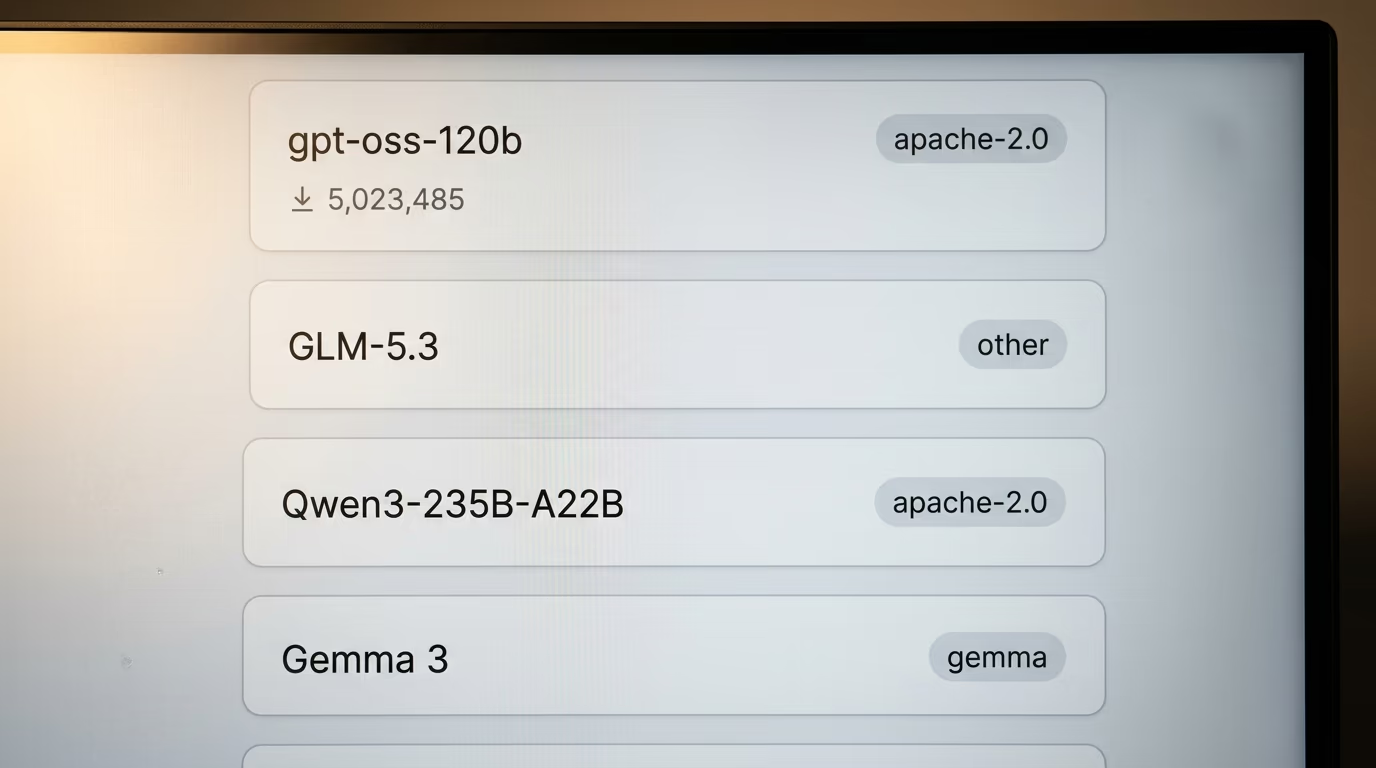
| Model | License tag | Parameters | Published |
|---|---|---|---|
| GLM-5.3 | other (custom) | 753,329,940,480 | 25 Aug 2026 |
| GLM-5.3-Flash | mit | 321,323,031,390 | 25 Aug 2026 |
| DeepSeek-V4-Flash-0731 | mit | 304,180,418,494 | 31 Jul 2026 |
| Qwen3-235B-A22B | apache-2.0 | 235,093,634,560 | 27 Apr 2025 |
| gpt-oss-120b | apache-2.0 | 116,829,156,672 | 4 Aug 2025 |
| gpt-oss-20b | apache-2.0 | 20,914,757,184 | 4 Aug 2025 |
| Llama-3.1-8B-Instruct | llama3.1 | 8,030,261,248 | 18 Jul 2024 |
| gemma-3-1b-it | gemma | 999,885,952 | 10 Mar 2025 |
The most instructive rows are the top 2. Z.ai uploaded GLM-5.3 and GLM-5.3 Flash within the same minute on 25 August 2026 and gave them different terms. Flash carries an MIT license, which is about as permissive as software licensing gets. The larger model is tagged other, which on Hugging Face means the lab wrote its own conditions and you are expected to go and read them.
Size varies across this table by a factor of more than 750. Google's gemma-3-1b-it holds 999,885,952 parameters and runs on a laptop, while GLM-5.3 needs server hardware before it will answer anything at all. Both are open weight models by the same definition, so the phrase on its own tells you nothing about whether you can actually run the thing.
The license tag is the fastest signal in that table once you know how to read it. Hugging Face shows a short machine readable value on every model, so mit and apache-2.0 tell you the terms are standard and already understood by any lawyer you might ask. A value naming the model family, like llama3.1 or gemma, means the vendor wrote its own agreement and you are expected to read it before shipping. A value of other means exactly the same thing with even less warning attached, and that is what GLM-5.3 carries today.
What does an open weight license actually let you do?
That depends entirely on which license the lab attached, and the range runs from genuinely unrestricted to conditional on the vendor's approval. Apache 2.0 and MIT, used by gpt-oss-120b and by GLM-5.3 Flash, place no limit on who you are, how large you grow or what you build.
Meta's Llama 3.1 license takes a firmer position. Section 2 says that if the monthly active users of your products were greater than 700 million in the calendar month before the release date, you must request a license from Meta. Section 1.b.i separately requires you to display "Built with Llama" on a website, user interface, blog post or product documentation. The first condition targets a handful of companies, and the second one applies to every single user.
Google's Gemma terms reach further than most readers expect. Section 3.2 states that Google reserves the right to restrict, remotely or otherwise, usage of any of the Gemma Services that Google reasonably believes are in violation of the agreement. Section 3.1 requires you to pass those same restrictions on to anyone you give the model or a derivative to. Weights already sitting on your own disk still come with terms naming a remote restriction right.
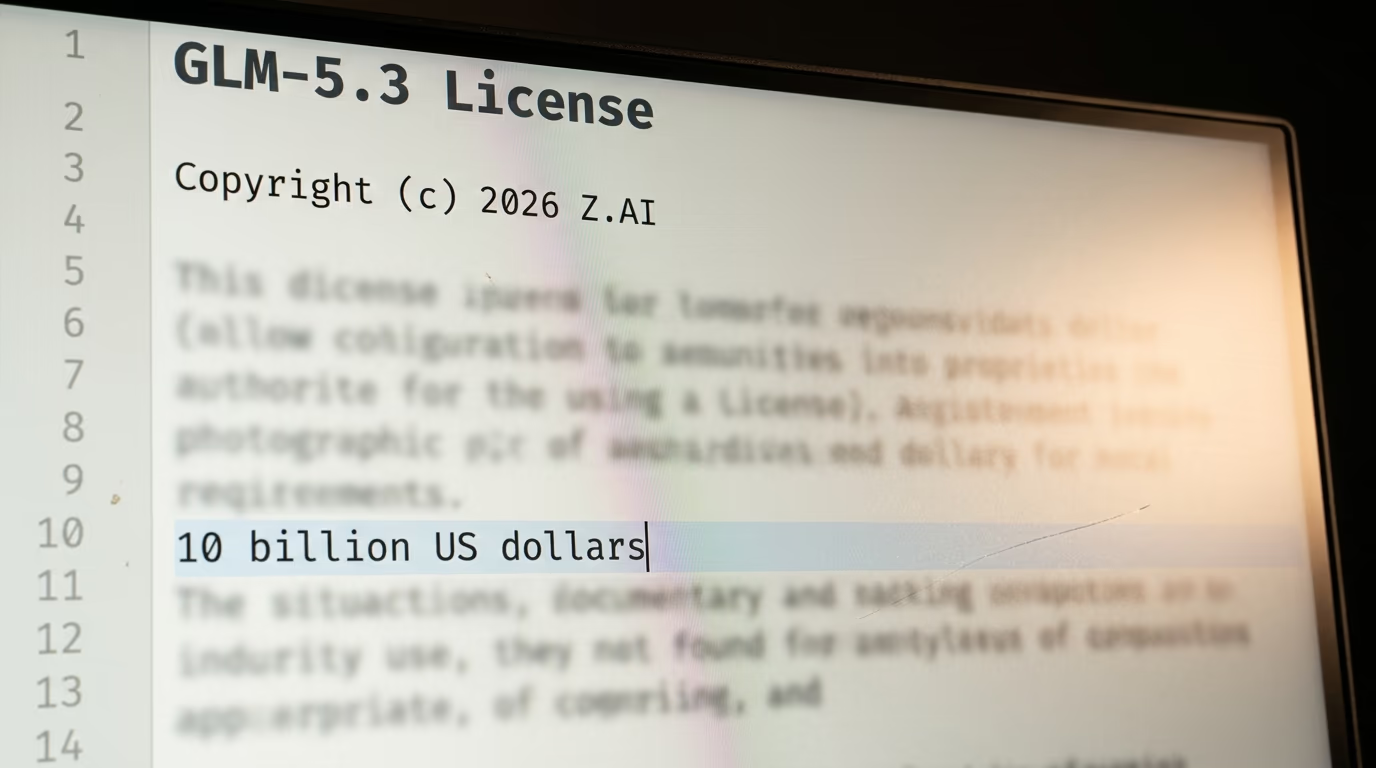
The GLM-5.3 license is the mirror image of Meta's, and it is short enough to read over a coffee. It behaves like MIT for almost everybody, then adds one condition. If you run what the text calls a Model as a Service business, and revenue across any consecutive 12 months goes over 10 billion US dollars, you have to pass Z.AI's security review before any commercial use, with Z.AI deciding the scope of that review.
You can check any model's tag yourself in about 20 seconds, which is worth doing before one goes anywhere near production. The command below asks Hugging Face for a model's public record and pulls out the license line.
curl -s https://huggingface.co/api/models/openai/gpt-oss-120b | grep -o '"license":"[^"]*"'It prints "license":"apache-2.0" and nothing else. Replace the last 2 segments of the address with any other model and you get that model's tag back, where a value of other means the lab wrote custom conditions and you need to open the LICENSE file in the repository before you decide anything.
What does it cost to run an open weight model?
Renting one through a marketplace is startlingly cheap, and running one yourself costs whatever the hardware costs. On OpenRouter on 28 August 2026, gpt-oss-120b was listed at $0.04 per million input tokens and $0.17 per million output tokens.
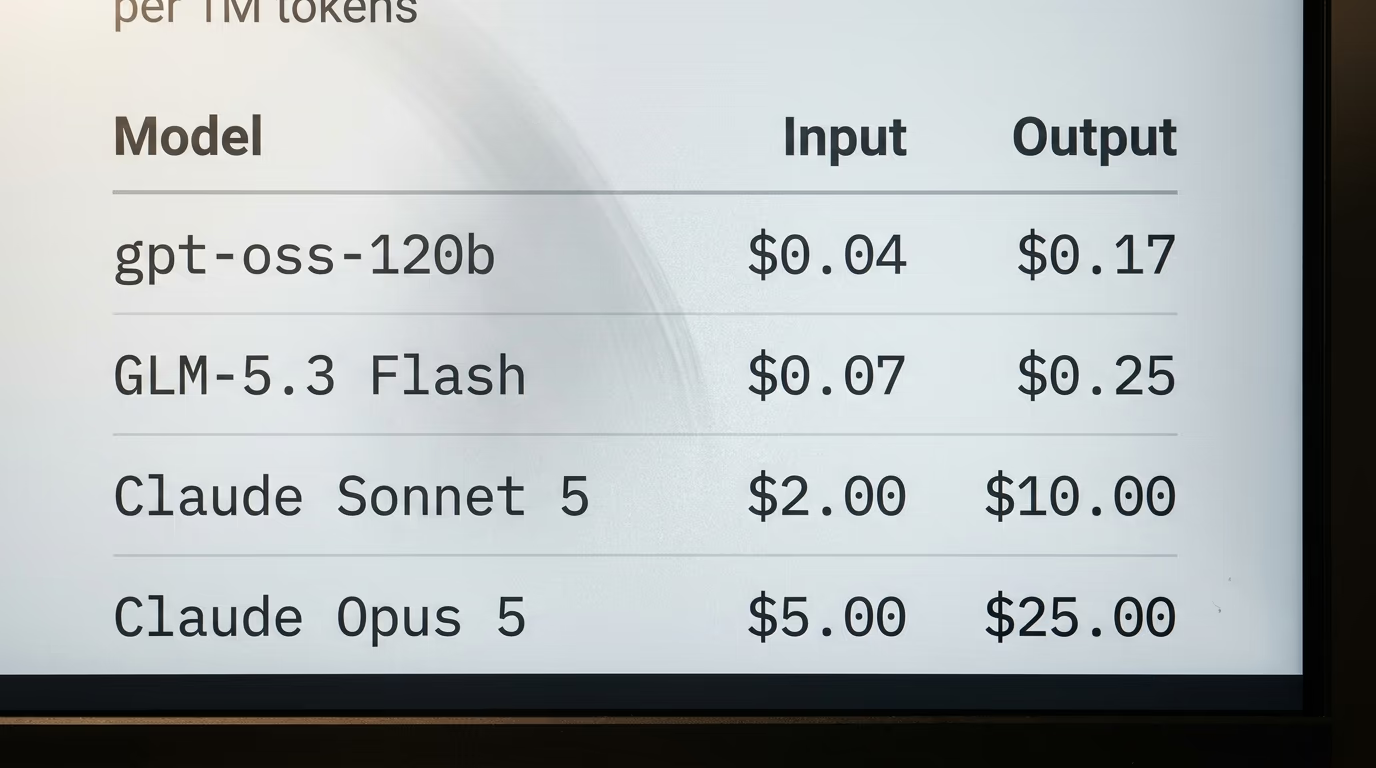
Set that against the closed models on the same marketplace on the same day. Claude Opus 5 was listed at $5.00 in and $25.00 out per million tokens, and Claude Sonnet 5 at $2.00 and $10.00. GLM-5.3 Flash sat at $0.07 and $0.25, and the full GLM-5.3 at $1.40 and $4.40. On output tokens, the cheapest open weight option on that page was roughly 147 times less expensive than the dearest closed one.
Running the weights yourself produces a completely different bill. The download alone is 195.9 GB for gpt-oss-120b and 755.7 GB for GLM-5.3, and the model has to fit into memory across your accelerators before it serves a single token. Renting that hardware by the hour is the usual answer, and it only costs less than a marketplace price once your usage is both steady and large. Reviews of what each release is genuinely good at sit on the tools desk.
Precision is the lever that moves those numbers, and some labs have already pulled it on your behalf. GLM-5.3 ships in an 8 bit float format rather than the 16 bit format that was standard for years, which is why 753,329,940,480 parameters land at 755.7 GB instead of roughly double that figure. Storing each weight in fewer bits shrinks the download and costs a little accuracy, so the size you see on the model page is the starting figure rather than the only one on offer.
Operational work is the cost that never appears on a pricing page. When a hosted model starts returning errors, somebody else gets paged at 3am. When your own deployment falls over, you are the one awake, and you also own the version upgrades, the precision choices, the capacity planning and the on call rota that came free with the API. Cheap per token and cheap in total are 2 separate claims, and only the first one is printed on the page.
Why do the labs publish the weights at all?
Because distribution and acquisition value are worth more to them than the revenue they give up by not charging for access. A model that thousands of teams have already fine tuned into their products is very hard to displace, and the companies serving those models have turned out to be worth a great deal.
TechCrunch reported on 28 August 2026 that open weight companies have become some of the most sought after acquisition targets in the Valley. Its article names a reported $13 billion Nvidia deal for Hugging Face that was still pending confirmation, a $6 billion Nvidia agreement with Poolside, and Stripe's purchase of OpenRouter for more than $7 billion. Those are prices paid for the distribution layer around open weights rather than for any set of weights itself.
The safety argument runs alongside the commercial one. Anthropic published its position on 27 July 2026, stating that it has never advocated for a ban on open weights models, and quoting Dario Amodei that open weights models without dangerous capabilities are a public good. Its stated concerns are aimed at capability thresholds and chip access rather than at the act of publishing weights. We follow the labs and their pricing moves on the AI desk.
For a lab that is behind on distribution, giving the weights away buys attention that cannot be bought any other way. Hugging Face's own counter puts downloads of gpt-oss-120b at 5,023,485. No marketing budget lands your architecture inside that many other companies' systems, and every team that builds on it is a team that stops evaluating alternatives.
When should you pick an open weight model over a closed one?
Choose an open weight model when the work is repetitive, the volume is high and the quality bar is one you can measure yourself, and stay on a closed API when you need the strongest available reasoning on unpredictable work. The arithmetic only turns in favor of self hosting at steady volume, which most teams reach later than they expect.
Adoption is still small, which is worth knowing before assuming the industry has already moved. The same TechCrunch article cites a Ramp survey putting usage of open weight models at 6% of companies, and a Jellyfish survey putting it at 2% of software engineers. Jellyfish's Nik Albarran is quoted saying that if prices from the frontier labs keep going up, more companies will be forced to at least consider it.
There is one objection to all of this that deserves a straight answer. A model costing 147 times less per output token is not 147 times cheaper to operate, because you have quietly absorbed the serving and the monitoring work that the API price was covering for you. For a team of 3 people that trade is usually bad, and the cheap hosted marketplaces are the sensible middle ground between the 2 extremes.
A rough test settles this faster than a spreadsheet ever will. Work out what you spend on a hosted model across a month, then price the smallest accelerator instance that holds your chosen model for that same month, and remember the instance bills you whether or not it serves a single request. If the hosted figure is smaller, the decision is made for now, and it stays made until traffic grows enough to keep that hardware genuinely busy. Most teams that move to their own hardware early end up paying for idle capacity they never use.
The other reason to care is control over time. Weights on your own disk cannot be deprecated or repriced on a vendor's schedule, provided the license has not reserved that right, which is exactly why the Gemma clause deserves a second reading. A model you can still run in 3 years is a fundamentally different asset from one you rent by the token.
So the open weight label tells you where to start looking rather than what you are allowed to do with the model. Read the license tag, open the file when it says other, check the download size against the hardware you actually have, and price the operational work honestly before you move anything. If you want to see these models put to work, the walkthroughs on the tutorials desk build with them step by step, and the software that runs on top of them is covered on the agents desk.
Questions people ask
What are open weight AI models in plain terms?
Open weight AI models are trained models whose parameter files have been published for anyone to download and run. You get the finished numbers that make the model work, so you can run it on your own hardware and fine tune it. You do not get the training data or the code that produced those numbers.
Are open weight AI models the same as open source?
No, and the Open Source Initiative treats them as different things. Its Open Source AI Definition 1.0 requires enough material for someone to study and rebuild the system, while open weights publish only the final weights and biases of a trained neural network. A release described as open source in a launch post is very often an open weight release with custom terms.
Can I use open weight AI models in a commercial product?
Usually yes, though the license decides it rather than the open weight label. Apache 2.0 and MIT models such as gpt-oss-120b and GLM-5.3 Flash place no restriction on commercial use. Custom licenses do add conditions, so Meta's Llama 3.1 terms require a separate license above 700 million monthly active users, and the GLM-5.3 license requires a Z.AI security review for a Model as a Service business above 10 billion US dollars of revenue in any consecutive 12 months.
How big is the download for an open weight model?
It ranges from under a gigabyte to well over half a terabyte. On Hugging Face, the gemma-3-1b-it repository covers 999,885,952 parameters, gpt-oss-120b weighs 195.9 GB of files, and GLM-5.3 weighs 755.7 GB. The weights also have to fit into memory across your accelerators before the model will serve anything.
Which open weight model is cheapest to run through an API?
On OpenRouter on 28 August 2026, gpt-oss-120b was the cheapest of the models compared here, at $0.04 per million input tokens and $0.17 per million output tokens. GLM-5.3 Flash was listed at $0.07 and $0.25 over the same period. Marketplace prices move, so the figure to trust is the one on the provider's page on the day you buy.
Why do GLM-5.3 and GLM-5.3 Flash have different licenses?
Z.ai uploaded both models to Hugging Face on 25 August 2026 and attached different terms to each. GLM-5.3 Flash carries an MIT license with no conditions attached, while GLM-5.3 carries a custom license tagged other on Hugging Face. That custom license reads like MIT until a Model as a Service business passes 10 billion US dollars of revenue, at which point a Z.AI security review is required.