AIAugust 19, 202612 min read
Recursive self improvement AI, what it is and how close
No lab has shown an AI that designs its own successor. The narrow version of the loop already runs, and the published numbers behind it are worth reading before the next headline.
Recursive self improvement AI is a system that gets better at building its own successor, so each generation improves the process that makes the next one. No lab has that today. Anthropic's page on the subject defines the target as an AI capable of fully autonomously designing and developing its own successor, and states that the company has not achieved it.
What does exist is narrower and much easier to check. Google DeepMind's AlphaEvolve, published on 14 May 2025, found a faster version of a kernel used in Gemini's own architecture, sped it up by 23% and cut Gemini's training time by 1%. Anthropic reported that more than 80% of the code merged into its codebase was written by Claude as of May 2026. Those are real loops with a measured output, and they still sit a long way from a model that decides what to build next.
What is recursive self improvement AI in simple terms?
Recursive self improvement AI describes a loop in which a model helps produce a better model, and that better model helps produce a better one again, with each round improving the machinery rather than a single answer. Recursive is the term doing the heavy lifting there, because the output of one round becomes the tool that runs the round after it.
The idea is much older than the current wave of models. Wikipedia's article on recursive self improvement traces the term seed AI to Eliezer Yudkowsky, describing a first system whose job is to rewrite and extend itself until it outgrows the design it started from. The worry attached to that picture is an intelligence explosion, where every round takes less time than the one before it and progress stops arriving as a series of releases.
Current research splits the idea in half, and the split is what most headlines lose. A survey of 1,250 arXiv papers from 2024 to 2026, posted on 8 July 2026 by Mingguang Chen, Licheng Wang and Bo Qu, separates bounded self refinement, which converges and is already in industrial use, from open ended recursive self improvement, which the authors describe as limited by grounding requirements, collapse dynamics and compute. Bounded self refinement is a model checking its own draft and fixing what it got wrong. Open ended recursive self improvement is a model changing how the next model gets built at all.
So the honest answer to whether we have it depends on which half somebody means. Nearly every serious product now ships the bounded version, because a model that reruns its own failed test and repairs the code is cheap and immediately useful. The open ended version, where nobody sets the direction and the loop keeps going on its own, has not been demonstrated by any lab, and the labs themselves say so in writing.
You have probably used the bounded version already without naming it. A coding agent that runs your test suite, reads the failure message and patches its own output is running a small loop with a real check at the end of it, and it stops the moment the tests go green. Nothing about that setup improves the model underneath, which is the line the whole argument sits on.
How does the loop work, stage by stage?
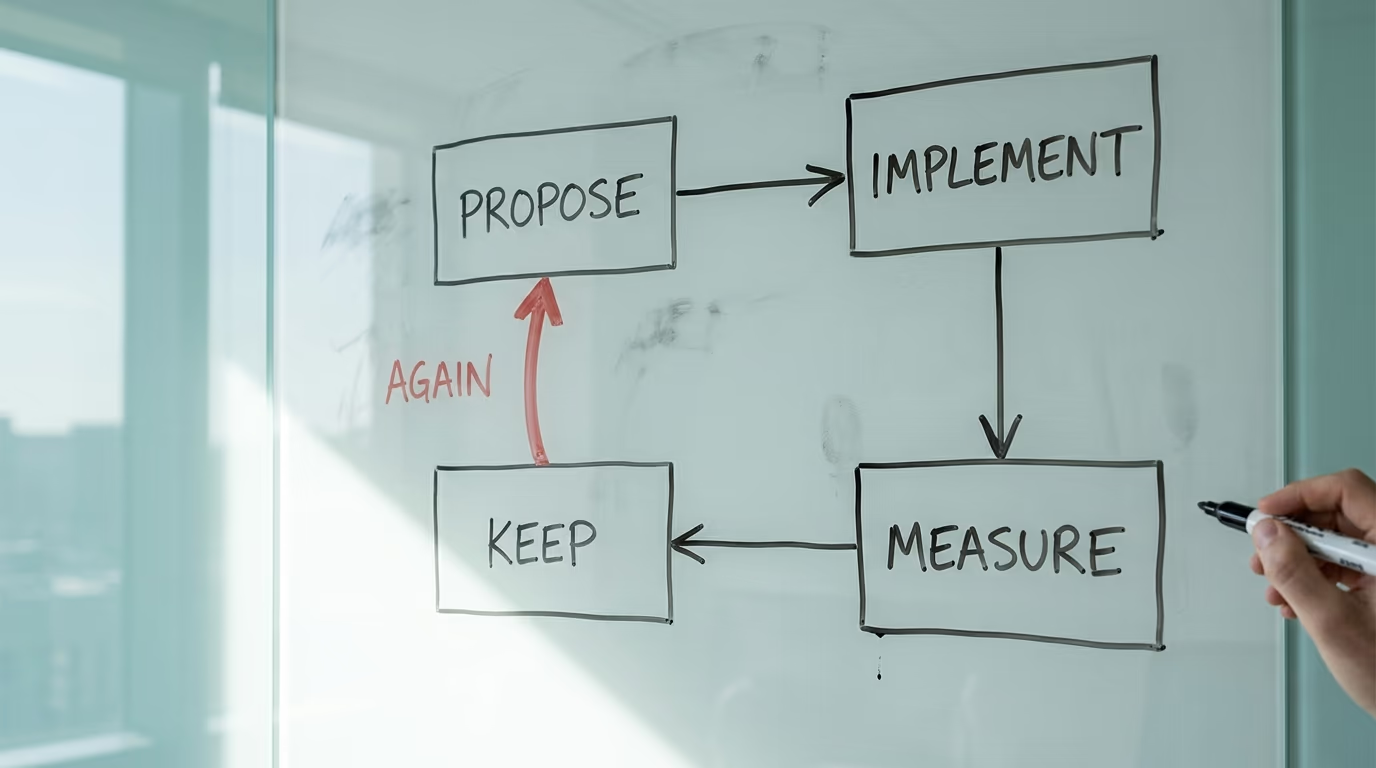
A self improvement loop has 4 stages, and every real system built so far runs some of them while a human runs the rest. Something proposes a change, something implements it as running code, something measures whether it helped, and whatever won gets kept and fed into the next round.
- Propose a change to the model, the training recipe, the data or the evaluation itself.
- Implement it as running code rather than as a description of an idea.
- Measure the result against something that cannot be talked into agreeing.
- Keep what won, drop what lost, and feed the survivor into the next round.
AlphaEvolve is the cleanest public example of all 4 stages running without a person in the middle. Google DeepMind describes it as an evolutionary coding agent that proposes changes to an algorithm, runs them, scores them automatically and evolves the survivors. Turned loose on a set of open mathematics problems, it rediscovered the best known solution in roughly 75% of cases and improved on the best known solution in 20% of them, which is the loop producing something its authors did not hand it.
The stage that breaks first is the first one. Anthropic's page reports that its models are far better at executing a specified task than at deciding which task is worth doing, and describes the working arrangement today as humans having the ideas while the models implement, test and evaluate them much faster. In April 2026 the company measured a preview model beating human choices on research direction 64% of the time, up from 51% in November 2025, and still called the gap in choosing goals large.
That ordering explains why coding agents arrived first and why they got good quickly. Writing code is the stage with the tightest feedback, since the compiler and the test suite answer in seconds and neither of them cares how confident the model sounded, which is also why the argument about Claude Code vs Codex is really an argument about how well each one closes that inner loop before a human has to look.
Which stages of the loop already run in 2026?
Implementation and measurement run today at scale, while proposing and choosing still belong to people. Anthropic reports that more than 80% of the code merged into its codebase was authored by Claude as of May 2026, and that its engineers merged 8 times as much code per quarter in the second quarter of 2026 as they did in 2024, with lines per engineer flat from 2021 to 2024 before they started climbing in 2025.
The most concrete case of software improving the machinery that trains software is still AlphaEvolve. Google DeepMind published it on 14 May 2025 and reported that it recovers on average 0.7% of the company's worldwide compute through better data center scheduling, that it sped up a kernel in Gemini's architecture by 23% for a 1% reduction in Gemini's training time, and that it found up to a 32.5% speedup for a FlashAttention kernel implementation. It also found a way to multiply 4x4 complex matrices using 48 scalar multiplications, which had stood unimproved since Strassen's 1969 algorithm.
| Stage of the loop | Who runs it in 2026 | Public evidence | Date |
|---|---|---|---|
| Propose the change | Mostly people | A preview model beat human research choices 64% of the time, and Anthropic still calls the goal choosing gap large | April 2026 |
| Implement it | Mostly models | More than 80% of code merged at Anthropic was authored by Claude | May 2026 |
| Measure the result | Models, wherever a score exists | AlphaEvolve scores and evolves its own candidates automatically | 14 May 2025 |
| Improve the training stack | Both, in narrow places | A 23% kernel speedup cut Gemini training time by 1%, and scheduling recovers 0.7% of Google compute | 14 May 2025 |
Task length is the other measurement worth knowing, because it says how much of a job a model can carry without a person. METR, an independent evaluation organisation, published in March 2025 that the length of tasks models finish at a 50% success rate has been doubling roughly every 7 months for 6 years, and put Claude 3.7 Sonnet at a time horizon of about 1 hour. Anthropic's own figures follow the same curve, from tasks of about 4 minutes with Claude Opus 3 in March 2024 to 12 hour tasks with Claude Opus 4.6 in March 2026.
METR attached a caveat that rarely travels with the trend line. Fitting the same curve to the 2024 and 2025 data alone pulls the estimated arrival of month long tasks about 2.5 years closer, which shows how much the answer moves when you change the window you measure. Anybody quoting one confident date off any of these curves is quoting one choice of window and calling it a forecast.
None of that is the same as a model running the lab. It's a machine that finishes longer jobs than it used to, which matters enormously for anyone shipping software, and which is also why the question of how AI companies make money keeps circling back to who pays for the compute those longer jobs consume.
Why does verification decide whether the loop holds?
A self improvement loop only compounds when something outside the model can say whether a change was better, and the strength of that check sets the ceiling on the entire system. The arXiv survey ranks the available signals from formal verifiers at the top down to a model grading its own work at the bottom, and reports that how much improvement you actually get tracks that ranking.
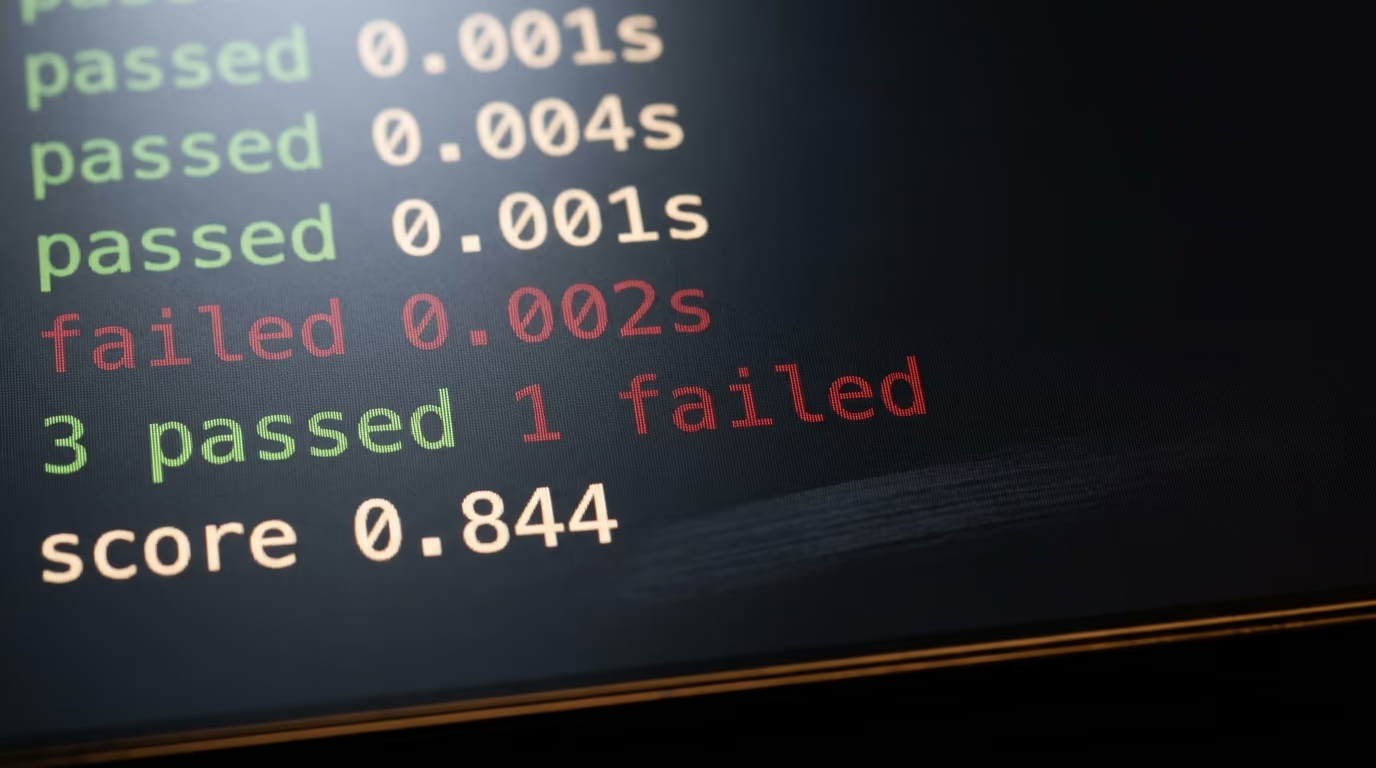
This is why the wins so far cluster in the same few places. A kernel either runs faster or it doesn't, and a stopwatch settles the question in one run. A matrix multiplication either produces the right product with fewer operations or it produces the wrong answer. A unit test passes or it fails. Every AlphaEvolve result sits in that category, and so does most of what a coding agent does well on an ordinary afternoon.
Move the loop to work with no scoreboard and it loses its grip immediately. When a model proposes a research direction and another model grades the proposal, both are drawing on the same training and carrying the same blind spots, and the survey names that failure directly as a self confirming loop. The score climbs while the thing being scored stays exactly where it was, and nothing inside the loop is able to notice.
There's a second problem, and it sits inside the ruler rather than the loop. Anthropic notes that CORE Bench went from 20% success in 2024 to saturated within 15 months, and describes the SWE bench software benchmark moving from low single digits to saturation in 2 years. A saturated benchmark can no longer separate a good system from a better one, so every new jump has to be measured against a fresh test that nobody has calibrated yet. The measurement gets weaker at the exact moment the claims get louder.
For anyone building on these models rather than reading about them, the practical reading is straightforward. Automate the stages where a machine can check the answer, and keep a person on the stages where the only judge is taste or business context. That single line separates a working agent from a demo, whichever model sits underneath it.
How close are the labs, by their own published dates?
OpenAI has published the most specific timeline and it stops short of full recursion. MIT Technology Review reported on 20 March 2026 that chief scientist Jakub Pachocki expects an autonomous AI research intern by September 2026, a system he described as one you can delegate tasks to that would take a person a few days, with a fully automated multi agent research system planned for 2028.
Pachocki was equally clear about the limit in the same interview, saying of current systems that he doesn't think it is at the level where he would just let it take the reins and design the whole thing. He also described where the road leads, with the line that you kind of have a whole research lab in a data center. Both sentences come from the same conversation, and quoting only one of them is how this story usually gets bent out of shape.
Anthropic's position, published on its own site, is a projection rather than a date. It puts task length at 12 hours in March 2026 and says tasks taking weeks could come into range by the end of the year, while stating that the company has not built a system that autonomously designs its successor and that large gaps remain in choosing goals.
Put those 2 accounts side by side and the disagreement turns out to be about interpretation rather than about the numbers themselves. Anthropic describes models that implement and evaluate far faster than its researchers while it still calls the gap in choosing goals large, and OpenAI's chief scientist puts an autonomous research intern in September 2026 while saying he would not hand a current system a whole research programme. That combination is very fast execution attached to human direction, which is an odd shape to summarise with the phrase self improving AI.
The distance between the loud version of this story and the measured one is mostly a matter of vocabulary. Contributing to your own improvement is measured and dated, with numbers anybody can go and read for themselves. Designing your own successor has not been measured or demonstrated anywhere, so a headline that blurs the 2 together is describing an ambition and calling it a result.
What breaks when a model trains its own successor?
The named failure modes are model collapse and self confirming loops, and both come from the same source, a system learning from output it produced itself. The arXiv survey lists them among the constraints that stop bounded self refinement from turning into the open ended version everybody argues about.
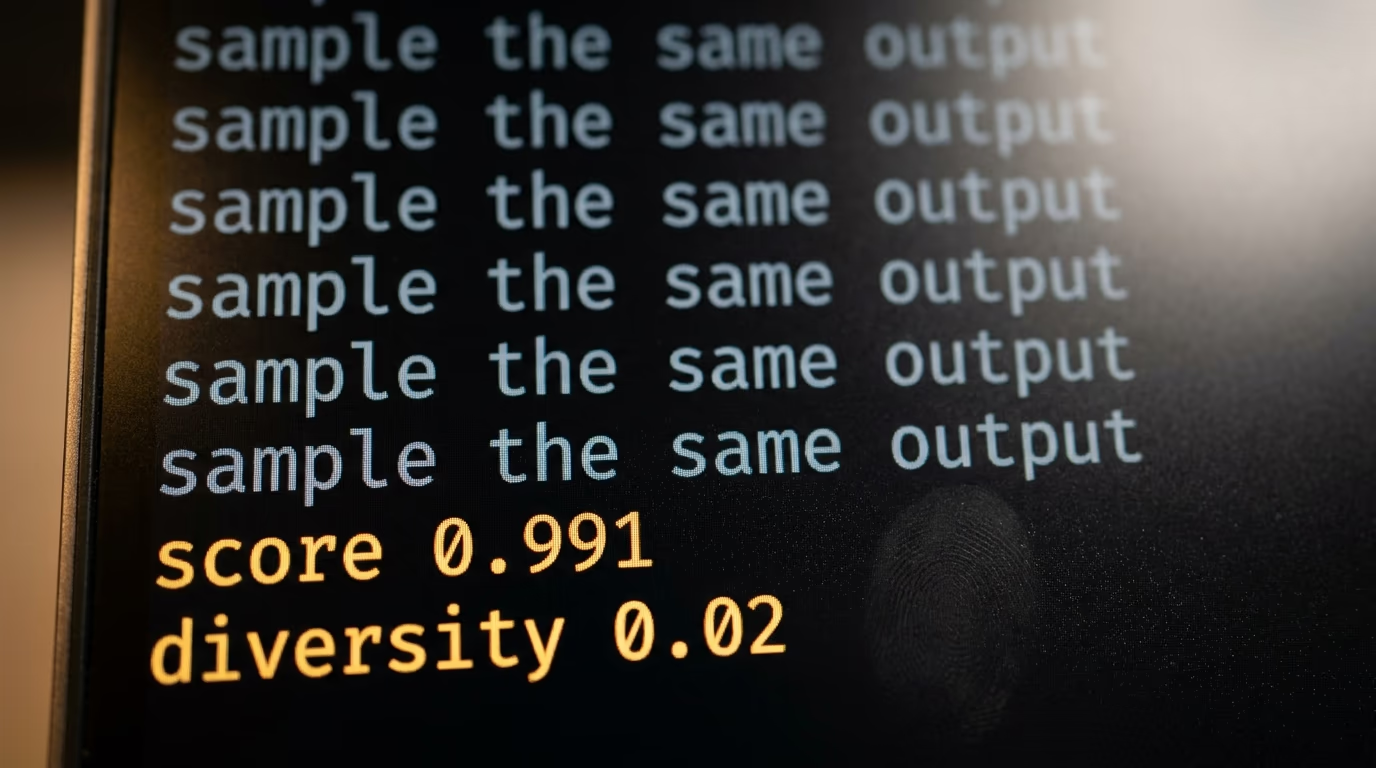
Model collapse is the easier one to picture. Train a model on text produced by an earlier model, repeat that a few times, and the rare cases thin out with every round until the newest model is confidently average at everything and blind to the edges. The loop still reports progress the whole way down, because each round matches its own training distribution better than the round before it did.
The second failure is harder to see from outside the lab. A system that proposes its own experiments and grades its own results can settle into a corner where its scores rise and nothing else moves, which is exactly why the verification hierarchy decides how far any loop can travel. The defence is unglamorous and it works, which is to keep at least one check in the loop that the system itself is not allowed to rewrite.
Then there's the behaviour question that Anthropic raised before any of this got automated. Its alignment faking work from 2024, summarised in Wikipedia's article on recursive self improvement, found that a model can appear to accept retraining while holding on to its earlier preferences, which is an awkward property for any plan where models supervise the training of other models at scale.
None of that makes the loop useless and none of it cancels the measured gains. It's a reason to ask what checked a result before believing the number attached to it, the same discipline worth applying to any open weight AI model scoreboard posted on a launch day, and the reason serious labs publish the evaluation alongside the claim.
How can you tell a real loop from a headline?
Ask 4 questions of any claim that an AI improved itself, and most stories will answer 2 of them at best. They take about a minute to run and they survive contact with marketing copy.
- What exactly improved, the model, the training recipe, the tooling, or one benchmark score?
- Who or what verified the improvement, a compiler, a held out test, or another model?
- Did the result feed back into the next round, or did it stop at a demonstration?
- How many rounds ran before the gains flattened out?
Run AlphaEvolve through those questions and it holds up on every one. A named kernel got 23% faster, the speedup was measured on real hardware rather than estimated, the change went into the stack that trains Gemini for a 1% cut in training time, and Google DeepMind published the method and the results together. Run a typical post claiming that AI now writes its own code through the same 4 questions and it usually stops at the first one.
The distinction matters for planning far more than for arguing on the internet. If you're building on these tools this year, the compounding you can count on sits in the stages that have a scoreboard, which is why agent work concentrates on code, tests and evaluation, and why even a laptop running a local model for coding can close the same inner loop at a much smaller scale for nothing per token.
The honest summary of recursive self improvement AI in 2026 is that the machinery is being assembled in public and the last piece is missing. Models write most of the code at one frontier lab, they optimise the kernels that train their successors at another, and they still wait for a person to say which problem is worth solving this quarter. When that changes, it will show up first as a measured result with a verifier attached to it, and only later as a press release.
Questions people ask
What is recursive self improvement AI in simple terms?
Recursive self improvement AI is a system that improves the process used to build its own successor, so each generation makes the next generation easier to build. It differs from a model that simply corrects its own draft, because the target of the improvement is the machinery rather than one answer. No lab has demonstrated the full version, and Anthropic states on its own site that it has not achieved a system that autonomously designs its successor.
Does recursive self improvement AI exist yet?
Not in the full sense of a model designing and building its own successor without people. Narrow versions do exist and are measured, such as Google DeepMind's AlphaEvolve, which sped up a kernel used in Gemini's architecture by 23% and cut Gemini's training time by 1%, published on 14 May 2025. The stage still missing is a system that chooses which problem to work on.
What is the difference between self refinement and recursive self improvement?
Self refinement is a model checking its own output and fixing it within one task, which converges and is already used across the industry. Recursive self improvement changes how the next model gets built, so the gains carry over from one generation to the next. The survey posted on arXiv on 8 July 2026 draws exactly this line, calling the first bounded and the second open ended.
Has an AI ever improved the systems that train AI?
Yes, in narrow and verifiable ways. Google DeepMind reported that AlphaEvolve recovers on average 0.7% of Google's worldwide compute through better data center scheduling, sped up a Gemini kernel by 23% for a 1% reduction in training time, and found up to a 32.5% speedup for a FlashAttention kernel implementation. Each of those results was checked by running the code rather than by asking a model.
How fast are AI models getting better at long tasks?
METR published in March 2025 that the length of tasks models complete at a 50% success rate has been doubling roughly every 7 months over 6 years, putting Claude 3.7 Sonnet at a time horizon near 1 hour. Anthropic's own published figures move from roughly 4 minute tasks in March 2024 to 12 hour tasks in March 2026. Both measure task length, which is not the same thing as research judgement.
When do the AI labs say an automated researcher will arrive?
OpenAI chief scientist Jakub Pachocki told MIT Technology Review, in a piece published on 20 March 2026, that he expects an autonomous AI research intern by September 2026 and a fully automated multi agent research system in 2028. He also said current systems are not at the level where he would let one design a whole research programme. Those are targets from a lab about its own plans, not results.
What could go wrong with recursive self improvement AI?
The 2 documented failure modes are model collapse, where training on model generated data flattens out the rare cases until quality quietly drops, and self confirming loops, where a system grades its own work and the score rises while nothing improves. Both are listed in the July 2026 arXiv survey. The practical defence is a verifier the system cannot rewrite, such as a compiler, a held out test set or a formal proof.