AIAugust 1, 202611 min read
Claude Pro vs ChatGPT Plus, what $20 a month buys in 2026
Both plans sit at $20 a month and both now ship a coding agent. 5 checks against what Anthropic and OpenAI publish themselves, and a verdict.

Claude Pro vs ChatGPT Plus is a $20 decision, and both subscriptions now put a coding agent inside that price. Anthropic lists Claude Pro at $17 a month if you pay for a year up front, as one charge of $200, while OpenAI's plan pages list ChatGPT Plus at a flat monthly rate with no annual price beside it.
The monthly prices match, so the 2 plans separate on what each company is willing to tell you about its limits. OpenAI publishes a table of how many messages a Plus account gets in each 5 hour window, model by model, and Anthropic publishes no message count anywhere. Below are 5 checks run only against what the 2 companies put on their own pages, and a verdict that picks a side.
How much do Claude Pro and ChatGPT Plus cost right now?
Claude Pro and ChatGPT Plus cost the same each month, and the yearly bill is where that stops being true. A year of Claude Pro paid up front costs $40 less than a year of ChatGPT Plus at its listed monthly price, because Anthropic discounts the annual commitment and OpenAI shows no equivalent on its plan pages. The table below has both totals side by side.

The ladders above and below the 2 plans don't line up, and that matters more than the difference in the yearly bill. OpenAI sells a cheaper paid step called ChatGPT Go underneath Plus, so anyone who finds Plus generous has somewhere softer to land. Anthropic sells nothing between its free plan and Pro, so the only move from Pro is upward, and upward means paying 5 times as much.
Above the entry tier the shapes rhyme almost exactly. Anthropic sells Max with a choice of 2 usage multipliers over Pro, and OpenAI's heavier tiers use nearly identical wording at nearly the same prices for nearly the same jump. Neither company asks you to think about tokens at that level, which is the whole appeal of buying a subscription instead of API access.
One line on Anthropic's help pages catches people out after they subscribe. The Pro plan doesn't include API usage through the Claude Console, so if you want a subscription for chatting and API access for your own scripts, you are buying 2 separate things. OpenAI draws the same line from its side, and says local chats run through your own API account are charged at standard API rates on top of whatever plan you already hold.
The free tiers deserve a week of your attention before you pay either company anything. Anthropic's free plan already covers chat on the web, on phones and on the desktop app, along with web search, memory across conversations and file creation with code execution, so the honest question is whether you meet its ceiling most days. OpenAI's free plan is narrower in one visible way, because its own documentation says image generation isn't available there at all.
| Claude Pro | ChatGPT Plus | |
|---|---|---|
| Monthly price | $20 | $20 |
| Annual price | $17 a month, billed as $200 up front | no annual price listed, $240 over 12 months |
| Cheaper paid step below | none, the free plan is the step down | ChatGPT Go at $8 a month |
| Heavier tier above | Max from $100 a month, 5x or 20x usage | $100 a month for 5x, $200 a month for 20x |
| Coding agent included | Claude Code | Codex |
| Where these figures come from | claude.com/pricing | learn.chatgpt.com/docs/pricing |
Both sets of figures are list prices in US dollars before tax. Anthropic's page states in writing that prices exclude applicable tax and that plans can change at its discretion, which is worth remembering before you hand over a year in advance.
How many messages do you get before you hit the wall?
OpenAI publishes a message count for ChatGPT Plus and Anthropic publishes none for Claude Pro, which is the widest gap between the 2 subscriptions. OpenAI's pricing documentation gives a ChatGPT Plus account a stated range of local messages per 5 hour window for each of its current models, reproduced in the table below, and adds that further weekly limits may apply.
| Model | Local messages per 5 hour window on Plus |
|---|---|
| GPT-5.6 Sol, for the hardest work | 10 to 100 |
| GPT-5.6 Terra, the everyday model | 25 to 200 |
| GPT-5.6 Luna, for high volume jobs | 250 to 2,000 |
| Claude Pro, every model | no message count published by Anthropic |
Those ranges are wide because a message isn't a fixed unit of anything. OpenAI's own explanation says model choice, context, reasoning, tool use, retrieval and caching all change what a single turn costs you, so prompt length on its own isn't a reliable estimate. A quick question about one function and a refactor across a whole folder both count as one message, and they are nowhere near the same thing.
Anthropic's structure has the same shape with the numbers taken out. Claude Pro runs on a rolling 5 hour session window with weekly limits stacked on top, and the help centre says the weekly meter resets separately for Opus and for every other model. The only quantity Anthropic commits to in writing is that Pro gives at least 5 times the usage per session compared with its free service.
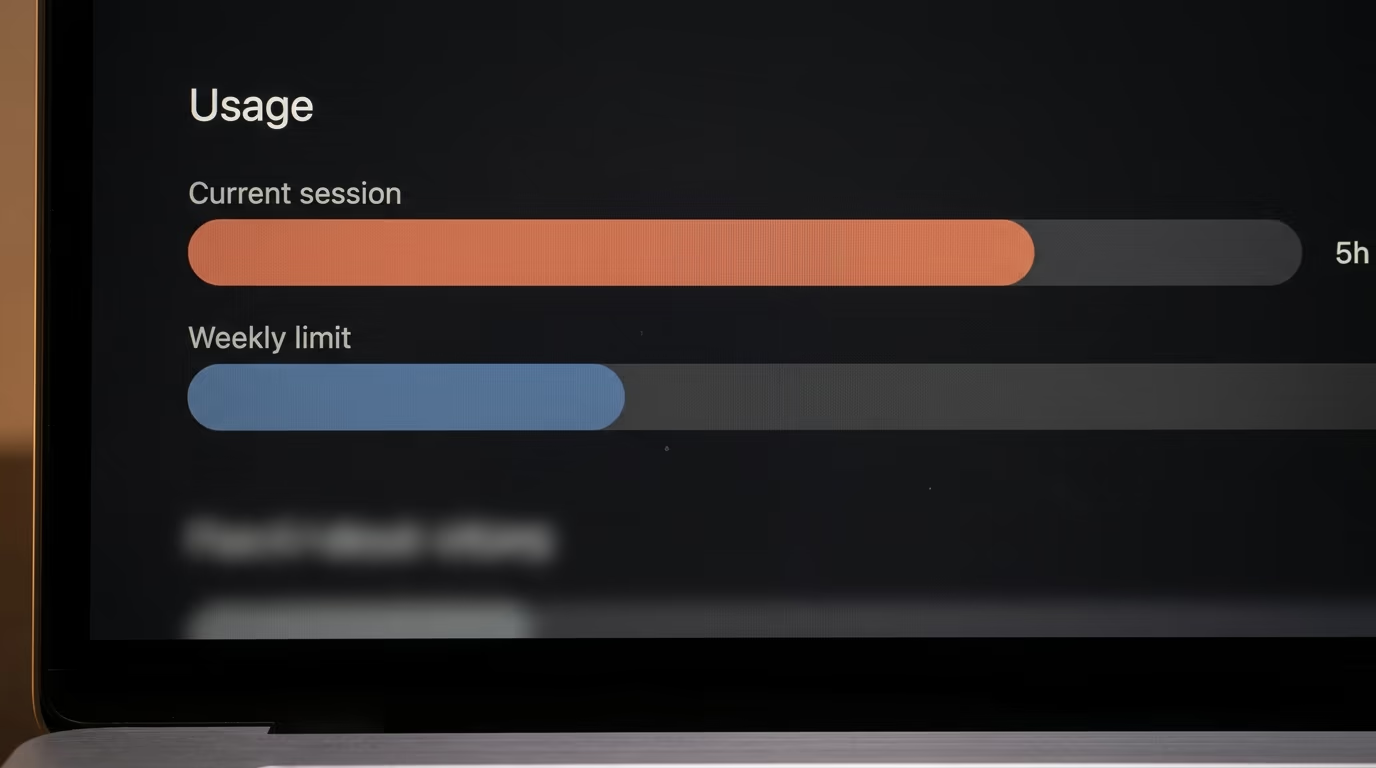
You can at least watch the meter drain while it happens. Under Settings, then Usage, Claude shows a bar for the current session with the time left in it and a second bar for the weekly limits, so you learn your own ceiling by living with it for a week rather than by reading a table before you buy.
There is one Anthropic detail here that quietly saves money, and almost no comparison mentions it. Anything you upload into a project is cached, and Anthropic says cached content doesn't count against your limits when it gets reused, so the same long contract answered a dozen times costs far less than uploading that contract a dozen times. Prompts you send often are partially cached as well.
The practical difference between the 2 plans is planning. With OpenAI's table you can look at a workload, pick the lighter model for the repetitive job, and know roughly how many turns you have before the window closes. With Anthropic you find out by hitting the wall, which is what one XDA Developers writer described after switching over, reporting 70% of the plan's usage gone within an hour of testing Cowork. That account reads well next to the plan pages themselves.
Which models do you get on Claude Pro and ChatGPT Plus?
Claude Pro gives you Opus 5 and Sonnet 5 inside the plan's own limits, along with the faster Haiku model, and ChatGPT Plus gives you the GPT-5.6 family, which OpenAI splits into Sol, Terra and Luna. Both companies name those models on the plan pages themselves rather than burying them in a support article.
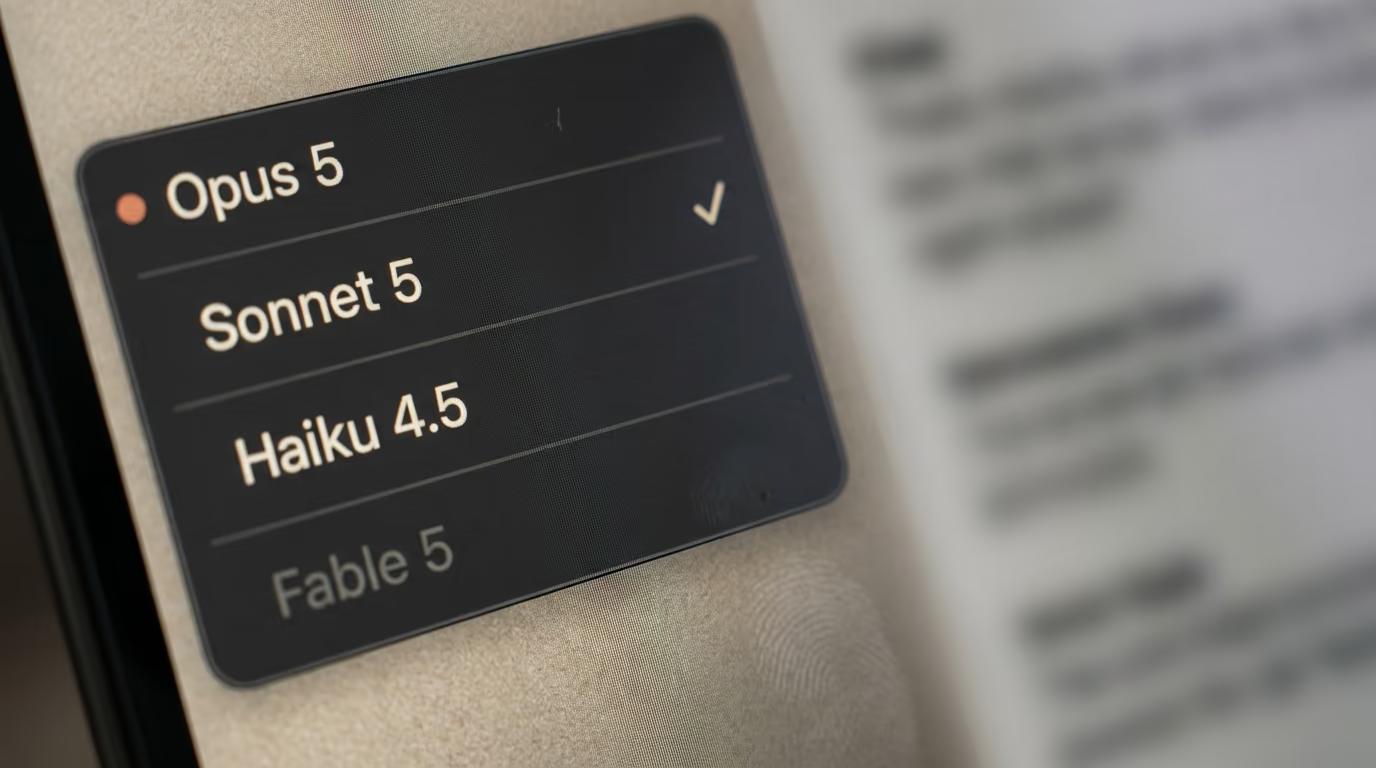
Fable 5 is where Claude Pro hides a catch worth knowing before you subscribe. Anthropic's help page says that on Pro plans Fable 5 isn't included in the plan's usage limits, and that you use it with usage credits you pay for on top of the subscription. The promotion that used to include it ended in July, and eligible Pro users were given a one time credit to soften the change.
On Max the same model behaves completely differently. Anthropic says Fable 5 is a standard component of the Max plan and that you can spend up to half of your weekly usage limits on it at no extra cost. So the newest Claude is a paid extra at the entry tier and an included feature further up, which is exactly the sort of detail that decides whether a plan fits the way you actually work.
OpenAI splits its 3 models by job rather than by price. Its documentation describes Sol as the model for the hardest and most ambiguous problems, Terra as the everyday workhorse for production tasks and document analysis, and Luna as the fast one for high volume jobs like routing, classification and extraction. Picking the right one is how a Plus account stretches, because the lighter model buys you far more turns in the same window.
If you want to know what these models cost when you rent them by the token instead of by the month, we lined the whole grid up against Google's and the open weight challengers in our LLM API pricing comparison. A subscription is the cheaper door for most people, and it stops being the cheaper door sooner than you would expect once agents enter the picture.
Does either subscription include a coding agent?
Claude Pro and ChatGPT Plus both include a coding agent at no extra cost, which is the biggest change to what this money buys. Claude Pro includes Claude Code in your terminal, and ChatGPT Plus includes Codex on the web, in the command line, in the IDE extension and on iOS, with cloud features like automatic code review listed beside it.
The catch is identical on both sides, and it surprises people in the same way. Anthropic states that Pro and Max usage limits are shared across Claude and Claude Code, so every terminal session eats the same allowance as your chats. OpenAI states the mirror image, that ChatGPT Work usage inside ChatGPT draws on the same pricing, credits and usage limits as Codex, with ChatGPT for Excel pulling from that allowance too.
So a heavy afternoon of refactoring takes your evening of chatting away with it, whichever logo sits on the invoice. Anyone planning to lean on an agent daily should read the entry tier as an evaluation budget rather than a working one, then choose between the heavier tiers with clear eyes. We put the 2 agents head to head, prompt by prompt, in Claude Code vs Codex.
Claude Pro also bundles 3 other applications that ChatGPT Plus has no exact match for. Anthropic's pricing page lists Claude Cowork, Claude Design and Claude Science in the Pro column, along with unlimited projects, access to Research and a Microsoft Office integration. Whether you will ever open any of them is a fair question to ask before you pay, because buying 4 applications and using one is how a cheap subscription quietly becomes poor value.
How much can you paste into one conversation?
Anthropic publishes a context window figure for Claude Pro and OpenAI publishes none for ChatGPT Plus. Anthropic's help centre says Claude Opus 5 and Sonnet 5 carry a 1M token context window on all paid plans when you chat with Claude, with smaller windows on the older models and on everything outside that list.

There is a conflict on Anthropic's own site that deserves naming rather than smoothing over. The plan comparison table on the pricing page still shows the smaller window for every consumer tier, while the support article gives the larger figures model by model. The support article is the more specific of the 2 and the one Anthropic updates per model, so it is what this comparison uses, and it is worth checking your own account before you count on the full window.
For scale, Anthropic's model documentation puts that window at roughly 555,000 words on its current tokenizer, which is several long novels going in at once. In Claude Code the same large window covers Opus 5 and Sonnet 5 as well as Fable 5 and the recent Opus releases, so an agent can hold a genuinely big repository in mind before it starts forgetting the beginning of the job.
OpenAI's side of this check is a blank page. Its ChatGPT model documentation and its pricing documentation both describe usage limits per 5 hour window without giving any context window figure for consumer plans, so the number that comparison sites keep repeating for ChatGPT Plus is not something OpenAI states on those pages today. Repeating an unpublished figure as a fact is how half the articles about these 2 plans go wrong.
If your reason for wanting a big window is research across your own documents rather than code, the pairing to compare is a different one, and we tested it in NotebookLM vs ChatGPT. Anthropic also notes that Claude summarizes earlier messages automatically as a conversation approaches its ceiling, so a long thread fades at the edges instead of stopping dead.
What happens when you run out before the reset?
Claude Pro and ChatGPT Plus both let you pay to keep working past the limit, in 2 different shapes. On Claude you turn on usage credits, which are off by default, add funds under Settings, then Usage, and everything past your plan limit is billed at standard API rates.
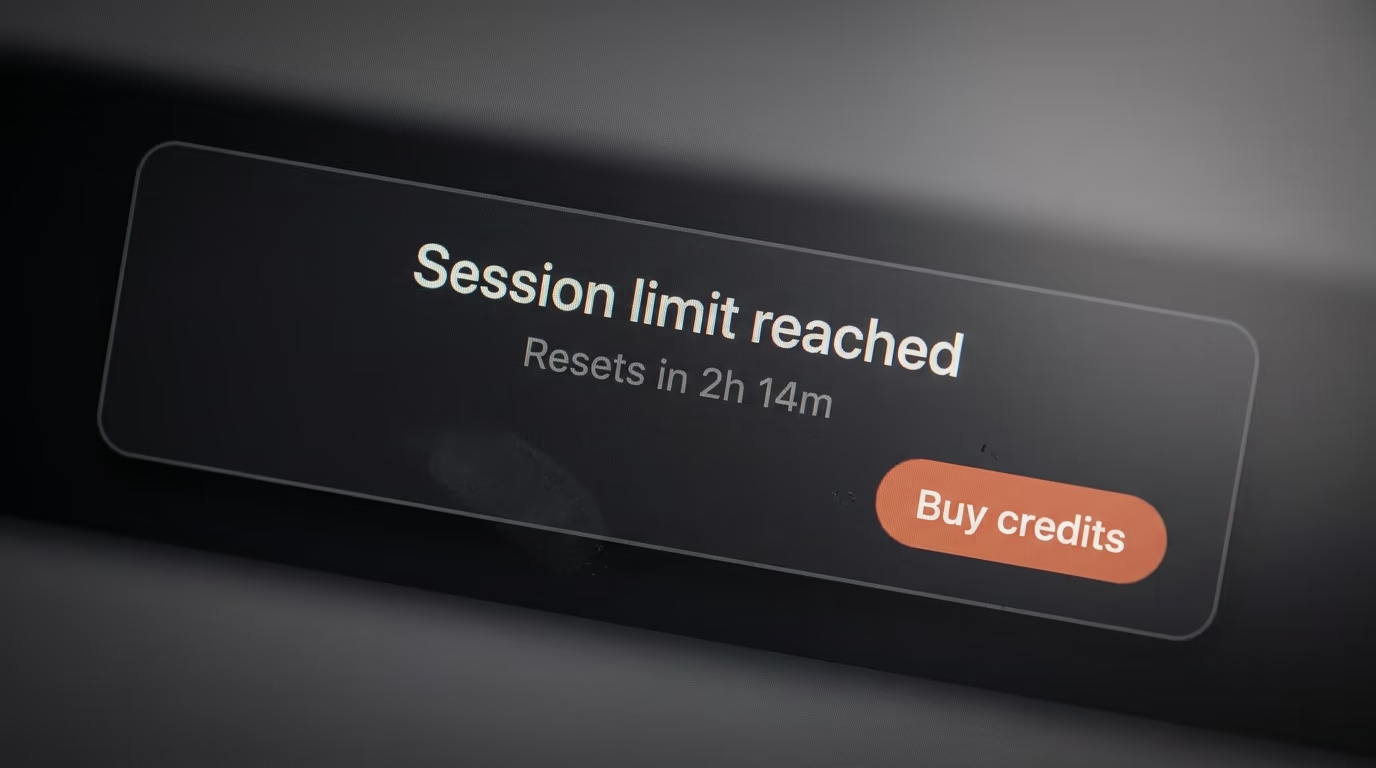
Anthropic also caps how much you can redeem in a single day, which reads less like a restriction and more like a guardrail for people running agents overnight. Billing overage at published API rates has one real advantage, because you can price a month of heavy use in advance instead of guessing what your own habits cost.
OpenAI sells credits rather than raw tokens. Its documentation says Plus and Pro users who reach their limit can purchase additional credits without upgrading their plan, and that a message on the current family averages 5 to 30 credits. It also warns that generating images burns through your included limits 3 to 5 times faster than an ordinary turn, and that voice on the desktop app gives a Plus account well under an hour of talking per rolling window.
Both companies suggest the same escape hatch before you spend anything extra, which is dropping to a smaller model so the allowance stretches further. If you would rather not meter anything at all, the models you can run on your own machine have become good enough for real work, and we ranked them by how much memory you actually have in best local LLM for coding.
So which subscription should you actually pay for?
Claude Pro is the better buy if you write code, run agents or hand the model long documents, and ChatGPT Plus is the better buy if you want to know what you are getting before you pay for it. That is the honest split after 5 checks, and the scoreboard below shows where each plan earns its side of the verdict.
| Check | Claude Pro | ChatGPT Plus | Winner |
|---|---|---|---|
| Cost over 12 months at list | $200 paid up front | $240 at $20 a month | Claude Pro |
| Limits published as numbers | no message count published | 10 to 2,000 messages per 5 hour window by model | ChatGPT Plus |
| Newest model inside the plan | Fable 5 needs usage credits on top | GPT-5.6 Sol included | ChatGPT Plus |
| Coding agent bundled | Claude Code, sharing the chat allowance | Codex on web, CLI, IDE and iOS, sharing the allowance | tie |
| Context window published | 1M tokens on Opus 5 and Sonnet 5, 200K elsewhere | no figure published for consumer plans | Claude Pro |
Take Claude Pro if your day involves a terminal. Claude Code arrives with the plan rather than beside it, the large window on Opus 5 and Sonnet 5 means a long report goes in whole instead of in slices, and the annual price is the cheaper of the 2 at list. In exchange you accept that you cannot know your allowance until you meet it, and that the newest Claude model costs extra on top.
Take ChatGPT Plus if predictability matters more to you than headroom. You get a published range of messages per model per window, image generation and desktop voice inside the same subscription, Codex across the web, the command line, the editor and the phone, and a cheaper step below you if Plus turns out to be more than you need. What you give up is any stated ceiling on how much text fits in one conversation.
A sceptic will say the verdict rots the moment either company ships a new model, and that is fair for benchmark scores. It is much less fair for plan structure, which is what these 5 checks actually measure. Both companies have settled on a 5 hour window with weekly caps above it, both bundle a coding agent that eats the same allowance as chat, and both now sell overage rather than simply stopping you. Those choices are what you live with every single day.
One honest note before you spend. Neither company publishes a figure you can compare directly against the other, because OpenAI counts messages per model per window while Anthropic counts a session and a week without ever saying how many turns fit inside them. Anyone telling you one plan gives exactly twice the other is guessing, and if you want to see what else this budget buys, our ranking of the best AI agents for coding covers the wider field around both plans.
Questions people ask
Is Claude Pro or ChatGPT Plus better value at $20 a month?
It depends on whether you write code. Claude Pro bundles Claude Code, Cowork, Design and Science, and gives Opus 5 and Sonnet 5 a 1M token context window on paid plans. ChatGPT Plus publishes how many messages you get in each 5 hour window, which Anthropic does not, and it costs less to leave because the commitment is monthly.
Does Claude Pro vs ChatGPT Plus change if I write code every day?
Yes, and mostly against both of them. Claude Code and Codex draw from the same allowance as your chats on Pro and Plus respectively, so a heavy coding day consumes the budget you wanted for everything else. Daily agent users usually end up on Claude Max or ChatGPT Pro, which cost 5 times as much.
How many messages do you get on ChatGPT Plus?
OpenAI's pricing documentation gives Plus a range of local messages per 5 hour window that changes with the model, from a few dozen on the heaviest one to a far larger allowance on the lightest. The range is wide because model choice, context, reasoning and tool use all change what a single message costs, and further weekly limits may apply.
Does Claude Pro include Claude Code?
Yes. Anthropic's pricing page lists Claude Code in the Pro column alongside Cowork, Design and Science. Anthropic also states that Pro usage limits are shared across Claude and Claude Code, so terminal work and chat draw down one single allowance.
Can I use Fable 5 on Claude Pro?
Only by paying for usage credits on top of the plan. Anthropic's help page says Fable 5 is not included in the Pro plan's usage limits, after the promotion that included it ended in July. On Max plans Fable 5 is standard, and you can spend up to half of your weekly limits on it at no extra cost.
What happens when you hit the limit on Claude Pro vs ChatGPT Plus?
Both plans let you pay to continue. Claude usage credits are off by default, need funds added under Settings, then Usage, and bill the overage at standard API rates under a daily redemption cap. ChatGPT Plus users can buy additional credits without upgrading, and a message on the current family averages 5 to 30 credits.
Is there a cheaper plan than ChatGPT Plus?
Yes, OpenAI sells ChatGPT Go below Plus at less than half the price. Anthropic has no paid tier between its free plan and Pro, so the only step down from Claude Pro is the free plan and the only step up is Max, which starts at 5 times the Pro price.
How big is the context window on Claude Pro?
Anthropic's support article says Opus 5 and Sonnet 5 carry a 1M token context window on all paid plans in chat, with smaller windows on the older models. The plan comparison table on the pricing page still shows the smaller figure for every consumer tier, so check your own account before you rely on the larger one.