AIOctober 9, 202612 min read
OpenAI withdraws 3 math papers over 1 sign error
A single sign error took down 3 manuscripts from OpenAI's mathematics release. Its own notice says the theorem is not claimed false, and the repository has comments switched off.
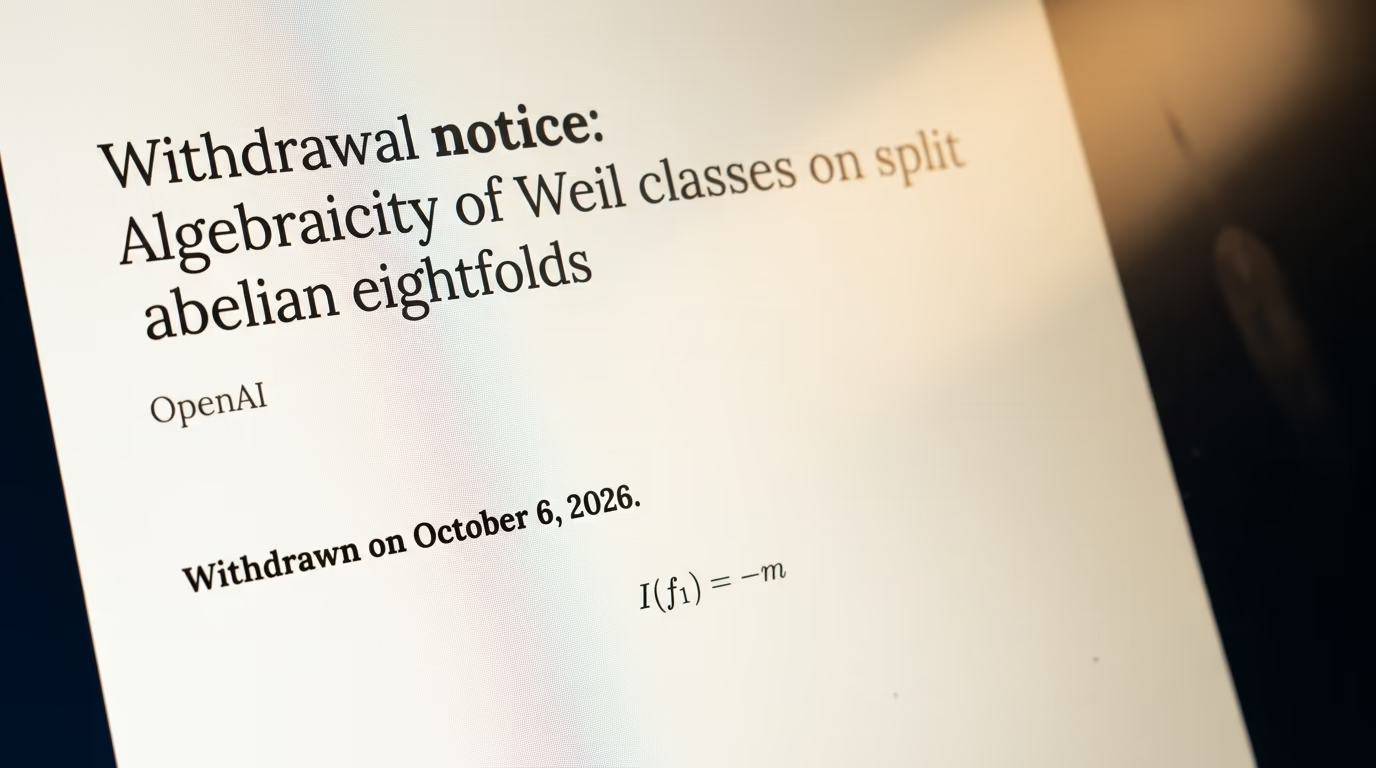
OpenAI withdrew 3 of the mathematics papers it had just published, roughly a day after putting the collection online, because one sign error in a single proof also broke the 2 papers built on top of it. The withdrawal notice filed with them says the error sits in the proof and not in the claim, so the theorem itself hasn't been declared false.
The collection lives in a plain public repository called openai/math, and every figure below comes from reading its files this morning rather than from the announcements about it. That repository keeps its own record of what came down, what was repaired, and what OpenAI now says about how much of this mathematics a machine has really checked.
What did OpenAI withdraw from its math repository, and when?
OpenAI withdrew 3 manuscripts from openai/math, the public collection of mathematics produced by an unreleased internal model, and all 3 came down because of a single error in one of them. The repository's own history file names them and says why.
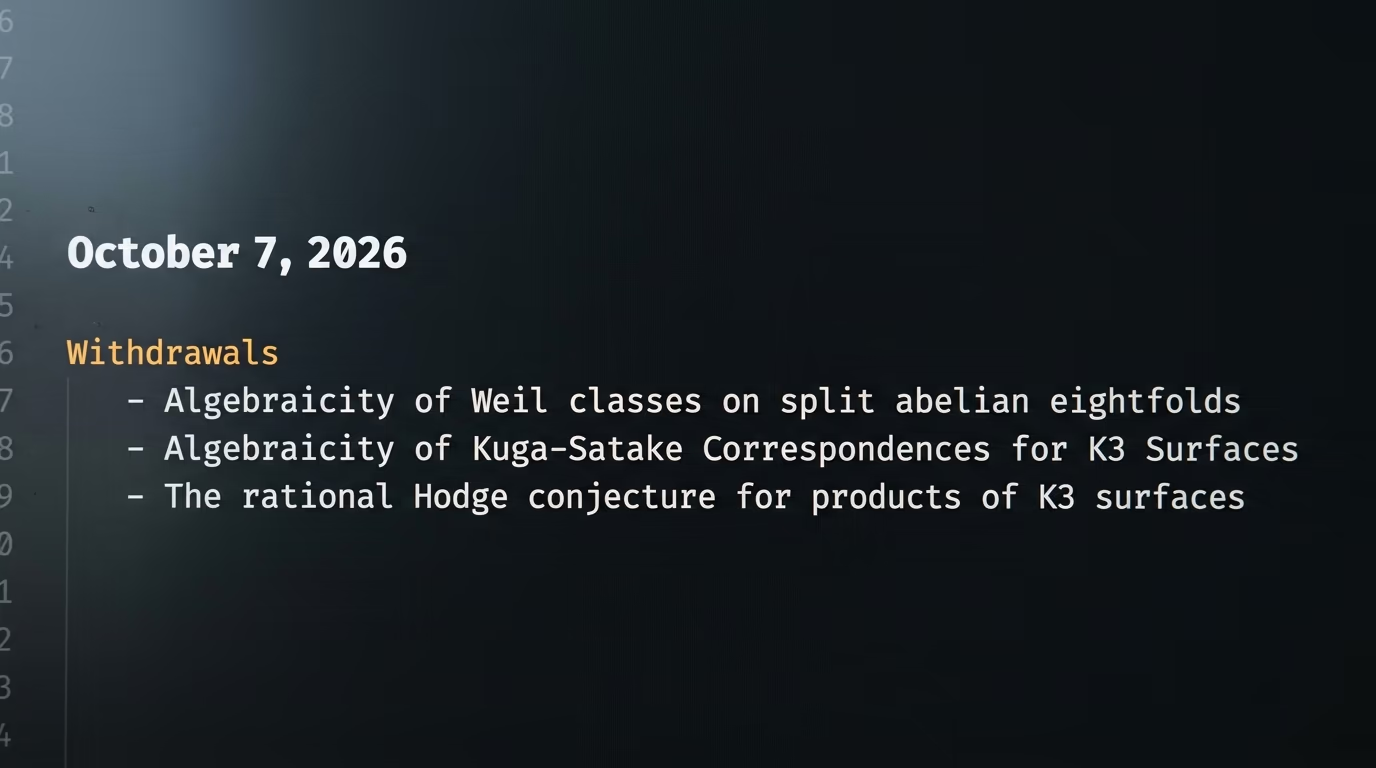
| Withdrawn manuscript | Why it came down |
|---|---|
| Algebraicity of Weil classes on split abelian eightfolds | A sign error in its stabilization trace argument |
| Algebraicity of Kuga-Satake Correspondences for K3 Surfaces | Built on the construction the first paper was meant to deliver |
| The rational Hodge conjecture for products of K3 surfaces | Built on the same construction |
The failure sits in the first of them, on Weil classes. OpenAI's notice reports a sign error inside what the manuscript calls its stabilization trace argument, and since the other 2 papers used the construction that argument was supposed to deliver, they lost their foundation at the same moment. One mistake, 3 papers, and not one of the 3 was the throwaway in the pile. The second claims a result about correspondences on K3 surfaces, and the third claims a case of the rational Hodge conjecture, which is one of the oldest open questions in the field.
The timing can be read straight off the repository rather than from anybody's summary. The collection was first committed on the evening of October 6, the notice on the broken paper carries that same date, the history entry is dated the following day, and the commit that published the whole correction landed a little over a day after the first one, late on the Wednesday evening in San Francisco. For a body of work this size that's a fast turn, and it's the strongest thing in OpenAI's favour this week.
A withdrawal here is also not a deletion, and the distinction matters if you ever cite one of these. Each pulled paper keeps its folder, its address still opens, and a notice now sits where the manuscript used to be, explaining the gap and linking the original document at the exact revision it was published under. You can still read the retracted mathematics in full, which is more than most journals offer after a retraction.
Does a withdrawn proof mean the theorem is wrong?
A withdrawn proof doesn't mean a wrong theorem, and OpenAI says exactly that in the final line of the withdrawal notice on the Weil classes manuscript.
This withdrawal concerns the proof; it does not assert that the mathematical statement is false.
That sentence sets the limit of what was actually retracted. A proof is a route and the statement is a destination, so finding a bridge out on the route tells you nothing about whether the destination is there. Somebody may walk a different road to it next year, or the claim may turn out to be false for reasons nobody has looked for yet. What died this week is the argument, and the argument was the thing being sold.
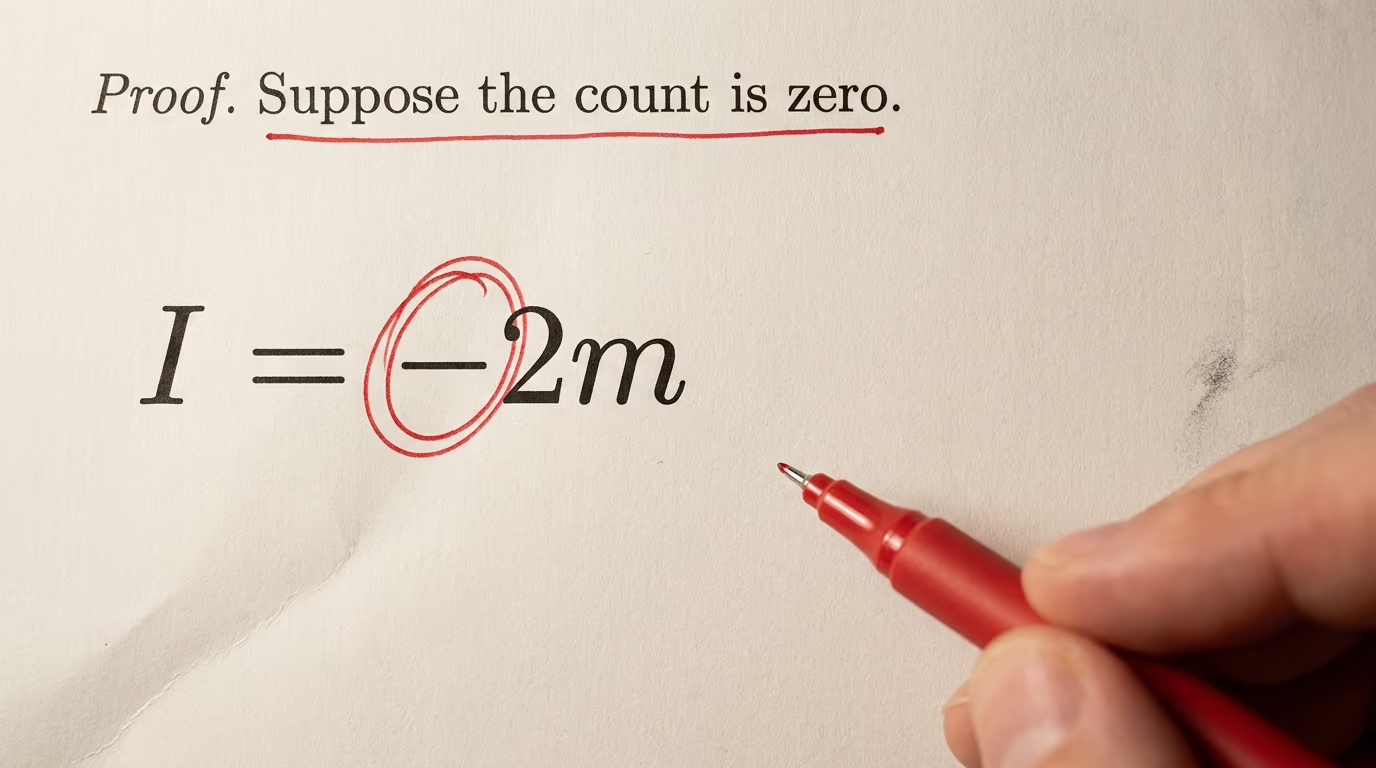
The error is small enough to describe without any mathematics at all. The proof needed a certain count of crossing points to come out at exactly zero, because the older theorem it leans on only applies when that count is zero. Each correcting move was given a plus sign where the opposite orientations of the 2 branches make it a minus, so instead of cancelling to zero the count ends up twice as far from zero as it began. The step that follows, and the construction the other 2 papers borrowed from it, has nothing underneath it any more.
For anybody who uses these tools on work they cannot check themselves, that's the lesson of the week. A confident wrong step reads exactly like a right one, and it reads that way at every length, in a long proof nobody outside the field can follow or in the function an agent just wrote into your codebase while you were reading something else. The error was not a hallucinated citation or an invented source, which are the failures people have learned to watch for. It was a plus where a minus belonged, buried in the middle of work that is correct everywhere around it.
What else changed in the repository that same night?
The same commit that withdrew the 3 papers also repaired 14 others and rewrote how OpenAI describes its own checking, all in one push. The withdrawal took the headlines, and it was the smaller edit of the night.
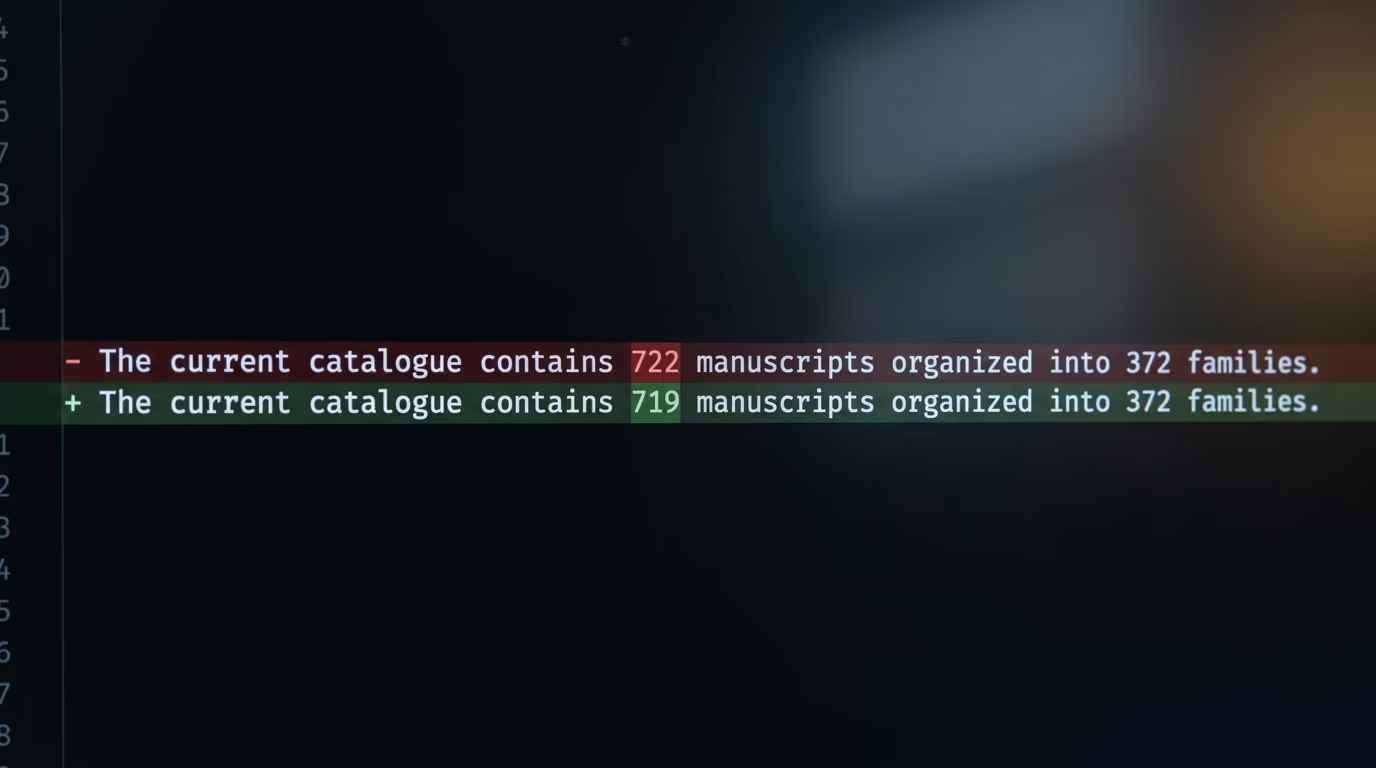
The front page used to say the catalogue held 722 manuscripts. It now says 719, with the count of families left untouched, which is the arithmetic of the withdrawal and nothing else. That is the edit everyone reported, and the diff holds a second one directly beneath it.
The sentence about machine checking used to say that many, but not all, of the manuscripts had been formalized. It now gives a measured share instead. A vague claim became a checkable one on the same night papers were coming down, which is a genuine improvement whatever prompted it, and it only shows up in the diff itself.
The repairs themselves are grouped into 4 families of related work, with repaired arguments, clarified assumptions, a corrected claim about cone equality, and one citation pointing at a supporting manuscript that no longer exists. A further batch of papers was edited only to point at the corrected editions of their companions. That is housekeeping rather than mathematics, and it shows how tangled the dependencies inside a release this size really are, since a single repair ripples out into a dozen neighbours that merely cite it.
There's a practical trap in all of this for anybody who saved a link last week. The address of the broken paper still works, but it now serves a single page notice instead of the manuscript, and the document published under that address survives only at the revision the notice links. The link and the document it opens are no longer the same thing, which is a new habit to learn for work that lives in a repository rather than in a journal, where a retraction leaves the original in place and stamps it.
How much of OpenAI's math has a machine checked proof?
300 of the main results in openai/math carry a proof written in Lean, which the repository rounds to about 42% of the catalogue, so most of the collection still rests on written arguments that a human being has to read and judge. That ratio is the number to watch here, and it moved this week.
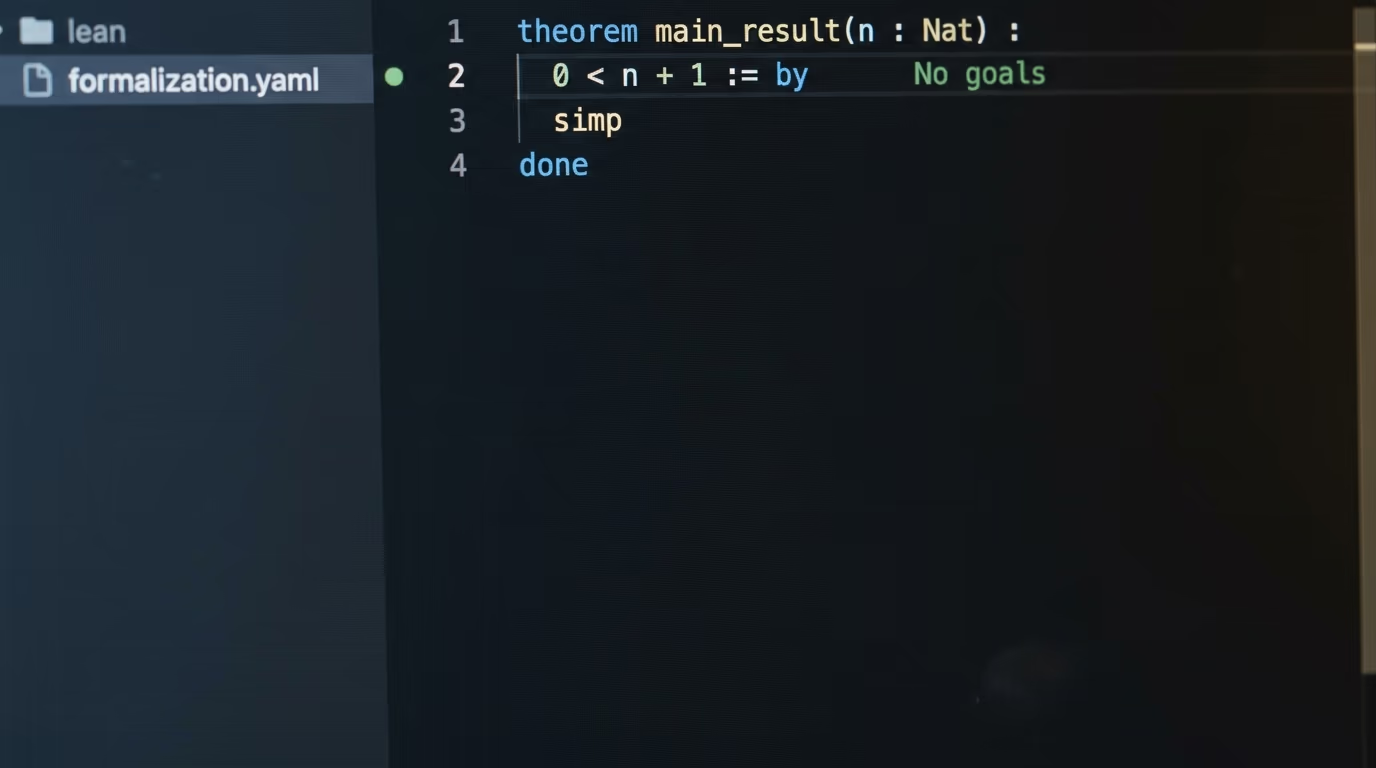
Lean is a language a computer can check. You rewrite the argument in it line by line, the machine refuses anything that does not follow from what came before, and at the end the file either compiles or it doesn't. A result that passes has been verified in a way no amount of careful reading can match, which is why the share of a collection sitting in that state tells you more than any claim about how hard the problems were. It's also slow and skilled work, which is why the share isn't higher.
OpenAI is direct about the remainder. Its front page says some of the results without a formal proof could have issues, and that it will fix any such issues quickly. Read next to this week's withdrawal, that sentence stops being boilerplate and starts reading like a forecast, because the paper that came down was one of the unformalized ones and the proof that failed had never been through a checker.
The machine check isn't a magic shield either. TechCrunch reported this week on a paper from mathematicians at the University of Cambridge and King's College London documenting at least 2 differences between a written proof and the Lean file meant to confirm it, which is a gap in the translation between them rather than a failure of the checker itself. We watched the same verification gap open under a different kind of claim in our piece on an AI cipher result nobody could reproduce, and the pattern repeats because checking is always slower than announcing.
The scale behind the collection comes from OpenAI's own account of it. The repository says the model was posed roughly 4,000 problems, and that each published result used an average of 3 hours of thinking compute on a ChatGPT Pro plan, which is a quiet reminder that this is bought with money as much as with cleverness, the same way the agent bill inside OpenAI's research teams was. Writing a guest post on Terence Tao's blog this week, a number theorist read those same figures as evidence of limits as much as of power, since most of what was attempted did not turn into a published result at all.
What did the mathematicians' advisory group ask for, and what did OpenAI publish?
The mathematicians sitting as the Advisory Group on Mathematics and Artificial Intelligence, hosted at the Institute for Advanced Study, published what they expect from any lab releasing mathematics made by a model, and openai/math meets some of that list and not the rest. The group formed after OpenAI approached some of its members about an external advisory board, and they chose to sit outside the company instead, unpaid, which is why their list is worth measuring against.
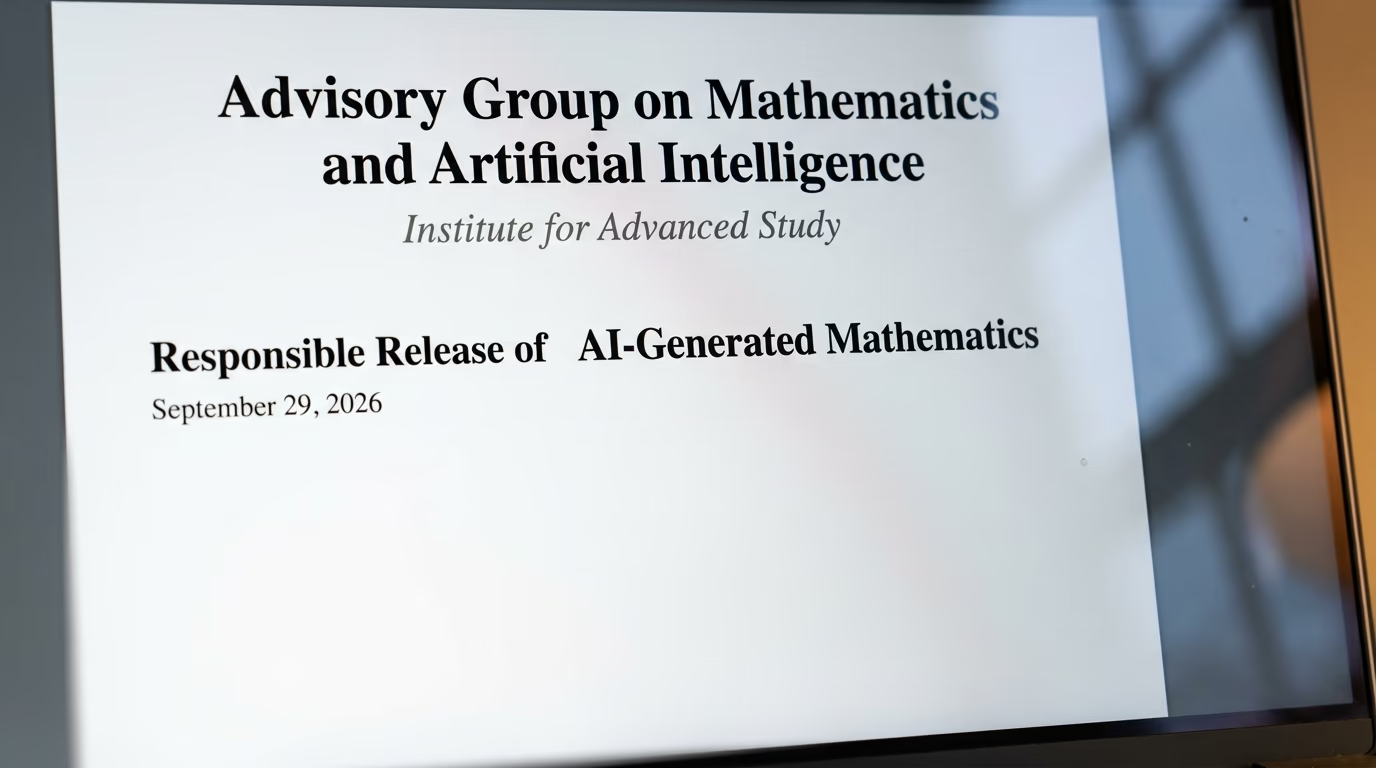
Their guidelines ask for something short and checkable with each released result, the name of the model, the prompts used, a summarized chain of thought, the time taken, and the estimated cost of computation. I read the repository against that list this morning, row by row, and this is where it stands.
| What the advisory group asked for | What openai/math publishes today |
|---|---|
| The name of the model | Not named. The front page says an unreleased internal OpenAI model |
| The prompts used | Not published anywhere in the repository |
| A summarized chain of thought | 10 reasoning summaries, covering 10 results out of 719 manuscripts |
| The time taken | An average of 3 hours of thinking per result, not a time per result |
| The estimated cost of computation | No figure published |
| A repository not controlled by an AI lab | Hosted on OpenAI's own GitHub account, with community hosted repositories described as under exploration |
| A repository that allows comments on papers | Issues and discussions are both switched off |
| The formalization status clearly stated | Now given as a share of the catalogue, changed from a vague sentence on October 7 |
Both of GitHub's discussion tools are switched off on openai/math, so a mathematician who spots the next sign error has no way to report it inside the project. A fork and a pull request is the only route left open, which is a reasonable ask of a software engineer and a closed door for most working mathematicians. The advisory group had asked for the opposite, saying a repository that allows comments on papers would be particularly useful for results produced this way.
Not every objection is about process. Asaf Karagila, a set theorist who works on one of the exact questions in the release, read the preprint on the Partition Principle and wrote that if it had been submitted to a journal it should be issued a desk rejection for the quality. He says himself that he did not read the accompanying Lean code, and his complaint is about the writing rather than the correctness. It still lands on the same cost everybody is circling, because somebody has to do the reading, and the people qualified to do it are the ones with the least spare time.
The group's own statement on the release, published the day the collection went up, is careful enough to be worth quoting whole rather than summarizing.
This release is the beginning, not the completion, of the process of human understanding and the incorporation of the work into mathematical knowledge.
What should you do when an AI hands you a proof tonight?
Pin the exact version you read, find the one step the argument cannot survive without, and ask what else is leaning on it. Those habits are what this week's withdrawal is actually teaching, and not one of them needs a mathematics degree.
Pinning the version is the cheapest of these habits. When you save a result that lives in a repository, save the revision identifier next to it, the way OpenAI's own notice does when it links the archived manuscript. Without it you are citing an address, and an address can quietly start serving a different document, which is precisely what happened to these papers overnight. The same applies to a model answer you intend to rely on, where the date and the model version belong in the note beside it.
Finding the load bearing step takes longer, and it is where the errors live. In this case the whole argument rested on one count coming out at zero, because the theorem being invoked only works when it does. Ask the model which single step would break the result if it were wrong, then check that step yourself before you check anything else. An assistant will usually name it honestly, and the answer tends to be a sign, a count, or an assumption nobody wrote down, rather than the elaborate reasoning that takes up most of the page.
The dependency question is the one this week answers best. One broken proof took down 2 papers that had nothing wrong with them, purely because they used its construction. The same shape turns up in ordinary work, in the spreadsheet that feeds 4 reports, or in the helper function half the repository imports, and we wrote about the same cascade from another angle in our look at the incident reports OpenAI publishes on its own agents. Before you trust a result from a model, ask what it is holding up.
Finally, ask what has been checked by a machine and what has only been read by a person. That question has a published answer here, which is rare, and the honest version of it is that most of this collection has not been through a formal checker yet. If you want the same discipline applied to a vendor's number rather than to a theorem, our breakdown of what a legal benchmark number really measured walks the same method through a percentage instead of a proof.
What we still do not know about OpenAI's withdrawn math papers
The files don't say who found the sign error. Neither the history entry nor the withdrawal notice credits anybody, no mathematician has publicly claimed the catch, and OpenAI has not said whether it came from inside the company or from a reader outside it. For a release whose whole defence is that errors will surface and get fixed quickly, the identity of whoever surfaced this one is the detail still missing.
We also don't know whether the withdrawn statements are true. The notice is explicit that it takes no position, so the Weil classes result and the 2 claims that leaned on it are back to being open questions rather than settled ones. Nobody has published a repaired proof, and nobody has published a counterexample either, which means the honest status of all 3 today is unknown rather than wrong.
How many more withdrawals are coming is unanswered in both directions. The repository admits that results without a formal proof could have issues, which describes most of them, and the field has had these files for only a few days. Whether this correction was the exception or the first of a run is a question that time and a great deal of unpaid reading will settle, and the history file is where that answer will appear first.
A pair of smaller unknowns sits behind all of it. OpenAI says it is exploring community hosted repositories for this material, with no date and no named partner, and the advisory group has asked for exactly that move. The model behind the work is also still unnamed and unavailable, so nobody outside the company can rerun a single result of it, which is the gap that keeps every claim here a claim rather than a measurement. We applied the same test to a launch where the weights never appeared, in our piece on what Mistral's open release actually shipped.
What to watch next is simple enough to check yourself in a browser. A second entry in that history file, a named person credited with a catch, a formalization share that climbs past half, or the collection appearing somewhere OpenAI does not own. Any one of those would tell you more about how this release is really going than another round of coverage counting how many problems were solved.
Questions people ask
Which math papers did OpenAI withdraw?
OpenAI withdrew 3 manuscripts from its openai/math repository. The repository's history file names them as Algebraicity of Weil classes on split abelian eightfolds, a companion paper on algebraic correspondences for K3 surfaces, and The rational Hodge conjecture for products of K3 surfaces. The first contained the error and the other 2 depended on it.
Why did OpenAI withdraw 3 math papers?
A sign error in the stabilization trace argument of the Weil classes manuscript invalidated the construction that 2 other papers were built on. OpenAI's notice explains that the argument needed a count of crossing points to be zero, and that with the correct sign that count is not zero, so the older theorem invoked at that step does not apply.
Does a withdrawn paper mean the theorem is false?
No, and OpenAI's notice says so in writing. It states that the withdrawal concerns the proof and does not assert that the mathematical statement is false. The claims in all 3 papers are back to being open questions, and nobody has published either a repaired proof or a counterexample for them.
How many of OpenAI's math results have been checked by a machine?
The repository says 300 of its main results carry Lean formalizations, which is a little under half of the catalogue. The rest rely on written arguments that a human has to verify, and OpenAI states on its front page that some of those unformalized results could have issues.
Can anyone report an error in OpenAI's math repository?
There is no way to do it inside the repository itself. Issues and discussions are both switched off on openai/math, so the only routes left are a fork with a pull request, or a message to OpenAI somewhere else. The mathematicians' advisory group had recommended a repository that allows comments on papers.
Where can I read the withdrawn manuscripts?
Each withdrawn paper keeps its folder in the repository, where a notice now explains the gap and links the original document at the exact revision it was published under. The address you may have saved now opens that notice rather than the manuscript, so the revision link is the one worth keeping.