ToolsOctober 19, 202611 min read
DeepSeek's search API is $0.75 per 1,000, Claude's is $10
DeepSeek opened its own search index to developers on 17 October, and its change log says that index screens out SEO spam and weak AI text before a model sees it.
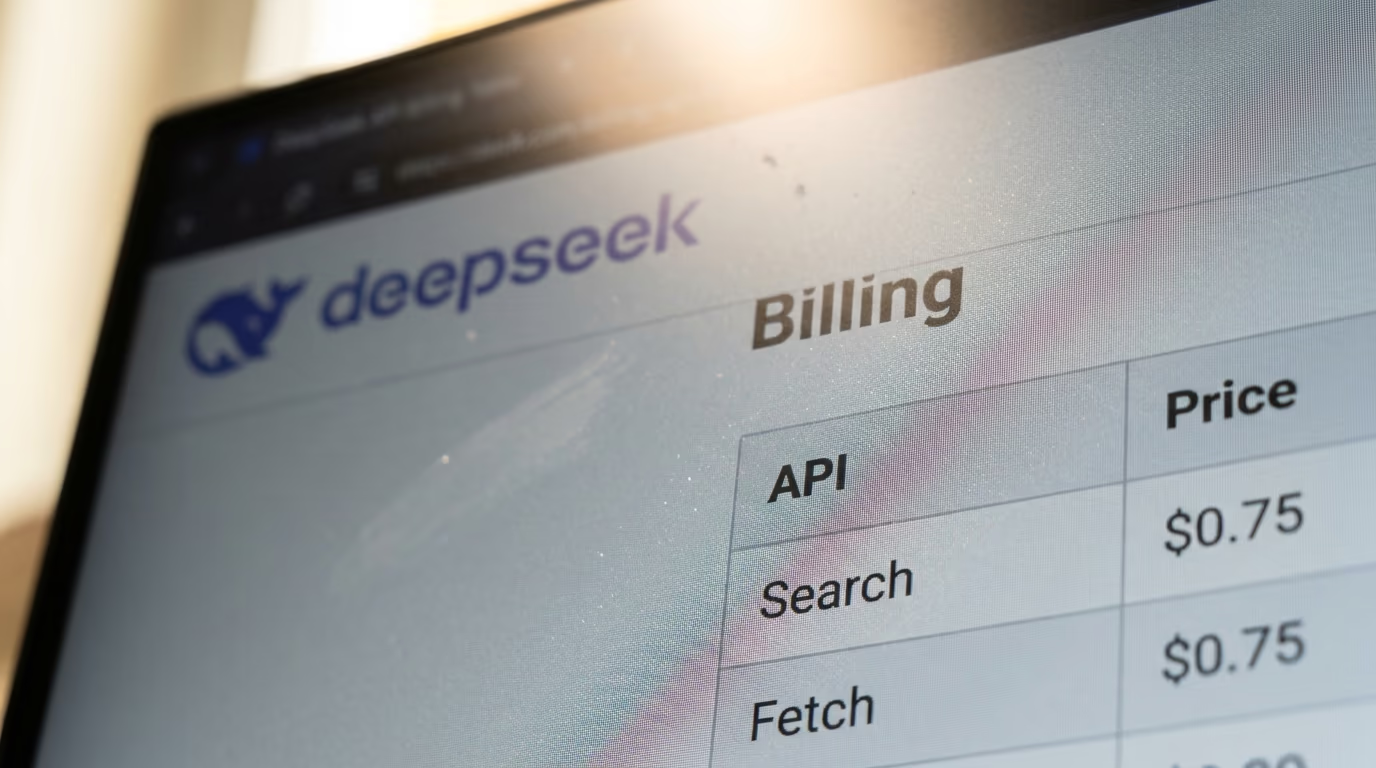
DeepSeek's Search and Fetch APIs each cost $0.75 per 1,000 successful requests, which is roughly a 13th of what the Claude API and the OpenAI API each charge for the same job. DeepSeek opened both routes on 17 October, they run on a search index the lab built itself rather than on anybody else's results, and DeepSeek's own change log says that index screens out SEO spam, what it calls GEO manipulation, and AI written content it judges to be of low quality.
Everybody who wrote about the launch over the weekend priced it against the independent search services, and those numbers are right as far as they go. Nobody set the new rate beside the web search that an agent built on the Claude API or the OpenAI API is already paying for, and nobody quoted the change log line where DeepSeek describes what its engine throws away before an answer reaches you. Both of those change what you would do tonight, so both are below, with every rate read off the vendor's own page this morning.
What is the DeepSeek search API, and what does it cost?
The DeepSeek search API is a pair of ordinary web requests that give an AI agent live access to the web, and both carry the same price per successful call. Search takes a query and returns ranked results, each one with a short snippet meant for a screen and a longer summary written to be read by a model. Fetch takes a single address and returns that page as plain text, with the navigation and the adverts stripped out, which is the form a model reads most cheaply.
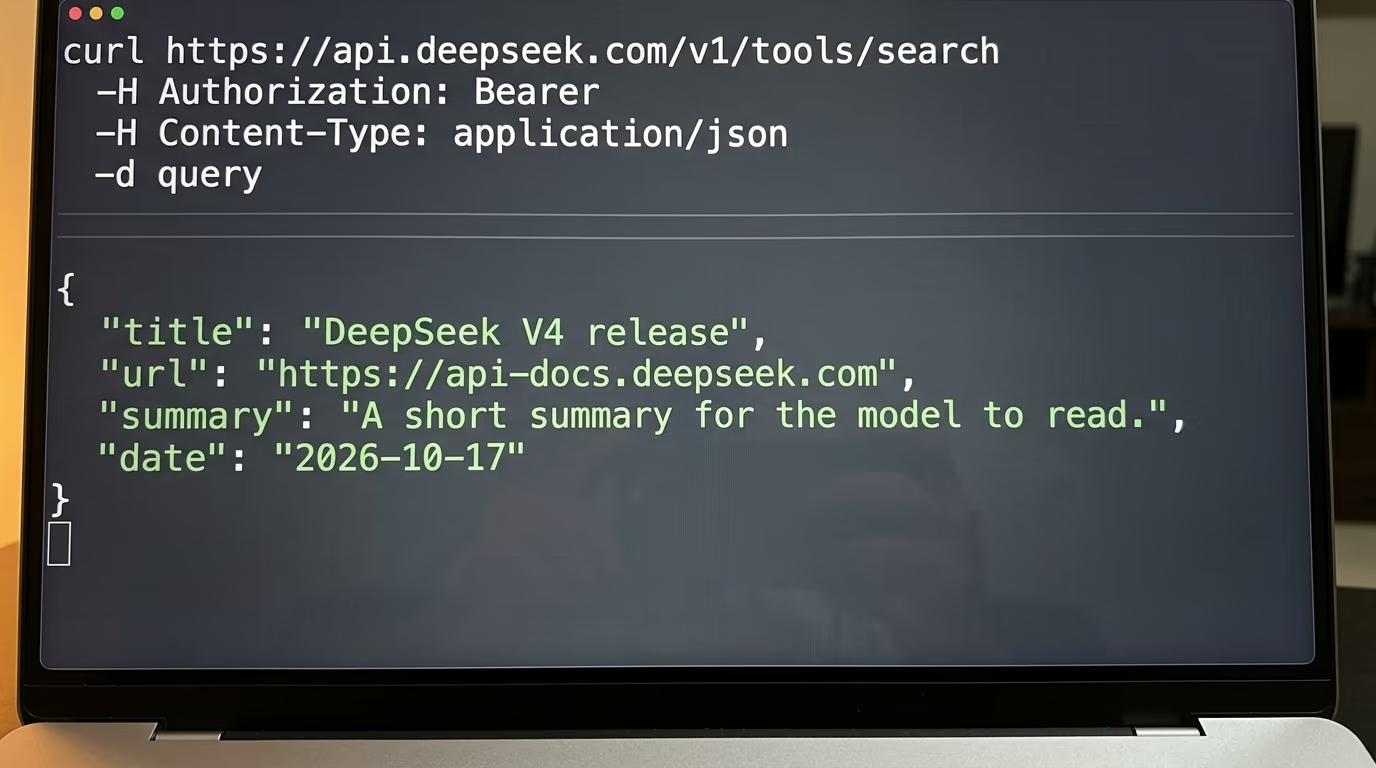
Both sit at the same address as the rest of the DeepSeek API and accept the same credential, so there is nothing new to sign up for if you already call the models. DeepSeek's guide publishes the whole thing as a curl command, and this is it, with your own credential dropped in where the placeholder sits.
curl https://api.deepseek.com/v1/tools/search \
  -H "Authorization: Bearer YOUR_DEEPSEEK_TOKEN" \
  -H "Content-Type: application/json" \
  -d '{"query": "DeepSeek V4 release", "count": 5, "need_content": true}'
What comes back is a list of results, and each entry carries the title, the address, the site name, the publication date when DeepSeek knows it, both summaries and 2 scores. One score rates how closely the result matches the query. The other is an authority tier that the lab attaches to the site rather than to the page, and anybody who publishes on the web should notice that it exists.
You can bolt the usual search operators onto the query and DeepSeek passes the syntax through untouched, so you can hold a search to one domain, to a list of languages, or to pages published after a date. That last one is the useful trick for an agent that keeps quoting things from last year, and it's a line of text rather than a setting.
{
  "query": "DeepSeek site:github.com OR site:huggingface.co lang:en after:2026",
  "count": 10
}
The billing rule is where this differs from everything else on the shelf. DeepSeek charges per request that succeeds, never per token and never per returned result, so a call asking for the maximum number of results costs exactly what a call asking for one costs. A request only becomes billable when it answers normally and actually produces something, which the guide defines as a non empty list of results for search and real page content for fetch. Failures, timeouts and searches that find nothing are not billed at all, so an agent that searches badly and comes back empty pays nothing for the attempt.
I posted to both routes this morning with no credential attached, and both answered with an authentication error rather than a missing route, so they're live and the only thing standing between a reader and a first search is an account with a balance on it. For the wider picture of what an agent runtime costs once you add the sandbox and the tokens, our piece on what OpenAI's Agents API costs priced the meters nobody else was pricing.
How does 75 cents compare with what your agent pays today?
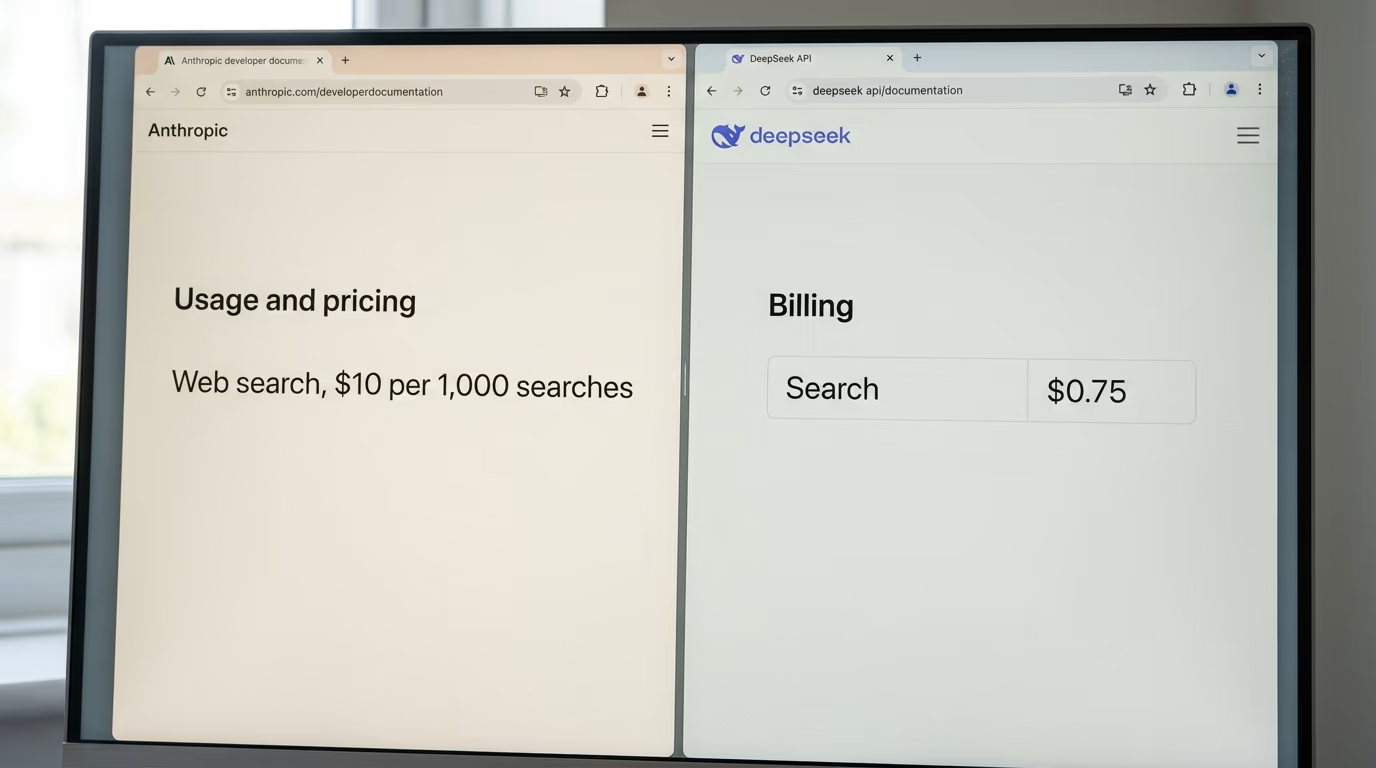
DeepSeek is the cheapest published web search rate among the services an AI agent normally calls, and the gap against the 2 American labs is the one nobody printed. The Claude API and the OpenAI API both charge $10 for the same number of searches, and both bill the tokens of the retrieved text on top of that.
| Service | What one request buys | Per 1,000 requests | 10,000 searches a month | Tokens billed on top |
|---|---|---|---|---|
| DeepSeek Search | ranked results, up to 50 of them, each with a summary for the model | $0.75 | $7.50 | no |
| DeepSeek Fetch | one page returned as clean text | $0.75 | $7.50 | no |
| Claude API web search tool | one search inside a Claude turn | $10.00 | $100.00 | yes |
| Claude API web fetch tool | one page inside a Claude turn | no request charge | $0.00 | yes |
| OpenAI web search tool | one search inside a model call | $10.00 | $100.00 | yes |
| Grounding with Google Search, Gemini 3 and newer | one grounded request, after 5,000 free a month | $14.00 | $70.00 | yes |
| Perplexity Search API | one search on the standard tier | $5.00, or $1.00 fast | $50.00, or $10.00 fast | no |
| Brave Search API | one search, with $5 of credit free each month | $5.00 | $50.00 | no |
| Exa | one instant search returning 10 results | $4.00 | $40.00 | no |
| Tavily | credits, and the page does not say how many a search costs | $8.00 per 1,000 credits | $80.00 | no |
Read the last column before you celebrate the gap. DeepSeek's price is the whole price, because nothing in the search response is billed as tokens, while the lab tools charge their request fee and then charge again for every line of retrieved text that enters the conversation, at the model's own rate. On a research task that reads several long pages for each question, the retrieved text is usually the bigger half of the bill, which our comparison of LLM API pricing works through on real jobs. The Google figure in that column already subtracts the free monthly allowance Google publishes.
There is one honest exception and it runs the other way. Anthropic charges no request fee at all for its web fetch tool, so pulling a page into a Claude conversation costs only the tokens it adds, while DeepSeek charges for every fetch that comes back with content. If your agent reads far more pages than it searches, Anthropic's fetch is the cheaper leg and DeepSeek's search is the cheaper one, and nothing stops a build from using both.
The nearest rival on price is Perplexity, whose fast search tier sits close to DeepSeek's rate with no token charge either, and the independent services are not far behind it. Brave and Exa both hand a new account a small monthly credit, enough to test either one without paying anything, and Tavily gives a free monthly allowance of credits while leaving the credits per search off its pricing page. Anybody choosing on price alone should also read what each service says it indexes, because a cheap search of a thin index is not a saving, it is a worse answer at a lower price.
What does DeepSeek say it keeps out of its own index?
DeepSeek's change log says its search engine filters out SEO spam and what it calls GEO manipulation, together with AI written content it judges to be of low quality, through what it describes as strict detection mechanisms. That sentence is the lab's own claim, it sits in the entry that opened the API, and nobody outside DeepSeek has tested it yet.
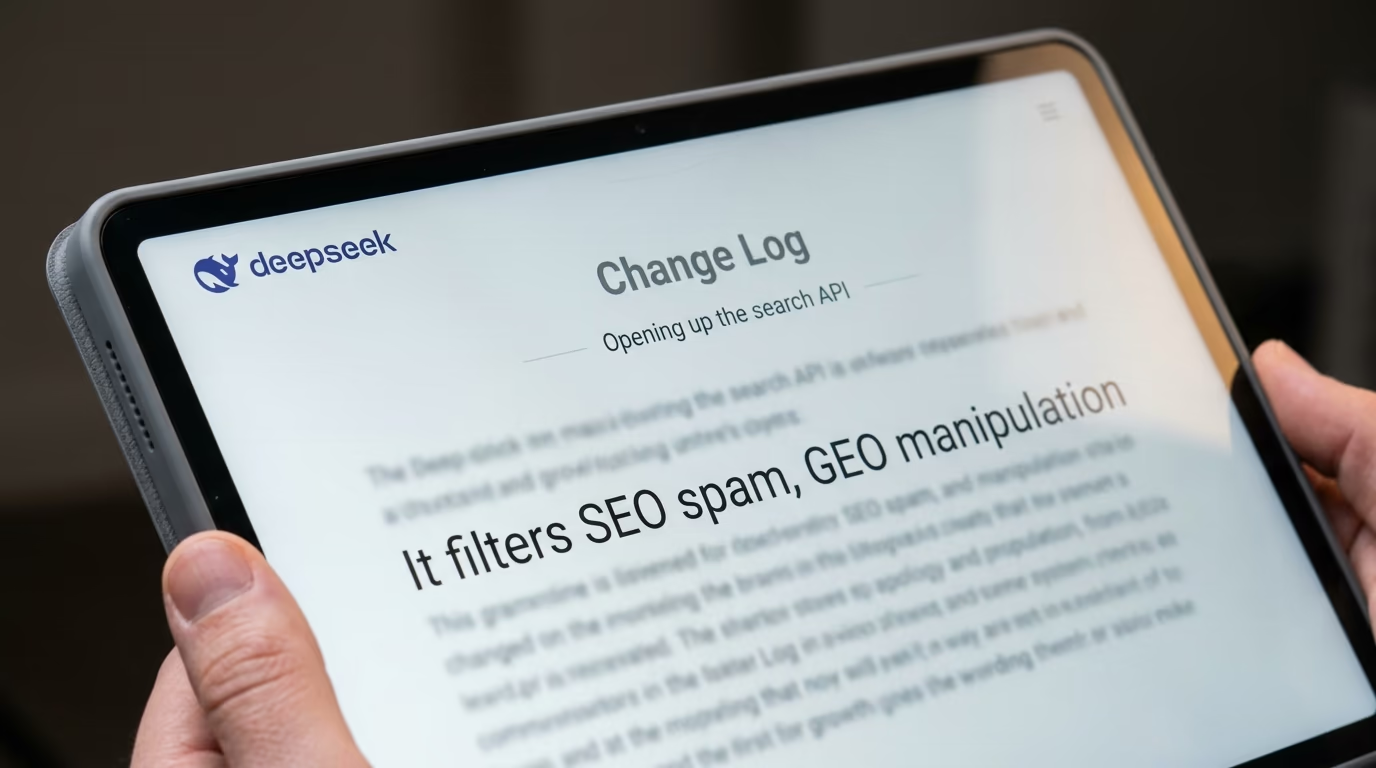
SEO spam is the old problem and everybody recognises it, pages built to rank rather than to be read. GEO manipulation is the new one, and the letters stand for generative engine optimization, which means writing a page so that an AI assistant quotes it when somebody asks a question. DeepSeek is saying that it tries to spot pages written for the machine rather than for a person, and that it drops them before a model ever sees them.
Anybody who publishes on the web sits on the other side of that sentence. A search engine owned by a model lab now says it screens pages by how they were made, and it publishes no figure for how much that removes, no way to find out whether your own site survived the screen, and no route to ask. The authority tier attached to every result is the visible end of the same judgment, a grade the lab gives a site before any model reads it.
Nothing in that sentence promises a human wrote the pages you get back, so it pays to read what it does say. DeepSeek names low quality AI content, not AI content, so a well made page drafted with help from a model is not what the filter claims to be hunting. The company also gives no accuracy figure for the detection, and every system of this kind makes 2 sorts of mistake, keeping junk and dropping something good, so the honest reading is that the index has an opinion about your pages and will not tell you what it is.
The claim cuts both ways for the people who will pay for this. If the filter works, an agent reading DeepSeek results wastes fewer tokens on junk, and on a long research run that is a real saving rather than a talking point. If it is too aggressive, the agent never sees a page the engine decided was machine made, and neither the reader nor the author ever learns that it was dropped.
Why is the search rate flat when every DeepSeek model halves off peak?
Every model rate on DeepSeek's pricing page is cut in half outside the hours the company calls peak, and the search and fetch rate does not move at all. The same page carries both tables, one with an off peak column beside a peak column, the other with a single price and nothing next to it.
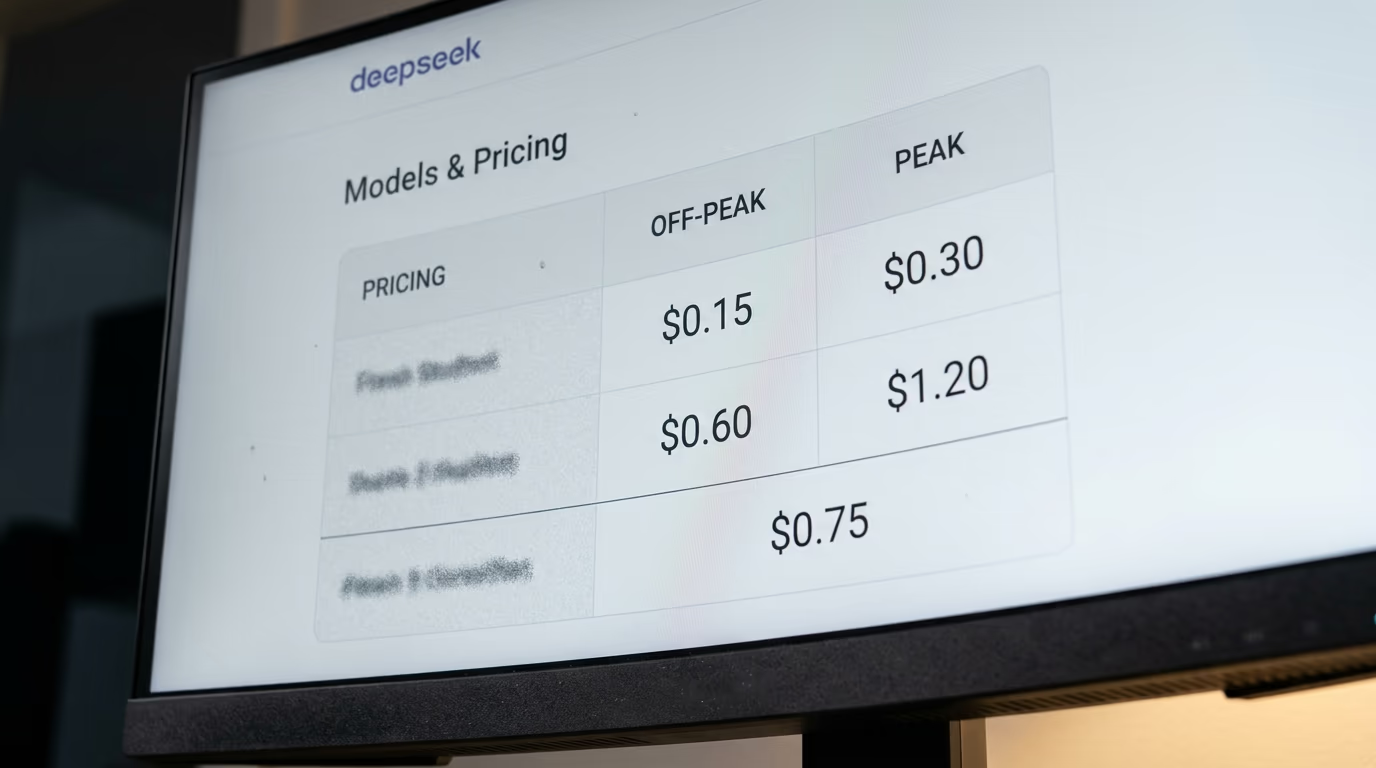
| What you are billed for | Off peak | Peak (01:00 to 04:00 and 06:00 to 10:00 UTC, Monday to Friday) |
|---|---|---|
| A million input tokens on deepseek flash, cache miss | $0.15 | $0.30 |
| A million output tokens on deepseek flash | $0.60 | $1.20 |
| 1,000 search requests | $0.75 | $0.75 |
| 1,000 fetch requests | $0.75 | $0.75 |
The window matters if you run anything on a schedule. A nightly job in Europe or the Americas lands outside the peak hours, so the thinking is half price and the looking is not, and the share of the bill that search represents quietly doubles in the cheap window. On a job that makes many searches for each answer, search can become the largest line on the invoice exactly when you moved the job in order to save money.
None of this is hidden, it's 2 tables on one page, and a flat rate sitting beside a halving rate on the same invoice breaks the habit of picking the cheap hour and assuming the whole bill follows. The same trap sits in agent model pricing, where a cached read costs a fraction of a fresh one, which is why our ranking of the best AI model for agents prices the models instead of scoring them.
If you want to know which side of the line your own jobs sit on, the peak window in the table is published in UTC, so convert it once and write it down. A job that starts early in the morning in Paris runs inside the peak hours, the same job started early in the morning in New York runs outside them, and the model bill between those 2 choices differs by half while the search bill does not budge.
Who is already using it for nothing, and when does the meter start?
If you point Claude Code, Codex or DeepSeek's own agent runner at a DeepSeek credential, the web searches those tools make on the server side are already hitting these 2 routes, and DeepSeek says those calls are free of charge until billing starts at midnight Beijing time on 1 November. In New York that is noon on Saturday 31 October.
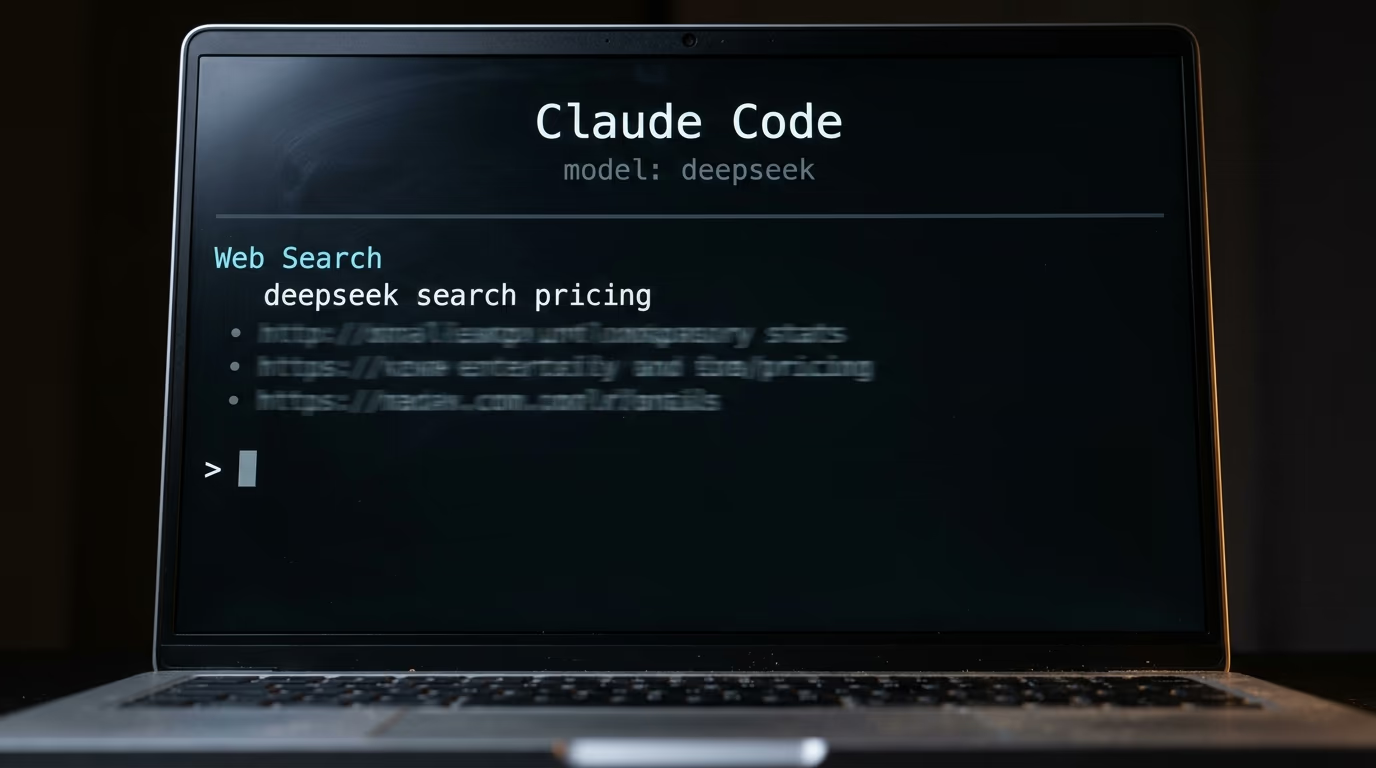
That note sits directly under the price table on the pricing page and again at the end of the billing section in the guide, and it names 3 tools. DeepSeek's own list of agent integrations is 3 times longer, and it carries OpenCode, OpenClaw, Hermes, Reasonix, Qoder and Tencent's CodeBuddy, none of which the free sentence names. Whether the searches those tools make are covered by the same grace period is not stated anywhere on either page.
Plenty of people are already using DeepSeek's search engine without ever having chosen it. If you wired a coding agent to DeepSeek for the cheap tokens, as the readers of our OpenCode vs Claude Code comparison were doing last week, its web lookups have been going through this index since Saturday. Our guide to AI spending limits covers which providers actually stop a bill when a ceiling is reached, which is the other half of this story.
Checking takes a minute and it's worth doing before the end of the month. Open the session your agent is running and look for the tool line where it says it searched the web, then open the usage page in your DeepSeek account and look for search requests listed separately from tokens. If the searches are there and the amount beside them is zero, you are inside the grace period and you now know roughly what that same volume will cost in November.
What the note does not say is what a direct caller pays today. The price table is published with no start date of its own, the grace sentence is written about calls made through those 3 tools, and nothing on either page says whether a raw call to the search route is billed this morning or not. If that answer matters to your budget, the honest move is to ask DeepSeek rather than to infer it from somebody's summary.
What happens when a website refuses the fetch?
DeepSeek's guide says that fetching is subject to the target site's availability and access policies, and it publishes 2 refusal codes, one for a request its own security policy rejects and one for a page it could not usefully read, which it says includes an address blocked by the site's own rules. Neither the guide nor the pricing page mentions robots.txt anywhere.

The contrast with Anthropic's documentation is sharp and anybody can check it. Anthropic lists robots.txt by name as one of the reasons its web fetch tool refuses an address, alongside private addresses and links that look as though they carry a credential. DeepSeek's pages name no crawler, publish no user agent string and never use the term at all, so a site owner who wants to allow or refuse this fetcher has nothing to write a rule against.
The rate limits say something about how the lab expects this to be used. Each account gets 5 requests a second on search and the same again on fetch, counted per account rather than per credential, and fetch carries a second limit per domain that DeepSeek describes but never quantifies. Run search flat out for an hour and the bill would be about $13.50, which is roughly what one long research run already costs on a frontier model.
The per domain cap is the one that reaches anybody running a site. It means DeepSeek is pacing itself against each website rather than only against each customer, which is the behaviour of a well mannered crawler, and the number it uses isn't published, so nobody outside the company can say whether the pace is polite or not. If your logs show a reader you cannot name, that is the gap in this launch rather than a mystery about your own site.
What we do not know yet
Several things that decide whether this is a good deal are not published, and they are questions for DeepSeek rather than for another summary of its announcement. Nobody has independently measured the quality of these results against Brave, Exa or Google, so the only evidence that the index is any good is the lab's own description of it.
- Whether a direct call to the search route is billed today, or whether the grace period covers everybody until the end of the month
- How much of the web the spam and AI text filter removes, and whether a publisher can find out which side of it their pages fell on
- What user agent the fetcher sends, and how a site owner allows or refuses it
- What the per domain fetch limit actually is, since the guide describes it without ever giving a number
- Whether the flat search rate stays flat once the free period ends and the real volume arrives
There is also the question no rate card answers, which is where the requests go. DeepSeek is a Chinese company and these searches and fetches run on its own infrastructure, so the queries your agent types leave your machine and land under another jurisdiction, along with the addresses it asks to have read. Anybody handling client material should settle that question before settling the price.
The cheapest way to find out whether the results are worth having is to send the same handful of queries through DeepSeek and through whatever you use today, then read both lists yourself. That costs a few cents and an evening, and it answers the one question no rate card can.
Questions people ask
How much does the DeepSeek search API cost?
DeepSeek charges $0.75 per 1,000 successful requests for its Search API and the same for its Fetch API, billed per request rather than per token or per result. Asking for the maximum number of results costs the same as asking for one, and failed requests, timeouts and searches that return nothing are not billed.
Is the DeepSeek search API free right now?
DeepSeek says the server side search and fetch calls made through Claude Code, Codex and its own agent runner are free of charge until billing starts at midnight Beijing time on 1 November, which is noon in New York on the Saturday before. The documentation does not say whether a direct call to the search route is already billed, so ask DeepSeek before you count on it.
What is the difference between the search route and the fetch route?
Search takes a query and returns ranked results with a snippet and a summary for each one, so a model can decide what to read. Fetch takes a single web address and returns that page as plain text, with the layout and the adverts stripped out. Both cost the same and both are billed only when they come back with something in them.
Is DeepSeek search cheaper than the web search in the Claude and OpenAI APIs?
Yes, by a wide margin on the request fee. The Claude API and the OpenAI API both charge $10 for that volume of searches plus the tokens of the retrieved text, while DeepSeek charges 75 cents for the same volume and bills no tokens for the search itself. Anthropic's web fetch tool is the exception, because it carries no request fee at all.
Does DeepSeek filter AI written pages out of its search results?
DeepSeek's change log says its search engine filters SEO spam, what it calls GEO manipulation, and AI written content it judges to be of low quality, through strict detection mechanisms. That is the company's own claim and nobody has tested it independently, and DeepSeek publishes no figure for how many pages the filter removes.
Can I use the DeepSeek search API with Claude Code?
Yes, and you may already be doing it without knowing. DeepSeek's documentation says that when you run the DeepSeek API through Claude Code, Codex or its own agent runner, the web searches those tools make on the server side already hit the Search and Fetch APIs. Those calls are free of charge until the meter starts at the end of October.
Does the search price fall during DeepSeek's off peak hours?
No. Every model rate on DeepSeek's pricing page halves outside the peak hours it publishes, but the search and fetch rate is a single flat figure with no off peak column. A scheduled job that runs in the cheap window pays half for thinking and full price for every search it makes.
Does DeepSeek respect robots.txt when it fetches a page?
DeepSeek's guide says only that fetching is subject to the target site's availability and access policies, and it returns a refusal code when a site blocks the address. Neither the guide nor the pricing page mentions robots.txt, names a crawler or publishes a user agent string, so a site owner has nothing specific to allow or refuse. Anthropic, by contrast, lists robots.txt by name as a reason its own fetch tool refuses a URL.