AIOctober 29, 202611 min read
Gemini 4 Carbon vs Argon, same price, only one on sale
Google's new number 1 model and the one it shipped 2 weeks earlier carry the same rate card. Only Argon is on sale, and the independent index found 1 thing Carbon does worse.
Gemini 4 Carbon vs Argon turns on a question no leaderboard answers, which is whether you can get the model at all. Google announced Gemini 4 Carbon on 28 October 2026 at the same introductory rate as Gemini 4 Argon, $2 per million tokens of input and $10 per million of output, then limited it to a group of vetted cyber defenders, while Argon stays on open sale through the Gemini API, the Gemini app and AI Mode in Search.
Everything else in this comparison sits downstream of that one difference. Google's own results say Carbon is the stronger model on every test it published, and the company hasn't said when anyone outside its partner list will be allowed to run it.
Most write ups of the launch reprint the ranking and stop there. This one opens the 4 Google pages behind the ranking, the announcement, the evaluation methodology, the security program and the published rate card, and reports what they say when you read them side by side. The short version is that Argon is the model you can use, Carbon is the model you can read about, and the independent index that crowned Carbon number 1 also measured it stating false answers more often than the model it builds on.
Can you use Gemini 4 Carbon today, and what do you get instead?
No, Gemini 4 Carbon isn't available to the public, and Google hasn't published a date when it will be. The announcement says access starts with a subset of cyber defenders and expands to further trusted partners through something Google calls the Fairwind Program, with developers, businesses and consumers reached, in its own wording, as soon as possible.
Gemini 4 Argon is the opposite case. Google's launch post says Argon is globally available for developers and enterprises through the API in AI Studio, for Google AI Ultra subscribers in Google Antigravity, and for Ultra and Pro subscribers in the Gemini app and AI Mode in Search. If you already pay for the Gemini app at either tier, you already have Argon, and you have had it since the middle of the month.
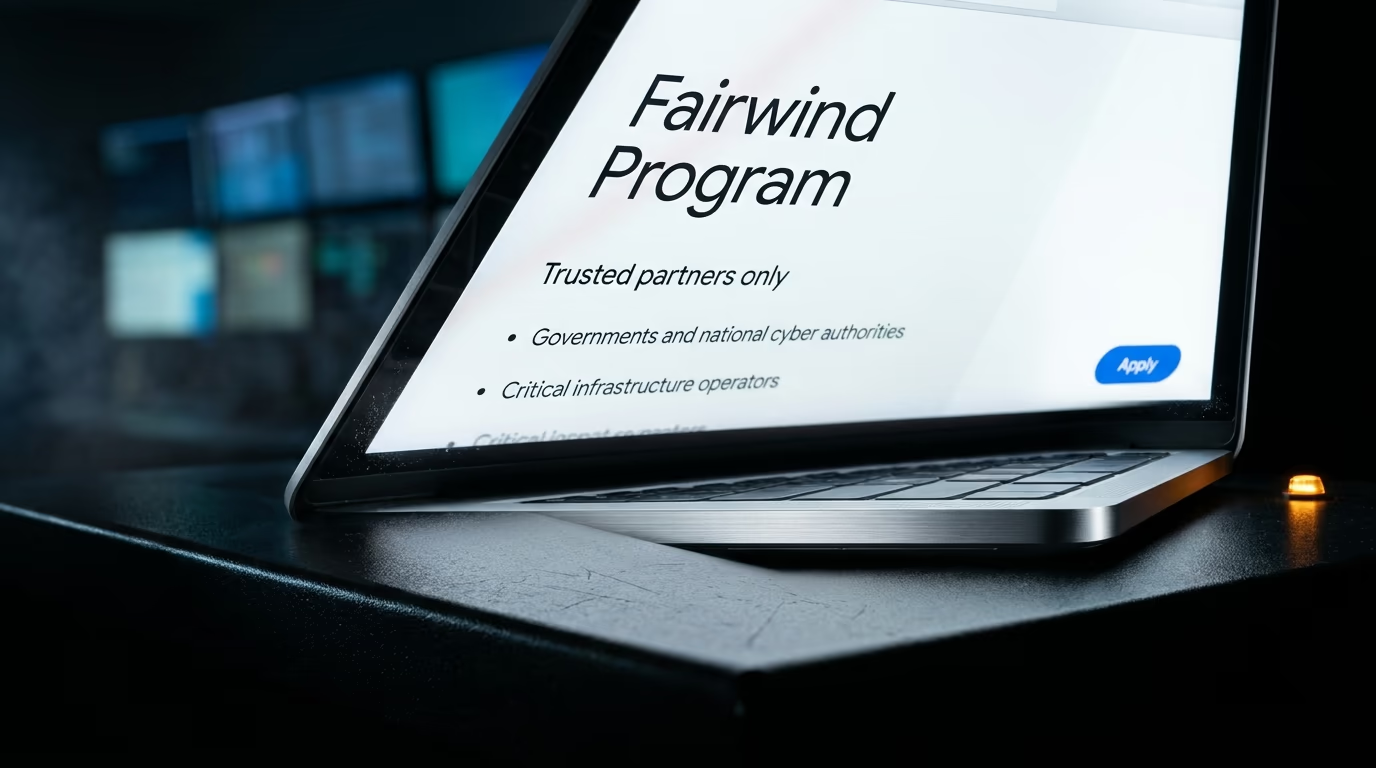
The Fairwind page is the door Google names for Carbon access, and when I opened it this morning it didn't mention Carbon once. It describes exclusive access to Gemini 4 Argon, used on its own or inside CodeMender, which is Google's automated code fixing agent.
The same page sets out who may apply, and the list is short. Google names governments and national cyber authorities, operators of critical infrastructure such as healthcare, telecommunications, energy and financial networks, and core technology platforms. It says it runs background checks on the organizations that apply, that it works with over 650 partners globally, and that an approved partner may only hand the model to its own security, incident response or penetration testing teams.
A freelancer or a small agency is on none of those lists, and Google doesn't pretend otherwise. Its own answer to what an organization that does not qualify should do is to use CodeMender with publicly available models. So for almost everybody reading this, the Gemini 4 Carbon vs Argon choice has already been made by Google, and the answer is Argon. It is the same move the company made this week with the Genie 4 world model it also declined to sell.
Do Gemini 4 Carbon and Argon cost the same?
Yes on the published rate, and the difference sits in the expiry date rather than in the dollars. Google says Gemini 4 Carbon launches at the same introductory price as Gemini 4 Argon, with cached input charged at a deep discount, and that a higher standard rate applies once the introductory period ends.
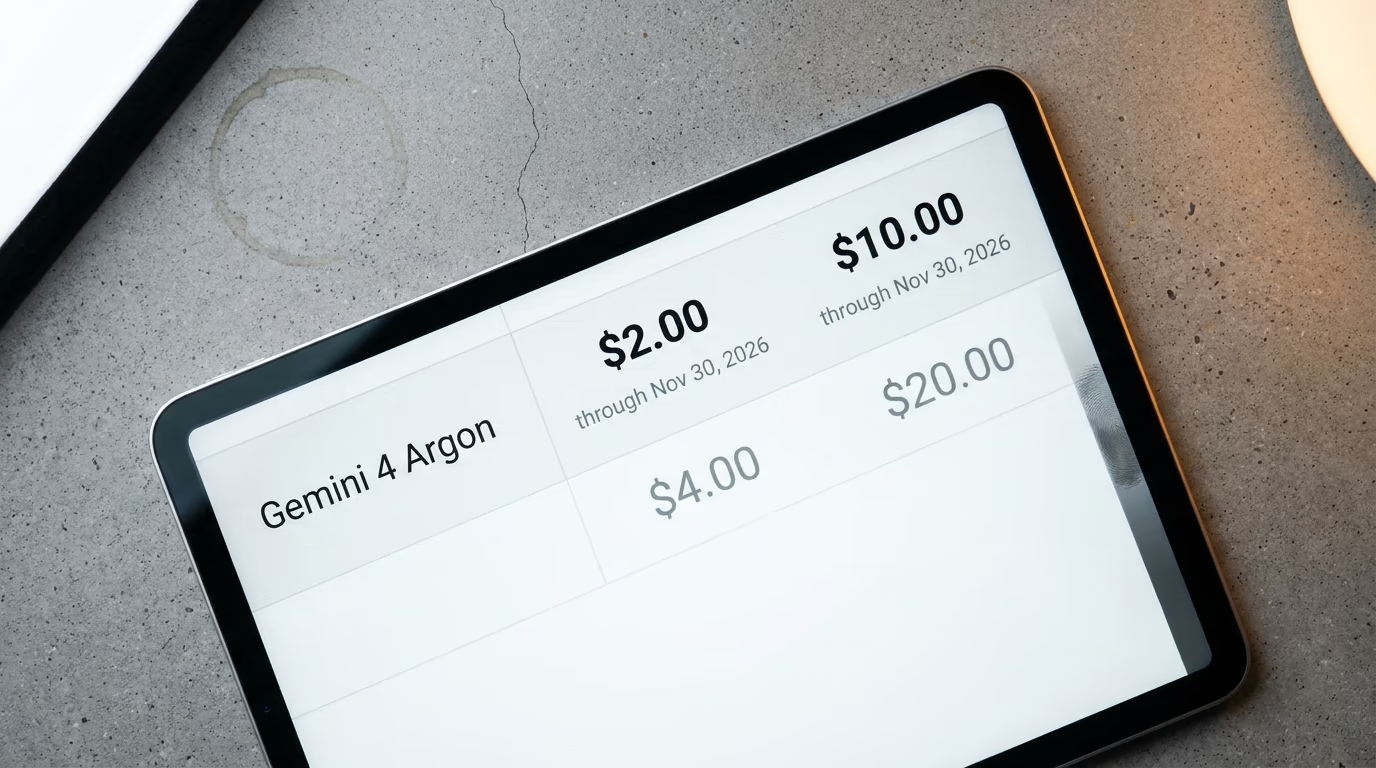
Argon's version of that sentence carries a date and Carbon's doesn't. The Gemini API pricing page prints an Argon row with both rates and both periods, the discounted one running through 30 November and the standard one starting the day after. The Carbon announcement says the standard rate applies after the introductory period expires, and stops there. Artificial Analysis, which runs the index Google quotes in its own announcement, described the discount the same way on the same day, as a launch discount with no confirmed end date.
A second gap sits on that same pricing page. Carbon has no row on it at all. The model has an announced price, a published set of results and no entry on the rate card a developer actually reads, which is what you would expect of a model nobody outside the program can call yet.
The footnote under Argon's price is worth reading as well, because it quietly describes 2 products where the coverage sees one. It says the rate applies to the Argon intended for public access only. There is a second Argon behind Fairwind, which Google describes as Argon with cybersecurity defense capabilities, and no price is published for that one anywhere.
For what the money actually buys, the useful figure comes from outside Google. Artificial Analysis ran its whole test suite on both models at standard pricing, and the 2 finished within 8 cents of each other per task, with Carbon fractionally dearer. Carbon scores higher and costs about the same, which is the cleanest argument anyone can make for it, and it is an argument nobody outside the program can act on. For how these rates sit against the rest of the market, we keep a running comparison of what the big models charge.
| Gemini 4 Carbon | Gemini 4 Argon | |
|---|---|---|
| Introductory rate per 1M tokens | $2 in, $10 out | $2 in, $10 out |
| Standard rate per 1M tokens | $4 in, $20 out | $4 in, $20 out |
| Cached input | 95% off the input rate | 95% off the input rate |
| Introductory period ends | no date published | 30 November 2026 |
| Row on the Gemini API pricing page | none | yes, with both dates |
| Cost per index task, standard pricing (Artificial Analysis) | $7.76 | $7.68 |
| Who can buy it today | vetted cyber defenders only | anyone, API and Gemini app |
How much better is Carbon than Argon on Google's own scorecard?
Google published a comparison table covering general capability, coding, computer use, knowledge work, multimodal understanding, long context, science and cybersecurity, and Gemini 4 Carbon is ahead of Gemini 4 Argon on every row of it. The gaps run from a fraction of a point to more than a dozen.
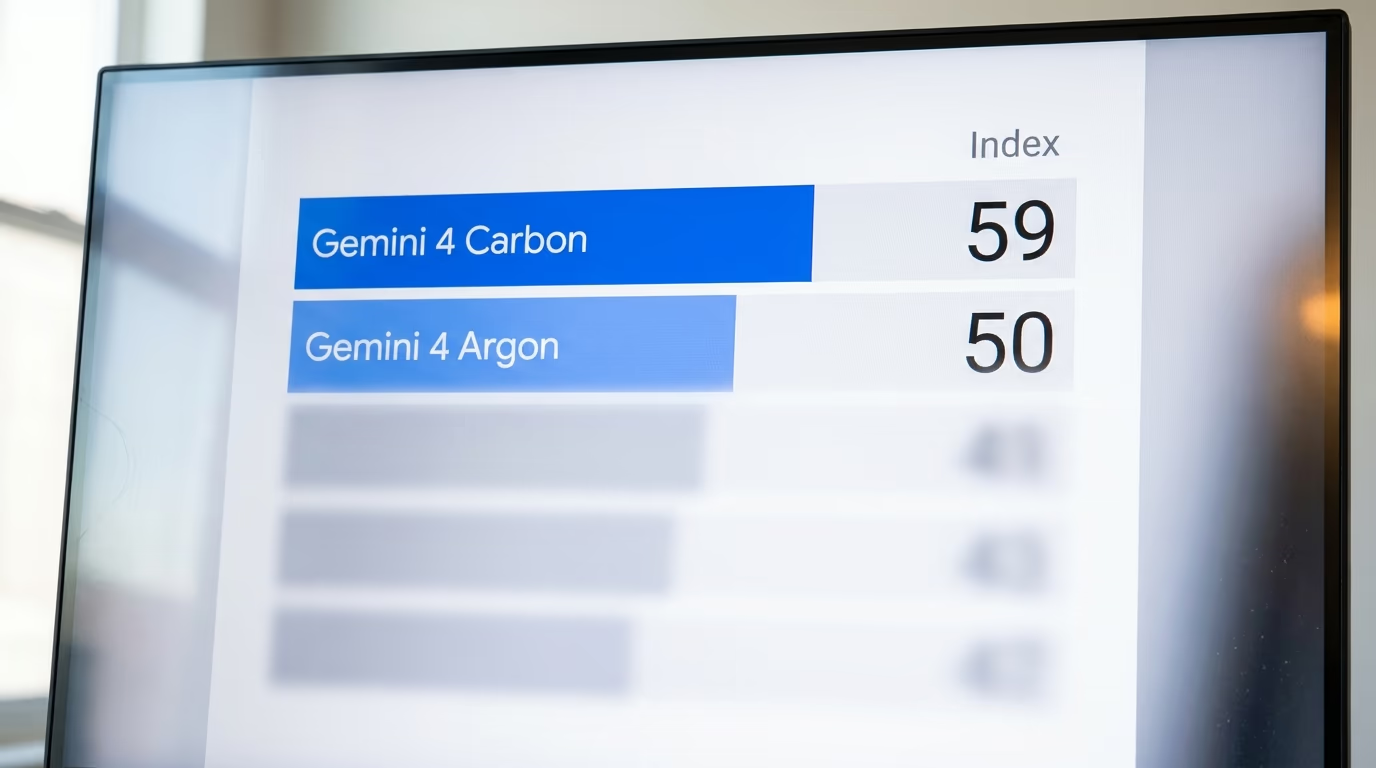
On the Artificial Analysis index, the one that produced the number 1 headline, Carbon scores 59 and Argon scores 50. That is the widest gap on the sheet and the reason for the coverage. Read across the same row, though, and the lead looks different, because Carbon sits 1 point above Claude Opus 5.5 and 2 points above the model after that. The new leader is ahead of its closest rival by a single point, and ahead of its own 2 week old sibling by a far wider one.
Google is open about where it loses, which is worth saying out loud. Its table marks 2 rows where a rival model is ahead of Carbon, 1 on agentic coding and 1 on computer use, and prints the rival's higher score inside the same grid rather than leaving it out.
On one of Google's own coding rows, every model on the table lands in single digits, Carbon included, and the methodology note says the figure there is a weighted reward rather than a success rate. Whatever exactly it measures, nobody on that sheet is close to finishing it.
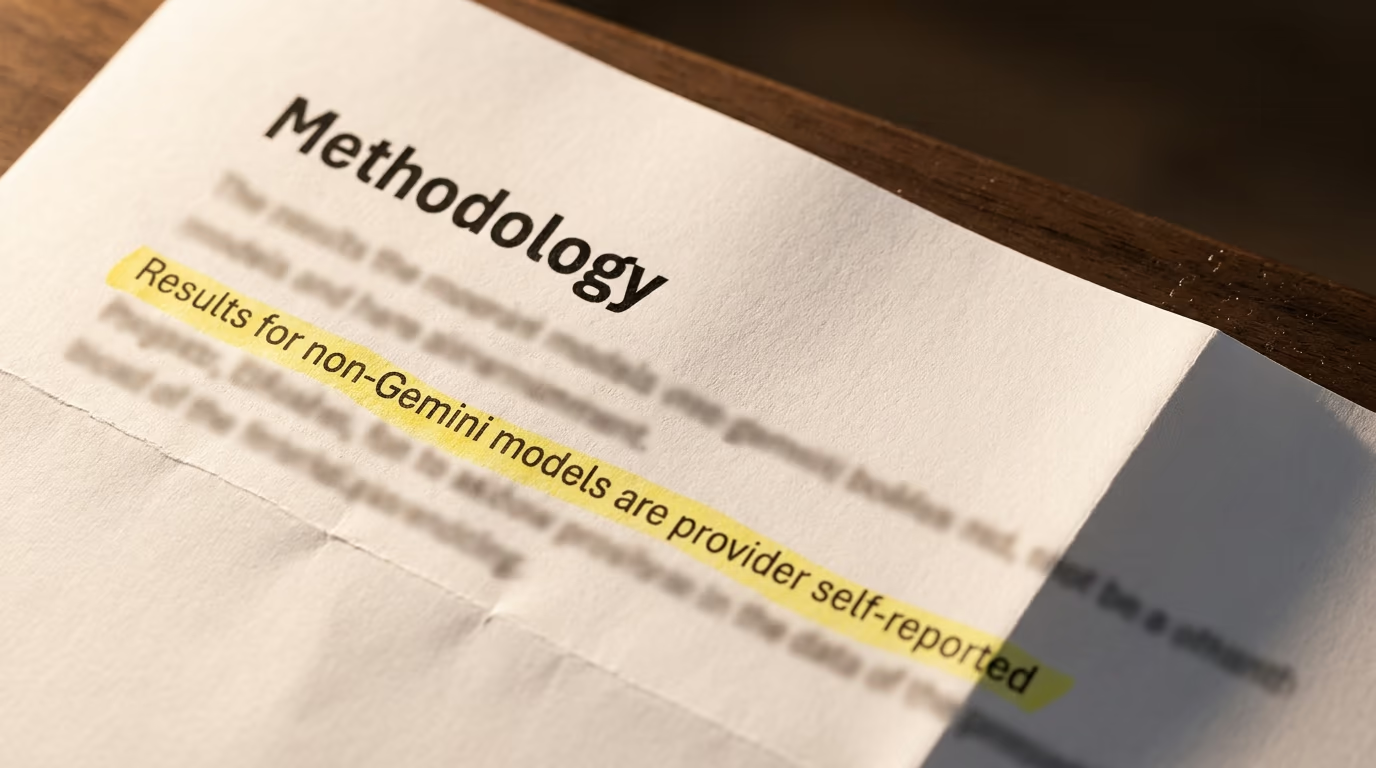
The methodology note under the table carries caveats the grid itself does not. Google says results for the models that are not its own come from those providers' self reported numbers. On the computer use row it says the Gemini scores are self computed and taken as the best of 3 runs, while the rival figures come from their published system cards. Google discloses all of it in writing, so there's no trick here, and it does mean the grid holds 5 models measured by different referees under different conditions.
| Google's own table | Gemini 4 Carbon | Gemini 4 Argon | Best rival on the row |
|---|---|---|---|
| AA Intelligence Index v5.0 | 59 | 50 | Claude Opus 5.5, 58 |
| SEC-bench Pro, finding flaws | 88.2% | 83.4% | GPT-6 Astra, 85.4% |
| ExploitGym, proving a flaw works | 54.8% | 42.0% | GPT-6 Astra, 42.4% |
| CWE-bench, patching a flaw | 71.0% | 68.0% | GPT-6 Astra, 68.0% |
| SWE-sweep, agentic coding | 9.6% | 4.3% | GPT-6 Astra, 9.5% |
| OSWorld-2.1, computer use | 81.5% | 74.7% | Claude Opus 5.5, 87.2% |
| GraphWalks, long context | 96.2% | 84.2% | GPT-6 Astra, 71.8% |
| Vending-Bench 2, running a business | $16,484 | $13,718 | GPT-6 Astra, $15,515 |
Is Gemini 4 Carbon really better at cybersecurity than Argon?
Yes on Google's published results, and by less than the framing suggests on the row a working defender cares about most. Google leads the launch with 3 security tests, 1 for finding flaws, 1 for proving they can be exploited and 1 for patching them, and Gemini 4 Carbon is ahead of Gemini 4 Argon on all 3 of them.
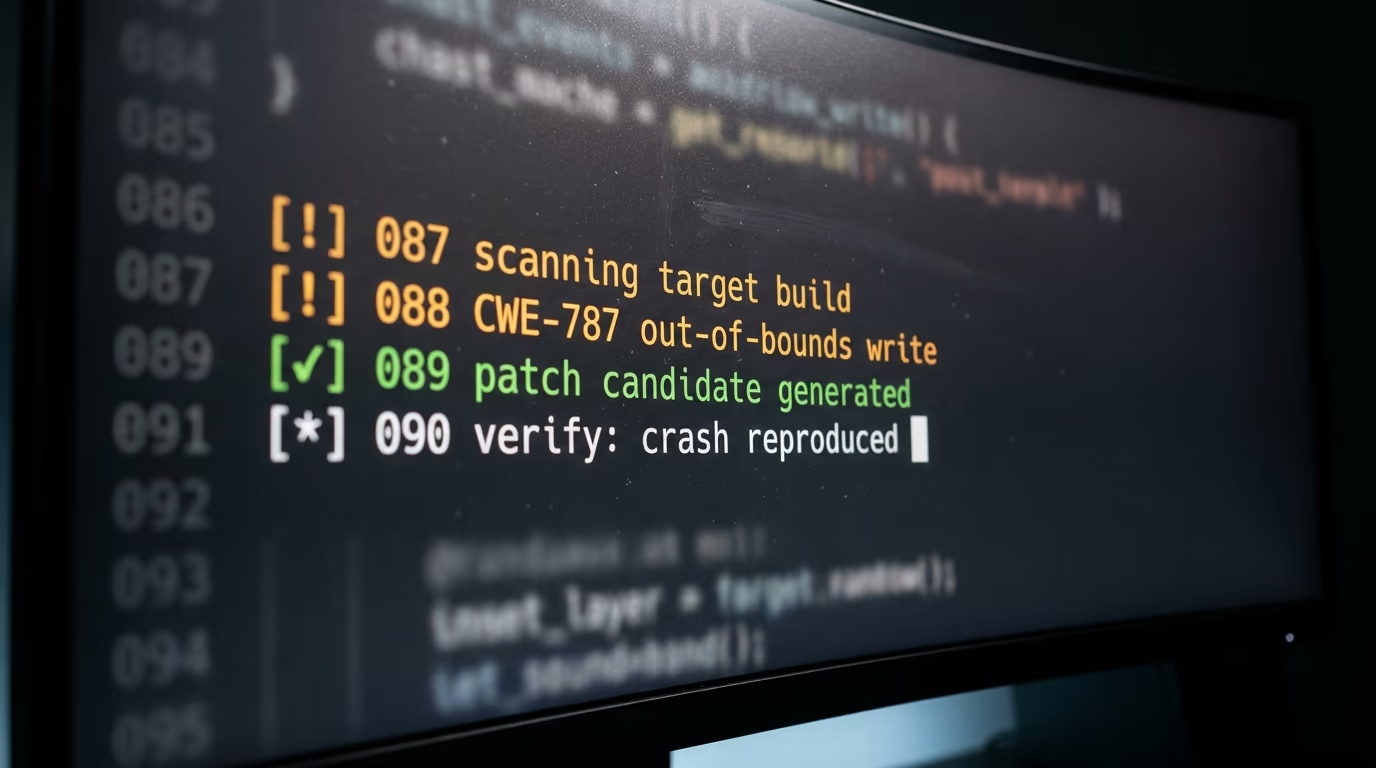
The patching row carries the smallest gap of the 3 tests. Carbon beats Argon there by 3 points, and the 4 strongest models on Google's own grid finish within a few points of each other, so the step forward on turning a confirmed flaw into a working fix is real and modest. Patching is also the step most likely to reach ordinary developers first, which is why the AI assisted flaw that hit PHP last week matters more to a small site owner than any leaderboard does.
The exploitation row is where the distance opens up, and it arrives with a condition Google states in its own methodology. The evaluation ran with the test environment's mitigations switched off, 1 attempt per task, and the timeout was measured both at the default and at an extended setting that hands a single task most of a working day. A score produced under those conditions describes what the model can do when it is given hours and the defenses are down, which is the right test for a defender and a poor description of a chat window.
A larger condition sits over all 3 of those numbers. Google says the external security results were produced without guardrails, and the Fairwind page says program partners get a version of Argon with cybersecurity defense capabilities while the public rate card covers the Argon intended for public access only. The model that produces these security scores and the model you can call from your laptop are not documented as the same build, under either name.
What that means for you depends entirely on who signs your paycheck. If you run security for a bank, a hospital group or a national network, these results are a reason to apply to the program, and the application is your next step rather than the model choice. If you write code for a living and simply want fewer flaws in it, neither security build is sold to you, so your real decision stays between the models you can already call today.
Does Gemini 4 Carbon make things up more than Argon?
On the independent knowledge test, yes. Artificial Analysis measured Gemini 4 Carbon's hallucination rate at 11% against 4% for Gemini 4 Argon, which means the newer model states a wrong answer more than twice as often as the model it builds on.
The qualifier has to travel with that number, because without it the line is unfair to Google. The same testing measured Carbon answering more questions correctly than Argon and scoring higher on that knowledge test overall, and it notes that Carbon's rate is still the second lowest of any model Artificial Analysis has measured, behind only Argon itself. The rival frontier models named in the same sentence miss about half the time.
Google describes the same behaviour in the opposite direction, which is the one real disagreement in the record. Its announcement says Carbon cuts unsupported claims by roughly half compared with Argon, measured in its internal testing, and describes a model that writes caveats into its output instead of inventing evidence to fill a gap.
Both findings can hold at once, and the way they hold matters for how you use the thing. A model that attempts far more questions will get more of them wrong in absolute terms, and the 2 organizations are not counting the same behaviour. Google is counting unsupported claims inside long working output, and Artificial Analysis is counting wrong answers to questions that have one correct answer. What a reader can take from this is narrow. The model Google calls more careful also asserts more, and nobody outside Google has tested the carefulness claim yet. If checking an AI result against its source is new to you, we walked through what happened when OpenAI's own math papers were checked.
Which one should you use tonight?
Use Gemini 4 Argon, because it is the only one of the 2 you can reach and the capability you give up is narrower than the ranking implies. Gemini 4 Carbon wins the comparison on Google's own numbers and is sold to nobody outside a vetted partner list, so for a reader with a laptop and a card there's only one answer.
If you sit inside an organization that qualifies for Fairwind, your calculation is a different one and the application is the next step rather than the model choice. Google says it reviews applications on a rolling basis and doesn't publish a processing time, so treat it as a queue and keep shipping with what you have in the meantime.
If you are waiting for Carbon to arrive in the Gemini app, watch the rate card rather than the press. Argon's discount has a published end date and Carbon's has none, so the first hard signal that Carbon is close will be a Carbon row appearing on the Gemini API pricing page with a date beside it. Argon itself arrived differently, with a dated price and global availability on day one, and we weighed it against its closest rival then.
| The 5 tests | Gemini 4 Carbon | Gemini 4 Argon | Winner |
|---|---|---|---|
| Can you buy it today | No, vetted cyber defenders only | Yes, API, Gemini app, AI Mode | Argon |
| Price certainty | Rate announced, no end date, no pricing row | Same rate, end date printed on the pricing page | Argon |
| General capability (AA Index v5.0) | 59, ranked 1st | 50 | Carbon |
| Cybersecurity (Google's 3 tests) | 88.2% / 54.8% / 71.0% | 83.4% / 42.0% / 68.0% | Carbon |
| Hallucination rate (Artificial Analysis) | 11% | 4% | Argon |
Across 5 tests that lands at 3 to 2 in favour of the model you can buy, which is a fair summary of the week. Google has built something stronger and has chosen, deliberately and in public, to hold it back while it checks the guardrails, and it said as much in the post that announced it. Whether the restraint lasts a month or a quarter is the question left open, and nothing Google has published answers it.
What we do not know yet about Gemini 4 Carbon
Several things are missing from the public record this morning, and each one is a reason to hold a judgment rather than form one. They are worth listing because the answers will arrive quietly, on pages rather than in announcements.
There's no model card and no safety report for Carbon. The Argon launch linked both, and the Carbon announcement links the Argon report instead, a document whose title names Argon and in which Carbon is never mentioned. The alignment claims in the announcement, the fall in cheating attempts and the improvement on shortcuts, therefore rest on a blog post rather than on a published evaluation.
There's no independent test of the security results either. Those numbers come from Google running open test suites itself, with the rival figures taken from the rivals' own reports, and no outside group has published a verification. The independent measurement that does exist covers general capability and knowledge work rather than vulnerability research.
There's no date attached to anything here. Google hasn't said when Carbon reaches developers, when it reaches the Gemini app, when the introductory discount ends, or how many defenders sit in the first cohort. The only date on the record belongs to Argon's discount, and it was published weeks ago.
And there's no published price for the security build of either model. The rate card covers the Argon intended for public access, the Fairwind version is described without a number anywhere, and Carbon has no row at all. If you are budgeting for security work on these models, there is nothing yet to budget against.
The next thing worth checking is the pricing page rather than the press, and it takes a minute. A Carbon row with a date beside it means the model is coming to everybody, and until that row appears, the model you can use this evening is the one Google shipped 2 weeks earlier. For what to point an agent at while you wait, our ranking of the models worth the money still holds.
Questions people ask
Can I use Gemini 4 Carbon right now?
No. Google has restricted Gemini 4 Carbon to a subset of cyber defenders through its Fairwind Program and has published no date for wider access. Gemini 4 Argon, the model it builds on, is on sale to anyone through the Gemini API and to paying Gemini app subscribers.
How much does Gemini 4 Carbon cost?
Google says Gemini 4 Carbon launches at the same introductory rate as Gemini 4 Argon, and that a higher standard rate applies once the introductory period ends. No end date has been published for Carbon's discount, and Carbon has no row on the Gemini API pricing page, so no developer can be billed for it yet.
What is the difference between Gemini 4 Carbon and Argon?
Gemini 4 Carbon scores higher than Gemini 4 Argon on every row of Google's published comparison, with the largest gap on general capability and the smallest on patching security flaws. The difference that decides it for most people is availability, because Argon is sold to the public and Carbon is not.
Is Gemini 4 Carbon better than Gemini 4 Argon?
On Google's own results, yes, on all of them. Gemini 4 Carbon also ranks first on the independent Artificial Analysis intelligence index where Argon does not, although the same testing measured Carbon stating false answers more often than Argon.
Who can apply to Google's Fairwind Program?
Google limits the Fairwind Program to governments and national cyber authorities, operators of critical infrastructure such as healthcare, telecommunications, energy and financial networks, and core technology platforms. It runs background checks on applicants, and it tells organizations that do not qualify to use CodeMender with publicly available models instead.
Does Gemini 4 Carbon hallucinate more than Argon?
Artificial Analysis measured Gemini 4 Carbon stating a false answer more often than Gemini 4 Argon on its knowledge test, while also measuring Carbon answering more questions correctly overall. Both models are far more careful than the rival frontier models in the same test, which miss about half the time.
When will Gemini 4 Carbon be available to everyone?
Google has not published a date for it. The announcement promises Carbon will reach developers, businesses and consumers through its products as soon as possible, with no date attached. The first checkable signal will be a Gemini 4 Carbon row appearing on the Gemini API pricing page.