AIOctober 28, 202612 min read
Genie 4 is not for sale, and Genie 3 gives you 60 seconds
DeepMind announced Genie 4 on 27 October with no resolution, no frame rate and no price. The door Google names is Project Genie, where a world still runs on Genie 3 and ends on a timer.
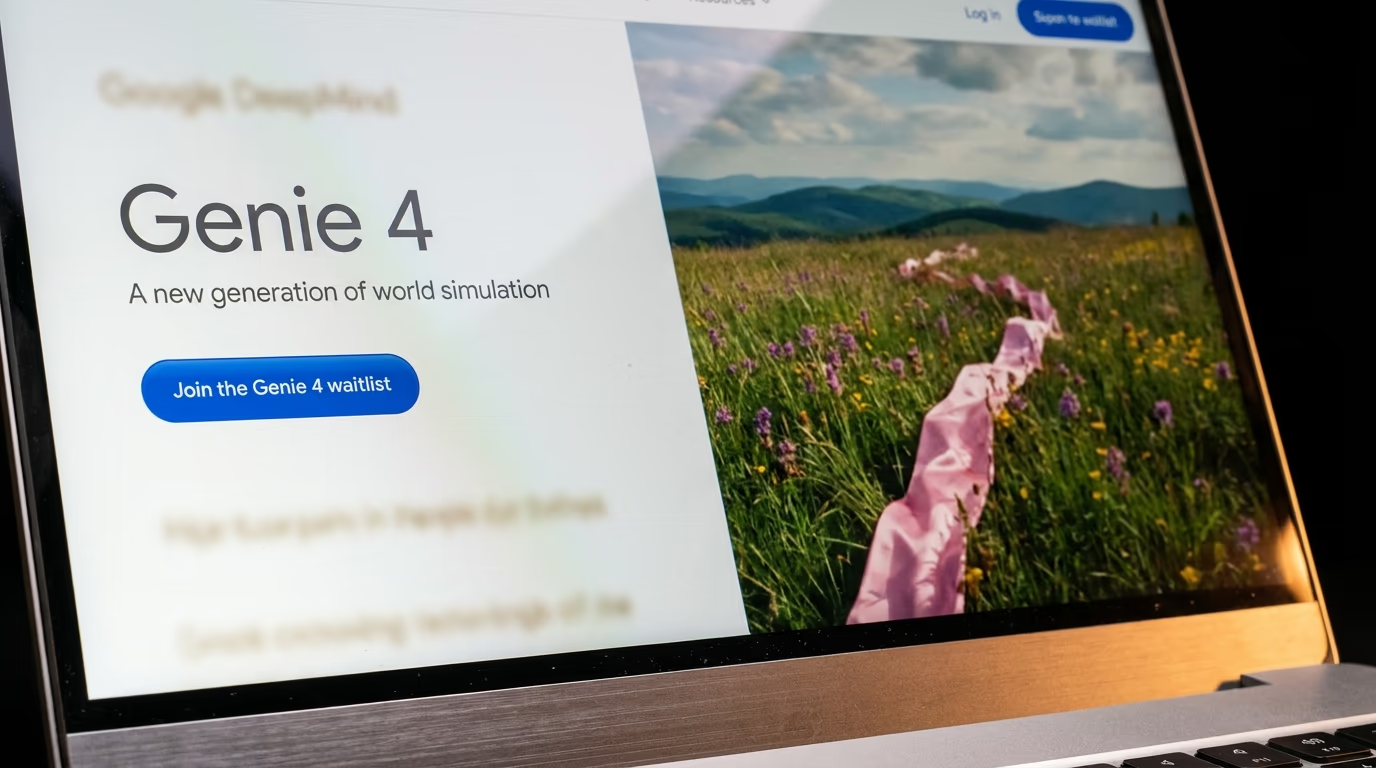
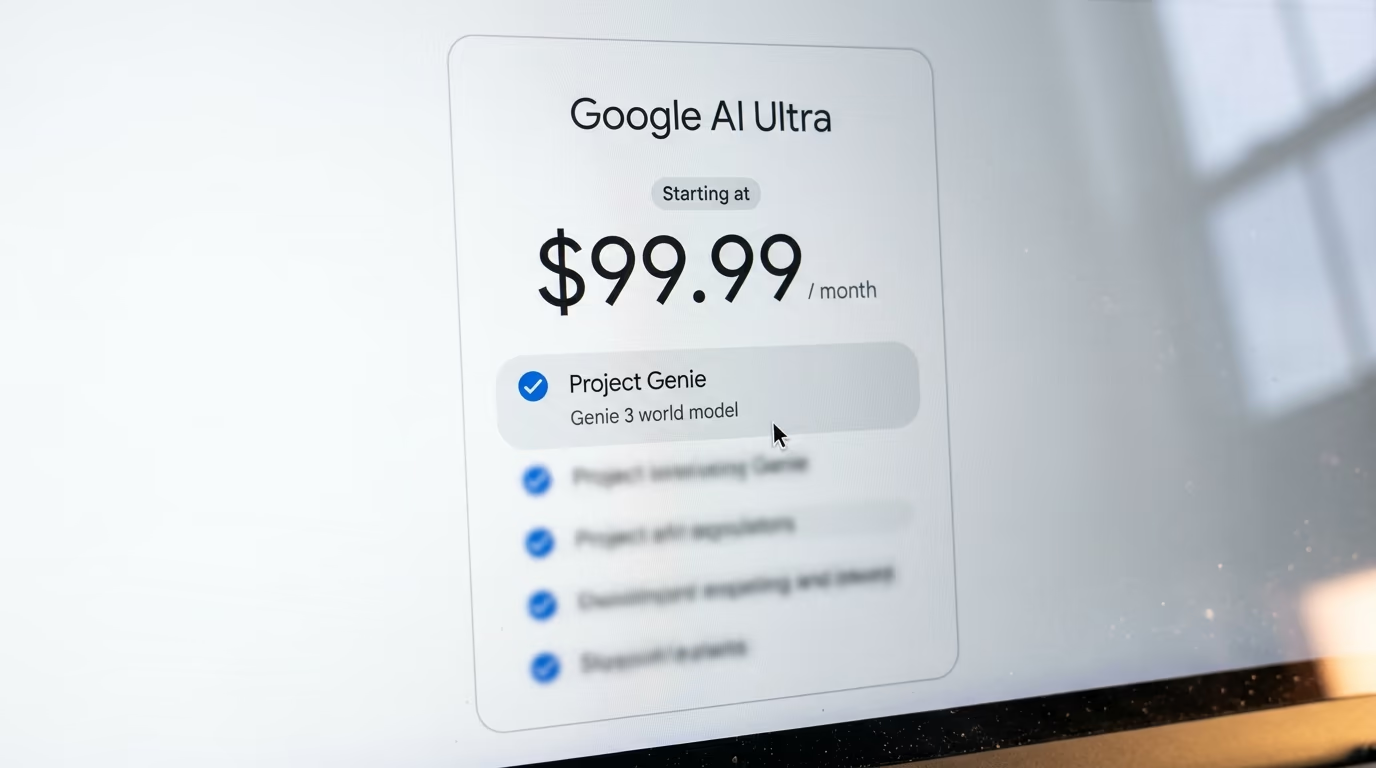
Google DeepMind announced Genie 4 on 27 October 2026, and unless Google invited you as a tester, you can't use it today at any price. The door Google names for everybody else is Project Genie, a Google Labs experiment reserved for Google AI Ultra subscribers, a plan that starts at $99.99 a month in the United States, and that experiment still runs the older Genie 3 and hands you 60 seconds inside each world you make.
A world model is software that invents a place and keeps inventing it while you move through it. You type a description, it draws the first frame, and then it draws whatever your keyboard asks for next, one frame at a time, with nothing built in advance. Genie 4 adds sound to that, so wind, footsteps and voices now arrive with the picture.
Every story published that afternoon carried the same capability list and the same claim, that a Genie 4 world now holds together for about 2 minutes, double what Genie 3 managed. I read Google's own pages instead, the Genie 4 announcement, the Genie 4 model page, the Genie 3 announcement from last year and the Project Genie help page written for subscribers. That claim appears on none of them, and the sentence Google uses to describe how long a world lasts has barely changed between the 2 models.
What is Genie 4, and what does a world model actually do?
Genie 4 is Google DeepMind's newest world model, which means it generates a place you can walk around in rather than a clip you sit and watch. You give it a written description, it renders what you asked for, and then it keeps rendering as you press keys, inventing the next frame out of everything that came before. Nobody built the room you are standing in, and nobody wrote the rules of that room either.

That is the line between this and an AI video model. A video model takes your prompt and hands back a finished film you can't change once it exists, the way the fast video models we have written about before do. A world model answers your keyboard while it runs, so turning left produces a wall nobody drew until you turned.
Genie 4 is also the first of these from DeepMind that makes its own sound. Google says every world carries the ambient noise of its setting, from wind in the trees to waves crashing at the beach, and that characters inside it hold conversations that adapt while you play. The lab calls interactive dialogue the frontier it is chasing, and admits in the same document that real time audio accuracy remains an area of ongoing research.
Google frames the whole project as groundwork for something larger than entertainment. Understanding and simulating the world, the announcement says, is one of the things AGI has to be built on, and the practical version of that argument is robot training. A machine that can generate endless variations of a warehouse gives a robot somewhere to fail cheaply before it fails in your warehouse. DeepMind also names film previsualization, game prototyping, education and journalism as the places its invited testers have been pointing it.
Can you use Genie 4 today, and what does it cost?
No, not unless Google has picked you for its tester programme. Genie 4 has started rolling out as a research preview for trusted testers, and Google has published no price for it on any page, for consumers or for developers.
Google names 3 doors in its own announcement. The first is that tester programme, which is invitation only and silent about who is inside it. The second is Project Genie, the Labs experiment, where Google says Genie 4 is coming to Google AI Ultra subscribers. The third is early access through the Gemini API and Google AI Studio, which means selected developers. Everyone else gets a Google Form, and you can join the Genie 4 waitlist in about a minute.
Reading Google's own subscriptions page for the United States this morning, Google AI Ultra starts at the price quoted above, with a higher rung costing twice as much that buys more usage of everything. Google AI Pro and Google AI Plus, the cheaper plans, do not list Project Genie among their benefits at all. Ultra does, described on that page as creating and exploring interactive worlds with the Genie 3 world model, which is the quiet admission that Genie 4 has not landed there yet.
For developers the answer is shorter, because the Gemini API pricing page names no Genie model anywhere on it. There is no rate for a minute of simulation, no rate for a session, nothing to put in a spreadsheet. Ars Technica reached the same conclusion from the other side on the day, reporting that pricing is not yet available and that consumer access will arrive through Google's most expensive plans.
For anyone budgeting this week, Genie 4 costs nothing, because it can't be bought. What the Ultra plan buys you today is Genie 3 in a browser tab, plus a place in the queue for whatever Genie 4 turns into. If you are weighing up that subscription anyway, our comparison of Gemini 4 Argon against OpenAI's Astra covers the model that comes with the same plan.
What did Google publish about Genie 4, and what did it leave out?
Google's Genie 4 announcement contains no resolution, no frame rate, no duration, no price and no benchmark table. I searched the published text for every one of them. The only figures anywhere in the body belong to the example prompts Google printed to show off the demos, a dragon race through a mountain course and a scene styled after an old Hong Kong film.
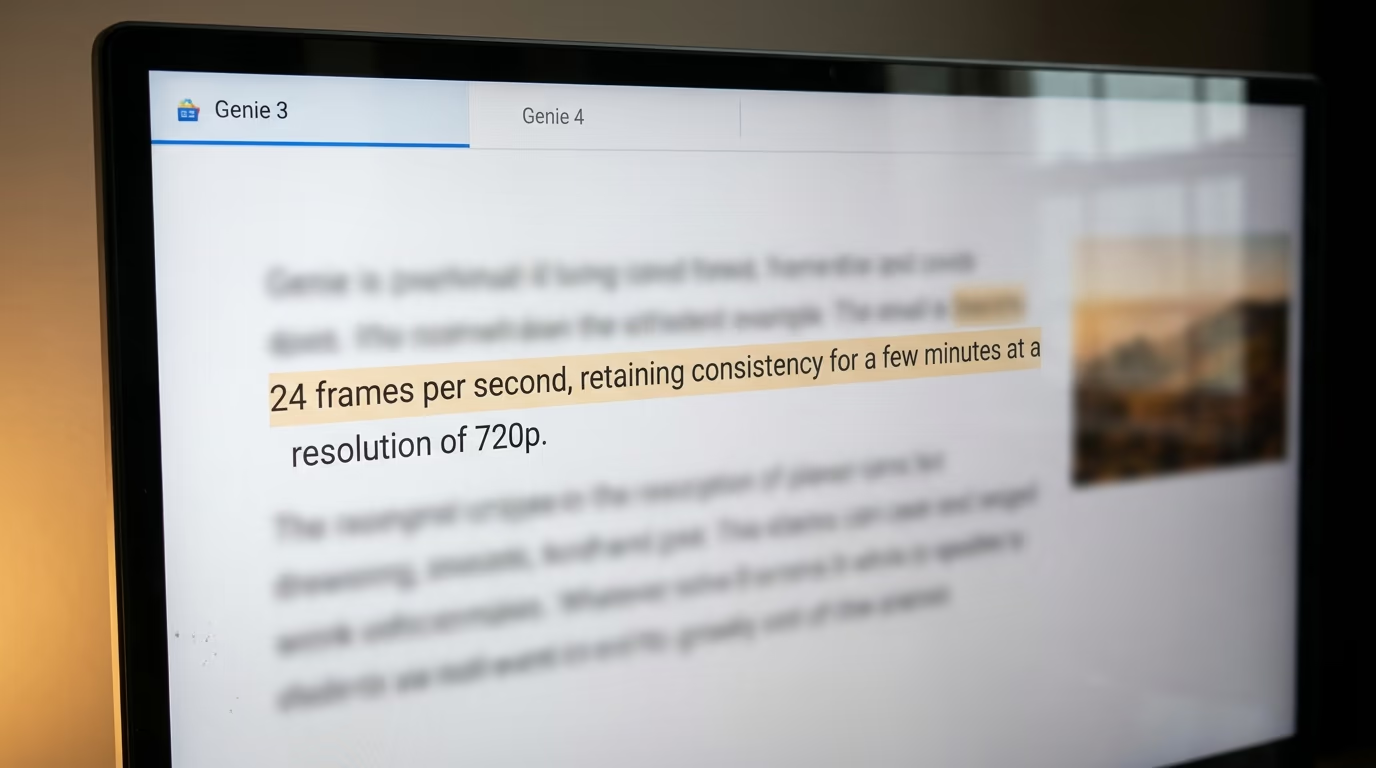
Compare that with the second sentence of the Genie 3 announcement, which told you exactly what you were getting. Genie 3 generates worlds you navigate in real time, at a frame rate and a resolution the post named outright, holding together for a few minutes. Translated into things you can picture, that is the smoothness of cinema film and the sharpness of a video call, held steady for roughly the length of a song.
| What Google published | Genie 3, announced 5 August 2025 | Genie 4, announced 27 October 2026 |
|---|---|---|
| Resolution | 720p | not published |
| Frame rate | 24 frames a second | not published |
| How long a world holds | a few minutes | a few minutes |
| Who can use it on launch day | a small cohort of academics and creators | trusted testers |
| Price | none published | none published |
| Benchmark table | none | none |
| Watermark on output | not named in the post | SynthID on all video and audio |
Every measurable thing Google published about Genie 3 has been left out of the Genie 4 material, while the prose claims around it have grown. A reader comparing the 2 generations on Google's own pages can't tell whether the picture got sharper, whether it runs smoother, or whether a world lasts longer, because only one of the 2 announcements committed to anything you could check.
This is not unusual for a research preview, and a lab owes nobody a specification sheet. It does change what the coverage is worth, because a story that repeats a capability list without a single verifiable figure in it can't be checked by the reader, and can't be checked next year either when somebody wants to know what the upgrade actually delivered.
Where does the 2 minute claim come from?
The 2 minute figure that travelled with every Genie 4 story comes from Google's press briefing, not from anything Google has published. TechCrunch reported that Genie 4 can maintain a consistent scene for up to 2 minutes, double Genie 3's limit. The Verge wrote that it creates experiences about 2 minutes long, up from one minute for the previous Genie 3 model. Neither figure appears on the announcement, on the model page, or on the help page for the product that will carry it.
What Google did publish about Genie 3 says something different again. That post describes consistency for a few minutes, says environments remain largely consistent for several minutes, and adds that the model's visual memory extends as far back as one minute ago. Visual memory and consistency are not the same measure, and the one minute baseline The Verge used as its before number is the memory figure rather than the duration.
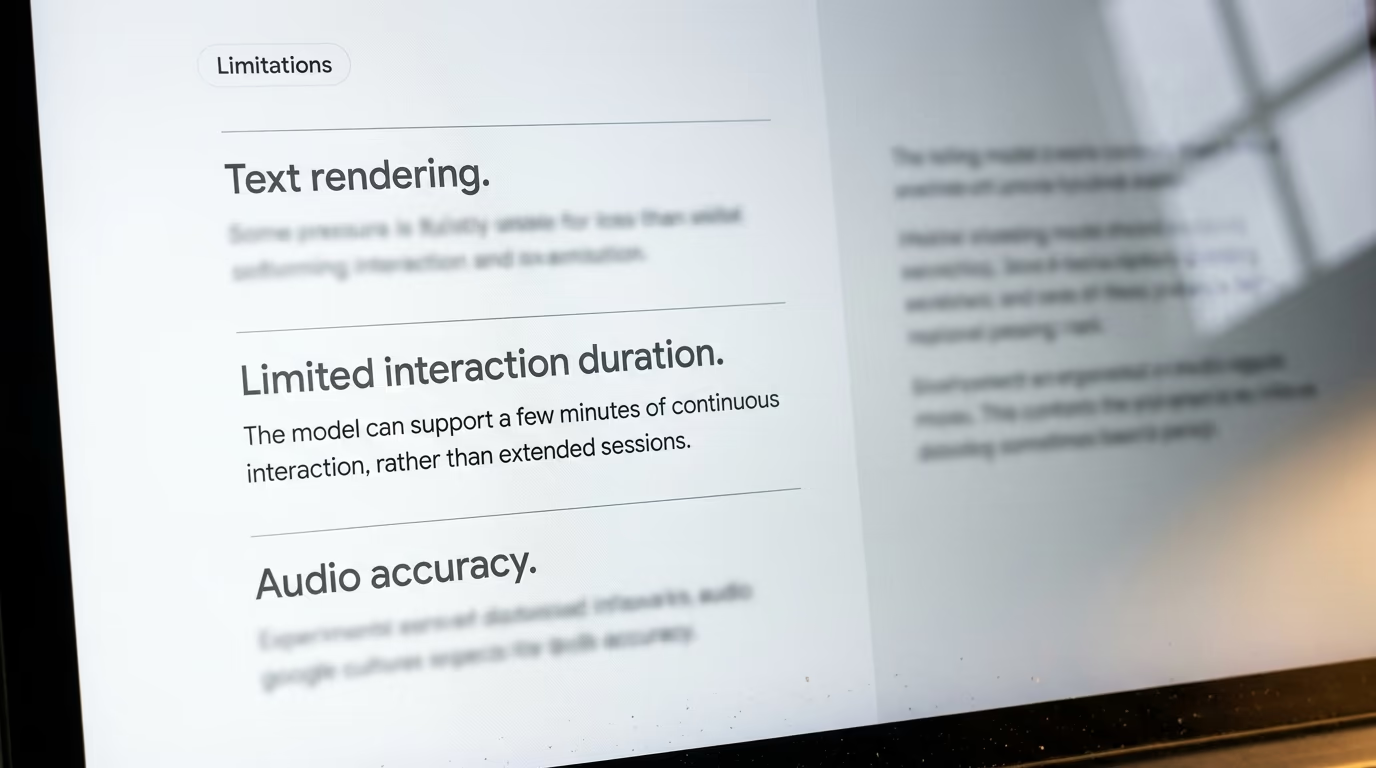
The clearest evidence sits in the limitations list that both model pages carry, where the line about how long you get has barely moved across the 2 releases.
Limited interaction duration. The model can currently support a few minutes of continuous interaction, rather than extended hours.
Limited interaction duration. The model can support a few minutes of continuous interaction, rather than extended sessions.
The first of those sentences comes from Genie 3 last August and the second from the Genie 4 page published this week. 4 of the 5 limitation headings on the Genie 4 page are headings Genie 3 shipped with, including the admission that text inside these worlds comes out legible only when you asked for that text yourself, and that neither model can represent real world places accurately.
None of this means the briefing was wrong. A doubling is entirely plausible, reporters were told it by the people who built the thing, and Google had no obligation to print it. It means the claim is unverified in the ordinary sense, that no document anybody outside Google can read supports it, and that the sentence Google chose to publish about duration on launch day still describes a few minutes of continuous interaction, the same words it used last year.
Duration decides what this thing is for. A world that holds for a few seconds is a demo, a world that holds for 2 minutes is a storyboard, and a world that holds for an hour is a training ground for robots, which is the use Google keeps naming. Until somebody outside the lab runs a clock against it, that question stays open.
What can you actually do tonight in Project Genie?
If you pay for Google AI Ultra, you can open Project Genie tonight at labs.google/fx/projectgenie and build a world in a browser tab, and Google's own help page says you get 30 seconds to describe it and 60 seconds to explore it. You have to be an adult by Google's rule, and signed in with a personal Google account rather than a work one.
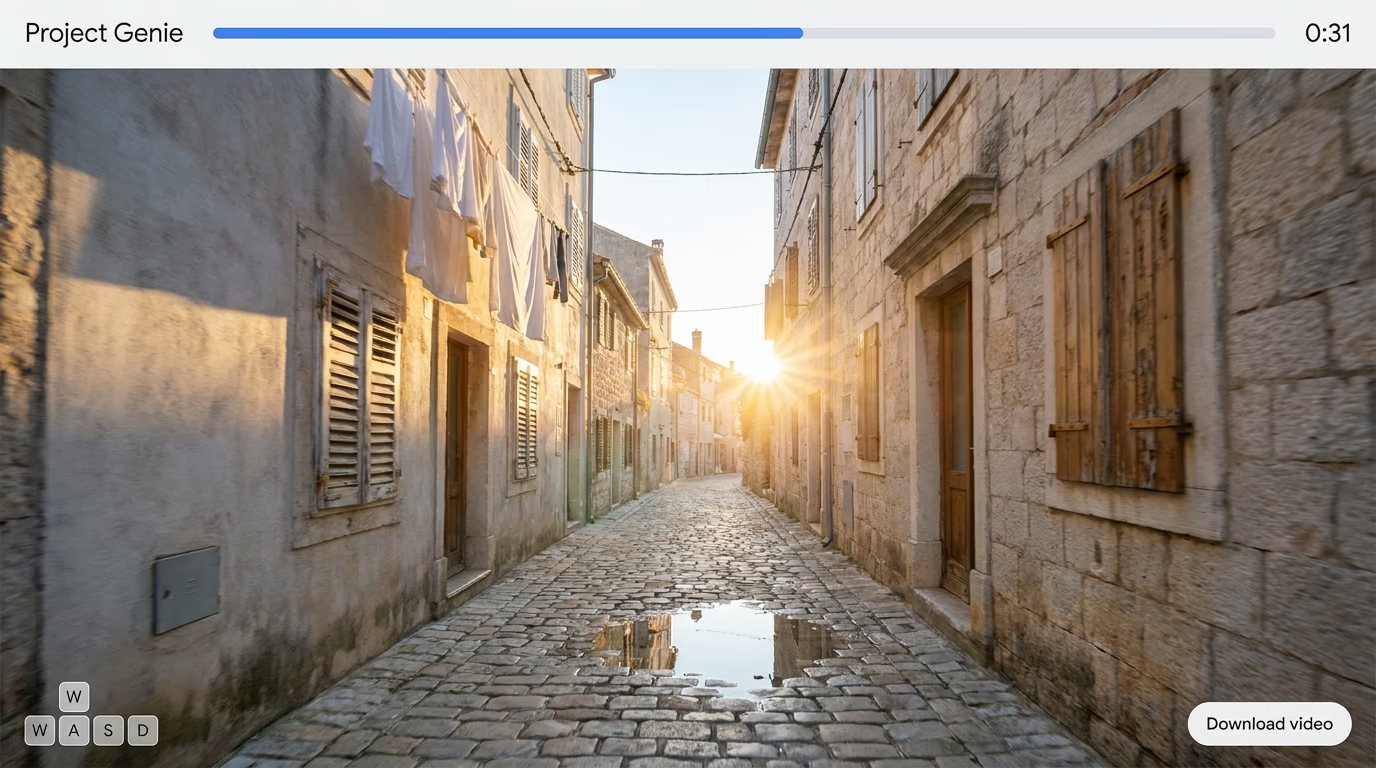
You may have to wait in a queue when demand is high, and the page tells you when your turn arrives. You then get that short window to write the world, either by describing an environment and a character in 2 text fields, by picking a spot in Maps Street View and choosing a style, or by clicking Roll the dice and taking whatever you are given. You choose first or third person, you generate, and the world starts on its own.
Inside, the controls are the ones computer games have used for decades. W, A, S and D move you, Spacebar jumps or lifts you, and the arrow keys turn the camera. A progress bar across the top of the screen counts your minute down. When the timer ends you can download a video of what you did, regenerate the same prompt for a different result, or start again from nothing, and Google notes that during this early access the worlds do not consume your AI credits.
Google also publishes its own list of what goes wrong in there, which is more useful than any review, and worth reading before you spend an evening on it.
- Your character sometimes runs backwards, and Spacebar resets it
- Sometimes you lose control of the character altogether
- Streaming quality drops when the servers are busy
- The picture tends to darken the longer you stay inside
The help page explains that last one by naming the model, saying that because Genie 3 is an early research model, the worlds and characters it generates can't always appear true to life or follow your prompt closely. That sentence is the whole gap between the announcement everybody read this week and the product anybody can actually open.
Why is there a Gemini model inside a world model?
Genie 4 does not steer itself, Gemini does. Google says Gemini Omni anchors the simulations in real world appearance and behaviour, while Gemini 3.8 Flash sits in the loop as a guiding agent, watching frames as they are generated, breaking your goal into a sequence of steps and checking that each step actually happened. When you type a change while the world is running, that Gemini model rewrites your request to fit the scene around it.
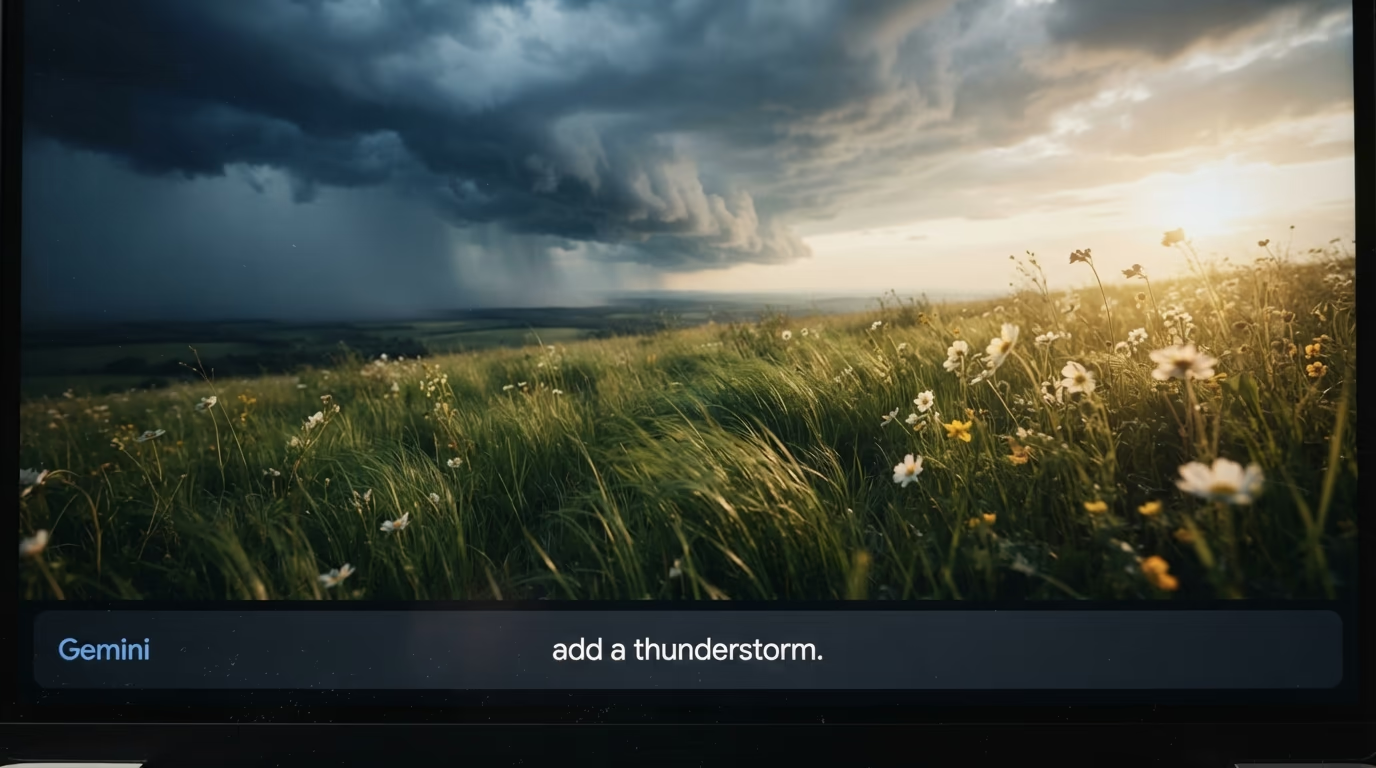
This is a genuine change in how such systems are built, and it is why steering a world with a sentence works at all. The older approach generated pixels and hoped they stayed coherent. This one puts a language model in the director's chair, and DeepMind says the direction of travel is hybrid world models, where code and language handle structure and plot while Genie renders how the result looks and sounds.
The clearest demonstration is a robotics one. Google paired Gemini 4 Argon with Genie 4 to simulate Apptronik's Apollo humanoid playing a game of checkers, with Argon breaking the task into steps and feeding them to Genie as text captions while the simulation ran. The robot is real, the game of checkers is not, and the point is that a machine now has somewhere to practise that nobody had to build first. If you want the wider map of which models agents are actually built on, we ranked the AI models agents run on by what they cost earlier this month.
There is a cost consequence nobody has priced yet. Running this means running 2 models at once, a world generator producing frames continuously and a reasoning model reviewing them, for as long as you stay inside. That is a different shape of bill from a chatbot answering a question, and it may be why the pricing page is still empty. For how other vendors meter open ended work like this, we went through which providers actually stop the bill this month.
What do we not know yet about Genie 4?
Nobody outside Google has yet measured Genie 4 itself, and the open questions are specific rather than vague. No independent test exists, no resolution or frame rate has been published, and every comparison with Genie 3 in circulation today rests on a briefing rather than on a document.

The price is unknown in both directions, with no consumer price beyond a subscription Genie 4 has not reached, and no developer rate at all, so what a minute of simulated world will cost is nobody's guess yet. The date is unknown as well. Google says coming soon, TechCrunch says the coming weeks, and a Google spokesperson told TechCrunch that it is still early days for Genie 4 and that it is not yet clear what the end to end product experience will be, which is an unusually honest thing to say about your own launch.
3 smaller questions matter most if you are the one paying. We do not know whether the ceiling on a session in Project Genie moves when Genie 4 arrives, or whether that ceiling is a property of the model, the servers or the business. We do not know whether the cheaper Google AI Pro plan ever gets access, though Ars Technica reported that Google may expand beyond Ultra eventually. We do not know what the waitlist is selecting for, because the form is the only published route in and Google has not said how many people it will take.
One thing we do know is what every output carries. Google says all video and audio generated by Genie 4 includes SynthID, its invisible watermark for identifying AI generated content, which is the safeguard that matters most for a model whose output is designed to pass as documentary footage of a place that has never existed.
What to watch before Genie 4 reaches your account
3 public pages will tell you the moment this becomes real. The Project Genie help page names its model in writing, so the day that sentence stops saying Genie 3 is the day consumers actually have the new model, and the same page is where a change to the timer would surface first. The Gemini API pricing page is where a developer rate has to appear before anybody can build a product on this. The Google subscriptions page is where a new plan, or a new benefit line on an old one, would land.
Until one of those changes, the reasonable position is patience. Joining the waitlist costs a minute and commits you to nothing. Paying for Ultra today buys Genie 3 in one minute doses, which is a fine toy and an expensive one, and the upgrade you would be paying in advance for has no date attached to it.
The demo reel is the least interesting thing here. Google has built something it can't yet describe in numbers, can't yet price, and won't yet let anybody outside test, while saying out loud that it is a step toward machines that understand the world. The first honest measurement of Genie 4 will come from whoever gets in and runs a clock against it.
Questions people ask
What is Genie 4?
Genie 4 is a world model announced by Google DeepMind in October 2026. It generates an interactive place rather than a video clip, drawing each frame as you move through it with a keyboard, and it is the first DeepMind world model that generates sound and spoken dialogue along with the picture.
Can I use Genie 4 right now?
That depends on whether Google invited you. Genie 4 is a research preview limited to trusted testers, and Google says it is coming to Google AI Ultra subscribers inside Project Genie and to selected developers through the Gemini API and Google AI Studio, with no date announced. Everybody else can join a waitlist form.
How much does Genie 4 cost?
Google has published no price for Genie 4 at all, for consumers or for developers, and the Gemini API pricing page lists no Genie model at all. The subscription that will carry it, Google AI Ultra, starts at $99.99 a month in the United States, and what that plan gives you today is Genie 3 rather than the newer model.
What is Project Genie, and which model does it run?
Project Genie is a Google Labs experiment where you type a description and then walk around the world it generates in your browser. Google's own plan page and help page both say it runs the Genie 3 world model, and it is available to Google AI Ultra subscribers who are adults, in the countries where that plan is sold.
How long does a Genie world last?
In Project Genie today you get 60 seconds inside a world, counted down by a progress bar, after which you can download a video or generate the world again. Google's own model pages say the model itself supports a few minutes of continuous interaction, the same wording used on both model pages.
Is Genie 4 a video game engine?
No, and Google does not describe it as one. A game engine runs rules and assets that somebody built in advance, while Genie 4 invents the scene frame by frame as you move, with no level, no assets and no code underneath. Google positions it as training ground for robots and agents, and as a drafting tool for film and game ideas.