AISeptember 4, 202611 min read
VDN H3 makes AI video faster than it plays, if you can use it
Researchers at UC Berkeley and the company Impossible published free weights that render a 14.4 second clip in 11.23 seconds. The license excludes the EU, the UK, South Korea and the US.
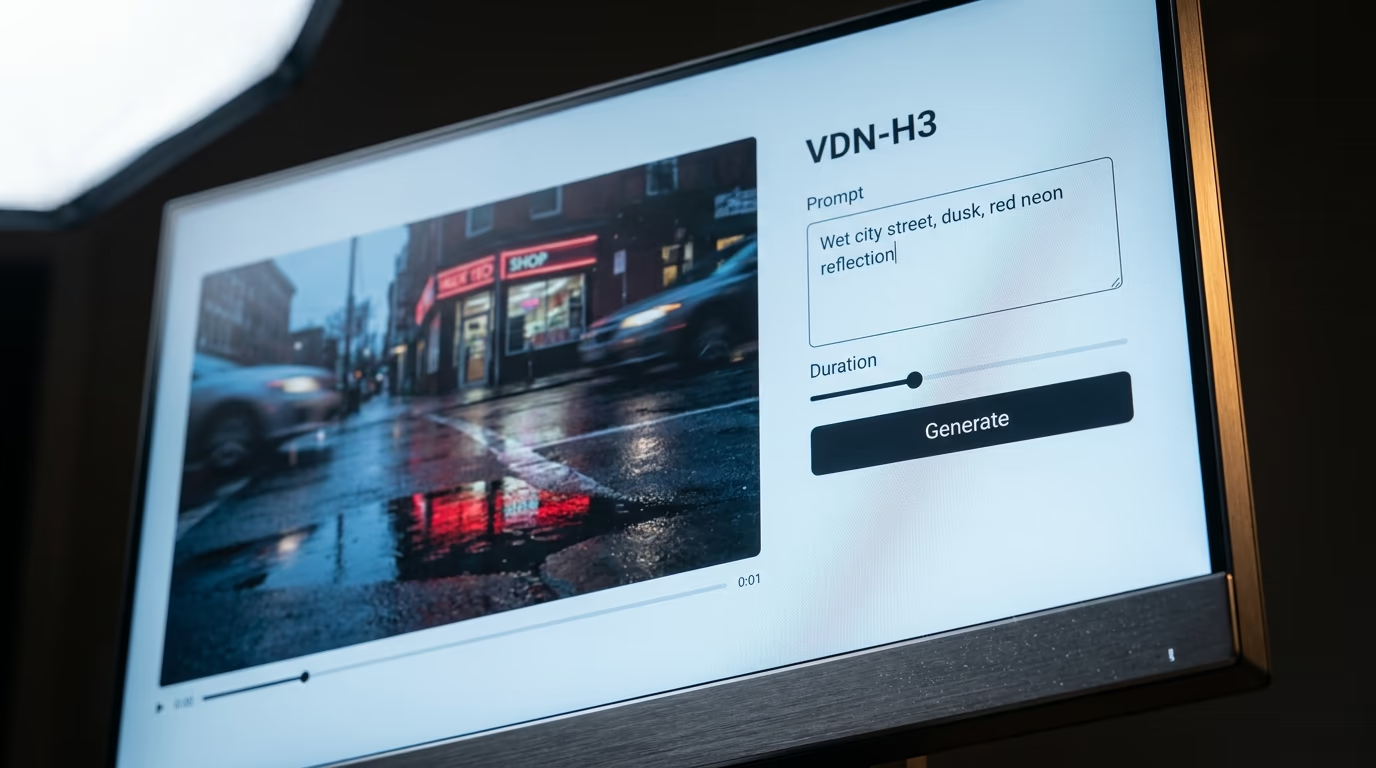
VDN H3 is a free video model, published on 2 September 2026, that its authors say renders a 14.4 second clip in 11.23 seconds when the work is spread across 8 of Nvidia's B200 chips. That is less time than the clip takes to watch, which is what the team means when it says the model generates video faster than it plays.
The weights come from a group calling itself OpenVDN, researchers at UC Berkeley, the company Impossible and UT Austin. They didn't train a new video generator. They took MiniMax H3, the open weights video model the Chinese lab MiniMax released at the end of July, and rebuilt the slowest step inside it so the same model does the same job with far less arithmetic. Their method has a name, Video DeltaNet, and the release carries the training code that produced it as well as the weights.
Crossing the playback line changes what generated video is for. Above it, a clip is something you order and come back to later, closer to a render queue than to a conversation. Below it, a program can hand you moving pictures while you watch them, which is the condition for an animated answer inside a chat, or for a scene a game draws while you play it.
The number travelling around this release hides 2 things worth knowing. It compares a single chip running the old model against a full server of chips running the new one, and OpenVDN prints the fair comparison right beside it. And the license these weights carry grants its rights everywhere except the European Union, the United Kingdom, South Korea and the United States, which is where most of the people reading about it live.
What is VDN H3, and who published it?
VDN H3 is a free set of weights, published on Hugging Face on 2 September, that makes the MiniMax H3 video model run several times faster on the same hardware. OpenVDN released the inference code and the training code beside the files, so anyone with the right machine can check the claim instead of taking it on trust.
The slow step inside a video model is attention, and attention works by comparing every scrap of the clip against every other scrap, the pixels of each frame against the pixels of every other frame, along with the prompt and the sound. Make the clip longer and the work does not grow in step with it, it grows much faster than that, which is why a long clip costs so much more than a short one and why a model this size has not been something you could stream.
VDN swaps most of those comparisons for a running summary that carries what happened in earlier frames forward, and keeps the real comparison inside a narrow window around each group of frames and around the prompt. The authors call the result hybrid attention. The trade is a cheap approximation nearly everywhere, with the exact comparison kept only where the picture would fall apart without it.
The download is about 82 GB, and nearly all of that is MiniMax H3 itself, untouched. What VDN adds is small, one extra branch and a pair of adapters that fold into the model as it loads, so the original weights are never rewritten on disk. The authors' own title calls Video DeltaNet a way to speed up video models in general, and this release is the method applied to one of them.
A second speedup rides along, and it has nothing to do with attention. A video model of this kind starts from noise and cleans it up in passes, and MiniMax H3 as released takes 50 of them. VDN ships a version distilled down to 8 passes, so a good share of the headline multiplier comes from doing less work rather than from doing the same work faster. Both are real, and they are worth separating, because only one of them is the research contribution.
Does VDN H3 really generate video faster than it plays?
On the hardware OpenVDN used, a full server of Nvidia B200 chips, its own measurement says yes. The figure being quoted everywhere is 74.5 times faster than MiniMax H3, and the same project page prints the honest comparison next to it, 10.7 times, which is what the speedup becomes when the old model and the new one get the same machine.

The gap between those numbers isn't a trick and OpenVDN isn't hiding it. The larger figure puts the original model on 1 chip and the new one on a full server, so it stacks 3 separate wins into a single multiplier, cheaper attention, fewer passes, and the job split across chips. Splitting work across chips is ordinary engineering that anyone can apply to any model, which is why the smaller figure is the one to carry around.
Their own timings tell the story better than any multiplier does. Every row below comes from the team's table for a clip of the same length, measured with their optimized code on Nvidia hardware.
| What is running | Time to make a 14.4 second clip |
|---|---|
| MiniMax H3 as released, one B200 chip | about 14 minutes |
| VDN H3, one B200 chip, same number of passes | about 5 minutes |
| VDN H3, one B200 chip, distilled to 8 passes | 51 seconds |
| VDN H3, a server of 8 B200 chips, distilled to 8 passes | 11.23 seconds |
One chip and the new model already turn a quarter of an hour into under a minute, which is the result most people would actually buy. The last row buys the final stretch to faster than playback, and it costs a full server of them to get there. The team also leaves model loading, warm up, decoding and video encoding out of these numbers, which is normal for a speed comparison and worth remembering when you plan anything real.
The quality claim deserves the same care. OpenVDN says the output is visually nearly indistinguishable from the original model's, and no outside score, no human preference test and no independent comparison backs that up yet. Their sample clips are convincing, and sample clips are always chosen by the people doing the releasing. If you want to know how much the approximation costs, right now the only honest answer is that nobody outside the team has measured it.
Can you try VDN H3 tonight, and what does it need?
You can try VDN H3 free in a browser tonight, and you can't run these weights on a home computer. A demo on Hugging Face, published by the Hugging Apps team rather than by the authors, loads the real model, takes a typed prompt and returns a short clip with a soundtrack the model writes at the same time. It sits at the VDN H3 Space on Hugging Face and it was running while this was written.
Expect minutes rather than seconds in that browser. The demo's own notes say the fast code paths are switched off, because Hugging Face's free shared card can't host them, so what you get is the same arithmetic as the released model with none of its speed. Those notes give a couple of minutes for a very short clip, most of it spent moving the model onto the card before a single frame is drawn, and there is a queue in front of you at busy hours.
The prompt is stranger than you might expect, and worth knowing before you type. MiniMax H3 reads shot by shot scripts rather than a single line of description, with headers for each shot, time cues, spoken lines marked as speech, and a closing block describing the ambience and the music. The examples in the demo are the repository's own. Treating it like a search box gives you a worse clip than treating it like a page of a screenplay.
Running the released files yourself is another matter entirely. The download is larger than the free space on most laptops, and the timings above come from chips that cost more than a car and live in rented data centres rather than under desks. Renting one by the hour is the realistic route for a curious person, and our look at what an hour of rented GPU time really costs covers how that market prices itself, while what a GPU does that a processor cannot explains why video generation needs one at all.
The base model is friendlier than its accelerated cousin. ComfyUI, the free app most people use to run image and video models at home, added support for MiniMax H3 the day the weights appeared, and its launch note says the model can run on a mid range gaming card, which means an ordinary machine at home and a great deal of patience. Salvatore Sanfilippo, the programmer behind Redis, wrote a separate engine that runs H3 natively on Apple Silicon Macs and published it under the MIT license.
Other people are already dragging VDN itself in the same direction. Within 2 days of the release, 2 separate repackagings for ComfyUI appeared on Hugging Face, one of them a smaller build in the spirit of the shrunken model files people download to fit their own machine. Neither comes from OpenVDN, neither has a published measurement behind it, and both inherit exactly the same license as the original.
Why are so many teams speeding up the same video model?
MiniMax H3 became the model everyone optimizes because MiniMax gave the weights away, and because it makes sound and picture together instead of leaving the audio to a second model. A lab that publishes weights gets an army of outside engineers making its model cheaper for free, and every speedup they publish makes that model harder to replace with somebody else's.

The sequence since the summer is short and fast. MiniMax released H3 at the end of July and put the weights up days later. ComfyUI shipped support the same week. In August, Sanfilippo's engine turned a data centre model into something a laptop could drive, and Nvidia's own Sana team published an acceleration report for H3, with speed claims of its own on a single newer chip and nothing to download beside it. VDN arrived in September with the weights, the inference stack and the training recipe all in the open.
Read the release notes of those projects side by side and a pattern shows up. The lab that trained the model is no longer the one deciding how fast it runs or what it costs to run. A research group, an independent programmer and a chip company all improved the same weights within 5 weeks, each for reasons of their own, and none of them asked MiniMax for permission to do it.
The speed of an open model is not fixed on the day it ships. The model you dismissed in July because one clip took a quarter of an hour is the model that now takes under a minute on the same chip, without a new version, without a bigger training run and without anyone paying for it. That moves the question from which lab has the best model to which model other people choose to work on.
It also explains why a lab would hand over something this expensive to train. Weights that everybody optimizes become the default choice for the next product and the next startup, and defaults are worth more than a licensing fee. What open weights actually buy you has never been about charity, and this release is a clean example of the trade working exactly as intended.
What does the MiniMax H3 license actually say?
The MiniMax H3 Community License Agreement grants its rights only inside what it calls the Applicable Territory, which it defines as worldwide minus the European Union, the United Kingdom, the Republic of Korea and the United States of America. VDN H3 is a derivative of MiniMax H3 and ships under that same agreement, so the restriction travels with it to every copy.

The definitions section of the agreement is blunt about it.
"Excluded Territories" means the European Union, the United Kingdom, the Republic of Korea and the United States of America.
A later clause says that using, reproducing, modifying, distributing or displaying the model or its outputs outside the Applicable Territory is not authorized by the agreement, and the text invites anyone in an excluded place to contact MiniMax about getting a license. There are redistribution conditions too, and an acceptable use policy, so passing the files on to somebody else brings its own set of rules. None of this is legal advice, and the agreement is short enough to read yourself before you download anything.
There is a split inside the release worth noticing. The code OpenVDN published on GitHub carries the Apache license, which is about as permissive as software gets, while the weights that code loads carry the territorial agreement. You can read the pipeline and reuse the ideas anywhere on earth. Whether you may run the released weights where you happen to live is a different question answered by a different document, and plenty of people will only read the first one.
This is the second time in a week that the most interesting model in its category came with a legal catch rather than a technical one. We wrote about Google closing the TimesFM 3 weights on Wednesday, where the restriction is on selling anything built with it. Here the restriction is a map. For a business in Paris, London, Seoul or San Francisco, both endings are the same, an excellent model you can admire and can't ship.
What don't we know about VDN H3 yet?
Nobody outside OpenVDN has measured VDN H3 on speed or on quality, at the time of writing. Every figure in circulation, including the ones in this article, comes from the team's own page, its own code and its own hardware, which is normal for a release this fresh and worth stating before anyone repeats those numbers as measured fact.
The published timings also stop at data centre hardware. There is a single chip row in their table and it is still a chip most readers will only ever rent, so what this model does on the cards ordinary people own is genuinely unknown. The community builds that appeared this week may answer that within days, and not one of them has published a measurement either.
The quality question is open in the same way. Nearly indistinguishable is the authors' description of their own output, and a cheap approximation in video tends to show up late and in specific places, in the motion of a hand, or in a face that drifts between frames. A careful comparison by someone with no stake in the result would settle it in an afternoon, and nobody has published one.
The license is the last open question and it isn't a technical one. MiniMax has said nothing publicly about the excluded territories since this release, and its own agreement invites people there to write and ask. Whether a company in Berlin or Seoul can get that permission, and on what terms, decides whether this becomes a tool people build products on or a demo they admire from a distance.
What happens next is fairly predictable, and it happens quickly. Somebody will distil the model further, somebody will fit it onto a smaller card, an independent test will finally put numbers on the quality, and the next open video model will land on top of all of it. If you want one thing to watch, watch whether a real product ships on these weights inside the territory that is allowed to use them, because that is the test this release has not passed yet.
Questions people ask
What is VDN H3?
VDN H3 is a free set of video generation weights published on 2 September 2026 by OpenVDN, a group of researchers from UC Berkeley, the company Impossible and UT Austin. It rebuilds the slowest step inside the MiniMax H3 video model so the same model renders a clip several times faster on the same hardware, and it ships with the inference code and the training code.
Is VDN H3 free to use?
The files are free to download and the code is published under the Apache license, but the weights carry the MiniMax H3 Community License Agreement. That agreement grants its rights only outside the European Union, the United Kingdom, the Republic of Korea and the United States of America, so read it before you build anything commercial on top of it.
Can I run VDN H3 on my own computer?
Not the released version, which expects Nvidia data centre chips and a download bigger than the free space on most laptops. You can try the model free in a browser through the demo Space on Hugging Face, and community repackagings for ComfyUI appeared within days of the release, none of them tested by anyone independent so far.
Does VDN H3 really make video faster than it plays?
On its authors' own machine, yes, and only there. Their measurement puts a 14.4 second clip at 11.23 seconds when the work is spread across a full server of Nvidia B200 chips. On a single chip the same clip takes under a minute, which is fast and still slower than watching the clip.
Which countries are excluded from the MiniMax H3 license?
The agreement names the European Union, the United Kingdom, the Republic of Korea and the United States of America as Excluded Territories, and grants its rights everywhere else. It states that use outside the Applicable Territory is not authorized, and invites people in those places to contact MiniMax about obtaining a license.
Does VDN H3 generate sound as well as pictures?
Yes. MiniMax H3 writes the picture and its soundtrack together rather than adding audio afterwards, and VDN H3 keeps that behaviour, so a clip arrives with its own sound effects and speech. The browser demo returns the picture and the sound in one file.