AIOctober 21, 202612 min read
Voxtral 3 costs more than Voxtral 2, and ships no weights
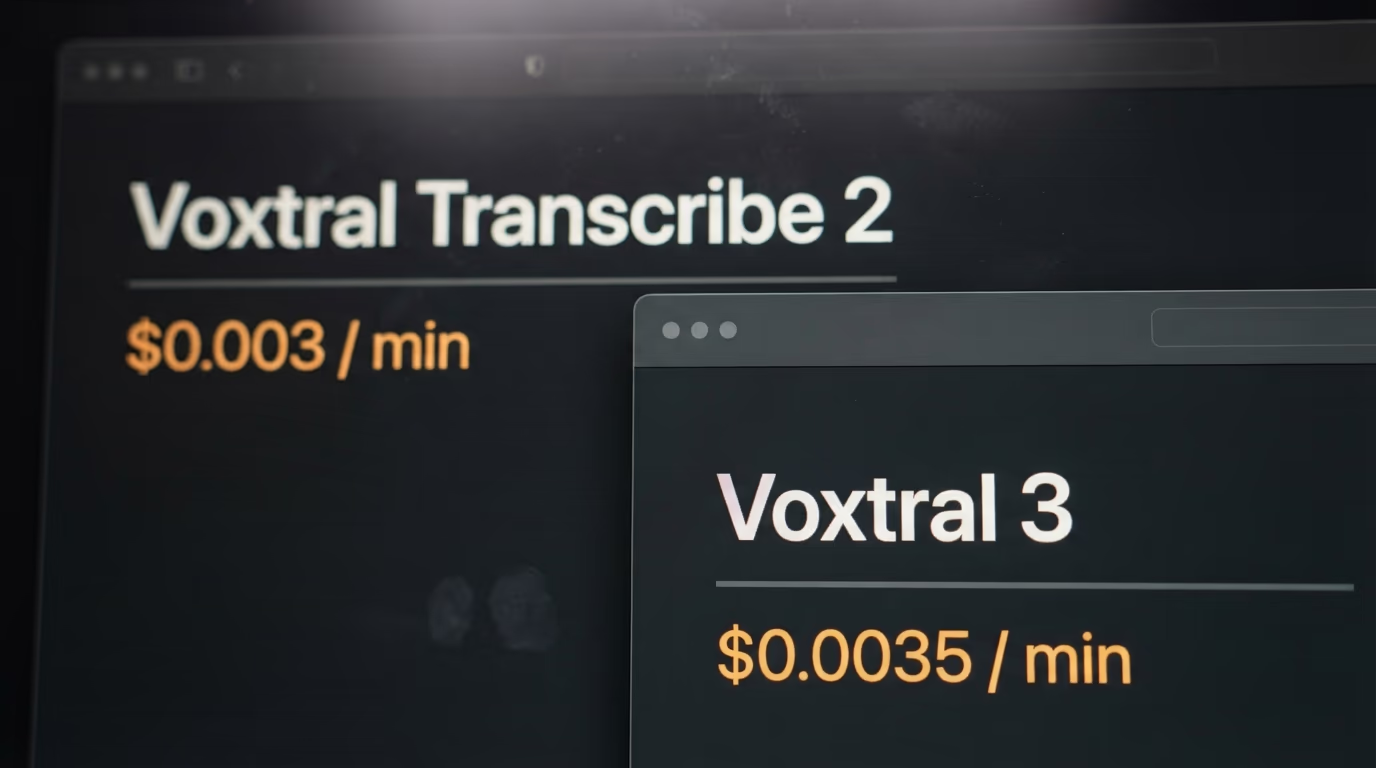
Mistral released Voxtral 3 on 20 October. Transcription starts at $0.0035 a minute, up from $0.003 in February, and no Voxtral 3 weights have appeared on Hugging Face.
Mistral released Voxtral 3 on 20 October 2026, a family of speech models that turn recordings into text and text back into speech, and the cheapest transcription in it costs $0.0035 a minute, which comes to about 21 cents for an hour of recorded audio. That is more than Mistral charged for the same job in February, and this release arrived with nothing to download.
Every write up of the launch repeats the announcement, that the models handle dozens of languages and that Mistral's own charts put them ahead of Whisper. Both of those are true and both come from the vendor. What nobody did was open the February announcement next to this one, or check whether the weights Mistral usually ships had turned up on Hugging Face. We did both this morning, and the answers change what you should reach for tonight.
What is Voxtral 3, and what did Mistral release?
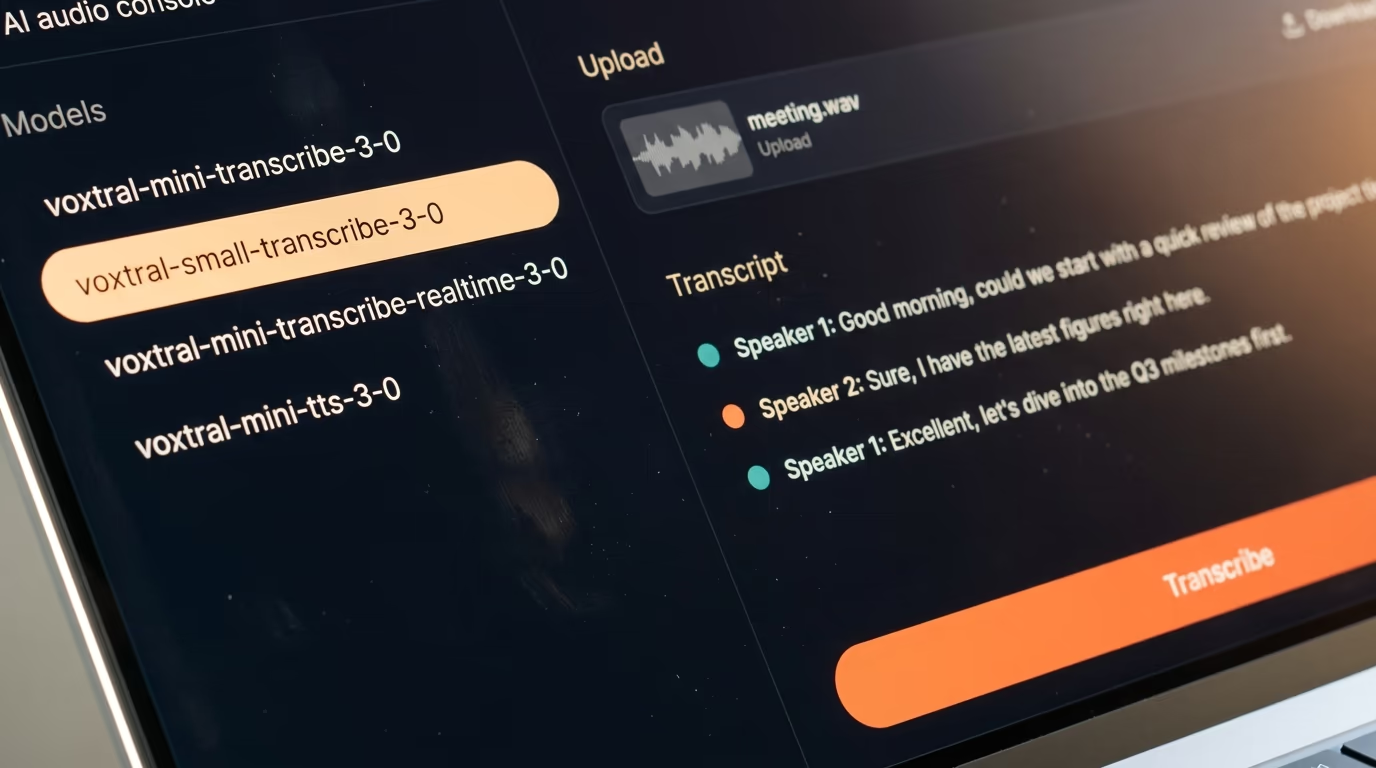
Voxtral 3 is Mistral's new family of speech models, and it holds 3 ways to turn speech into text plus one way to turn text into speech. The transcription side has a cheap model called Voxtral Mini Transcribe 3 and a more accurate one called Voxtral Small Transcribe 3 beside it, plus a live one called Voxtral Mini Transcribe Realtime 3 that writes captions while somebody is still talking.
The speech side is a single model called Voxtral Speech 3 and it reads text out loud in a voice you pick or a voice you clone from your own recordings. Mistral prices that one by the character rather than by the minute, which makes it awkward to compare against the transcription models until you know how much your software actually says out loud.
Wrapped around all of them is something Mistral calls the Voice Agent SDK, a kit that joins the listening and the speaking into one stream with a model thinking in between. The company says the result answers and places calls over SIP, which is the plumbing behind ordinary phone lines, and runs in a browser over WebRTC, which is how video calls work on the web. Mistral says a full turn, hearing you and answering you, finishes in under a second.
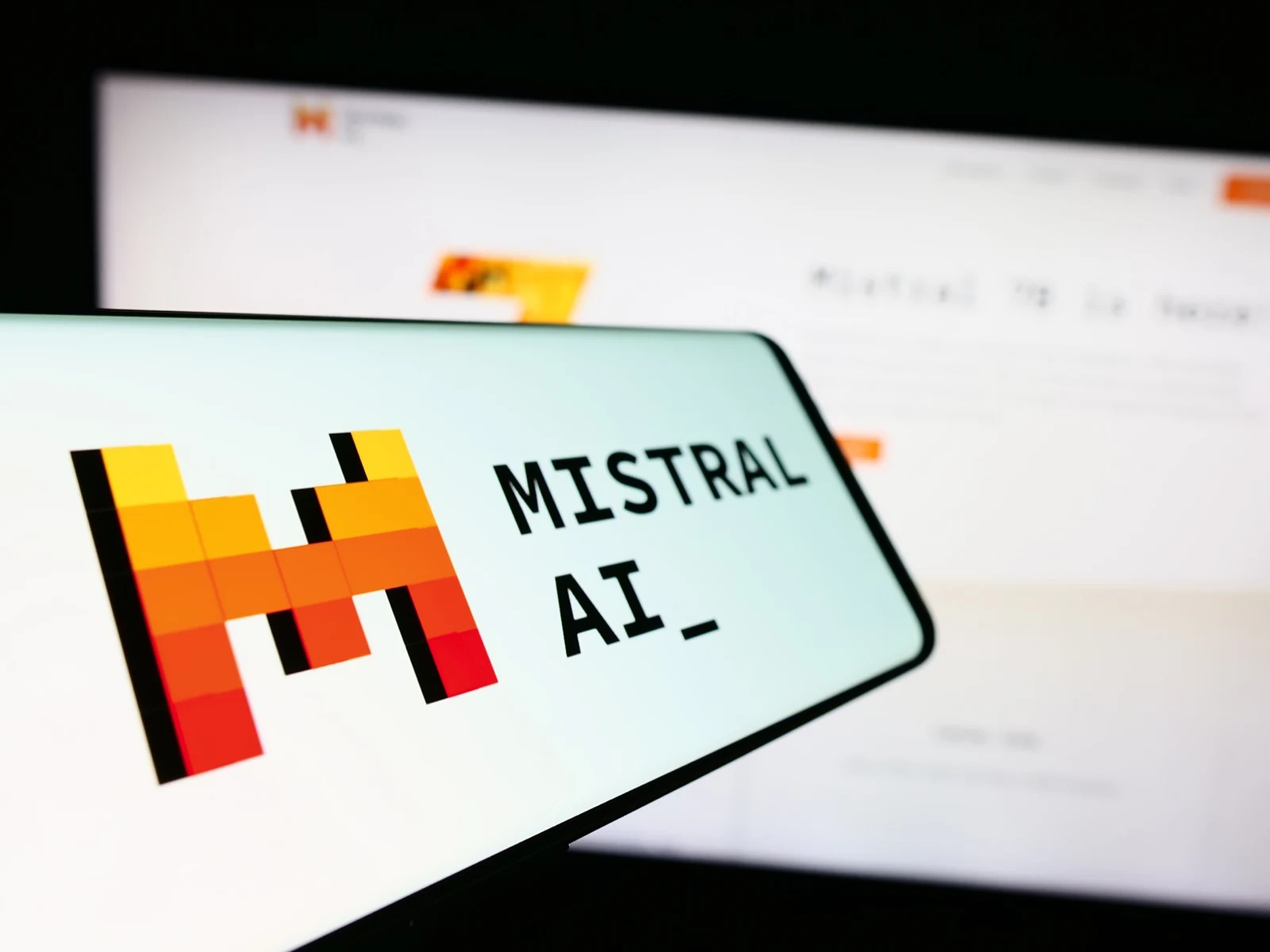
The route in is a Mistral account. The models run on Mistral's own API through European, US and global endpoints, and the console has playgrounds where you drop an audio file in and watch the transcript appear before writing any code. Running the whole stack inside your own building is offered as an option, and the announcement sends you to the sales team to arrange it rather than to a download page.
Where the audio gets processed is the argument Mistral leads with for business buyers. The company writes that running Voxtral 3 on its European endpoints or inside your own infrastructure gives an organisation control over where audio is handled and whether conversations are kept at all. For a French bank recording customer calls, or a German clinic recording consultations, that sentence is the reason to keep reading the page.
What does an hour of audio cost on Voxtral 3?
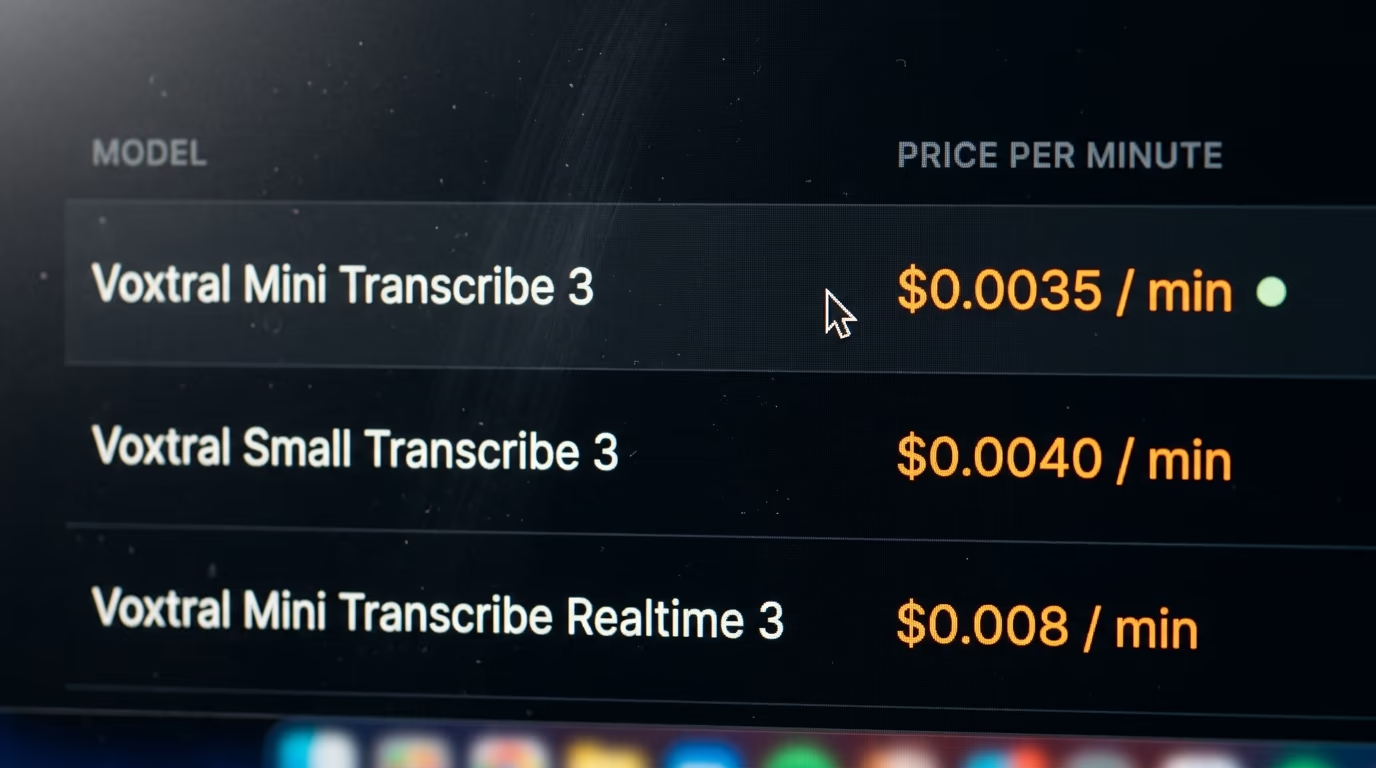
An hour of recorded audio costs about 21 cents on Voxtral Mini Transcribe 3 running in batch, the cheapest model Mistral published, which puts the family in the middle of the transcription market rather than at the bottom of it. Mistral prints its rates by the minute, so the hourly figures below are its own numbers multiplied out, while the rivals that publish by the hour are quoted exactly as they print them.
| What you buy | Rate as the vendor prints it | 1 hour of audio |
|---|---|---|
| Voxtral Mini Transcribe 3 (Mistral) | $0.0035 a minute | $0.21 |
| Voxtral Small Transcribe 3 (Mistral) | $0.0040 a minute | $0.24 |
| Voxtral Mini Transcribe Realtime 3 (Mistral) | $0.008 a minute | $0.48 |
| gpt-4o-mini-transcribe (OpenAI) | $0.003 a minute | $0.18 |
| gpt-transcribe (OpenAI) | $0.0045 a minute | $0.27 |
| Whisper (OpenAI) | $0.006 a minute | $0.36 |
| Nova-3 recorded (Deepgram) | $0.0043 a minute, printed also as $0.26 an hour | $0.26 |
| Universal-2 (AssemblyAI) | $0.15 an hour | $0.15 |
| Universal-3.5 Pro (AssemblyAI) | $0.21 an hour | $0.21 |
| Scribe v2 (ElevenLabs) | $0.22 an hour | $0.22 |
| Gemini 3.5 Transcribe Live (Google) | about $0.009 a minute, Google's own blended estimate | about $0.54 |
| Voice agent with Mistral Small 4 (Mistral) | $0.04 a minute | $2.40 |
| Voice agent with any other model (Mistral) | $0.08 a minute | $4.80 |
OpenAI's smallest transcriber undercuts Mistral's cheapest one, AssemblyAI's older model is the lowest published rate in the group, and Deepgram's standard recorded rate sits above both of the cheap Voxtral models. Nobody covering the launch put those rates in one column, because the announcement compares accuracy and never price.
A trap hides in the streaming rows, and AssemblyAI is the only vendor in that table that spells it out. Its pricing page says streaming charges are based on the duration of the WebSocket session, the time the connection stays open, and not the duration of audio sent. If your agent holds a line open while a customer thinks about an answer, you pay for the thinking. Mistral's page doesn't say how it meters a live session, which is the first question to ask before wiring a phone line to it.
For a person rather than a company, every row in that table is small money. An hour long podcast episode costs less than a bus ticket on any of them, and the gap between the cheapest row and the dearest transcription row is a few cents. These rates start to matter at the volume where a support team records every call, and at that volume the metering rule above moves far more money than the headline rate does.
The speech side and the bundled agent sit in different units again. Voxtral Speech 3 is billed by the million characters, and a million characters is roughly a thick novel read out loud, so a small project will never notice it on a bill. The agent rows at the bottom of the table are the ones to watch, because they bundle the listening, the reasoning model and the voice into one rate per minute that doubles the moment you attach a model other than Mistral's own.
Why does Voxtral 3 cost more than Voxtral Transcribe 2?
Mistral hasn't said why, and the rise is printed on its own announcement pages. The February release priced batch transcription at $0.003 a minute, and Voxtral 3 prices the same job roughly a sixth higher. Its live model moved further, from $0.006 a minute in February to a third more today.
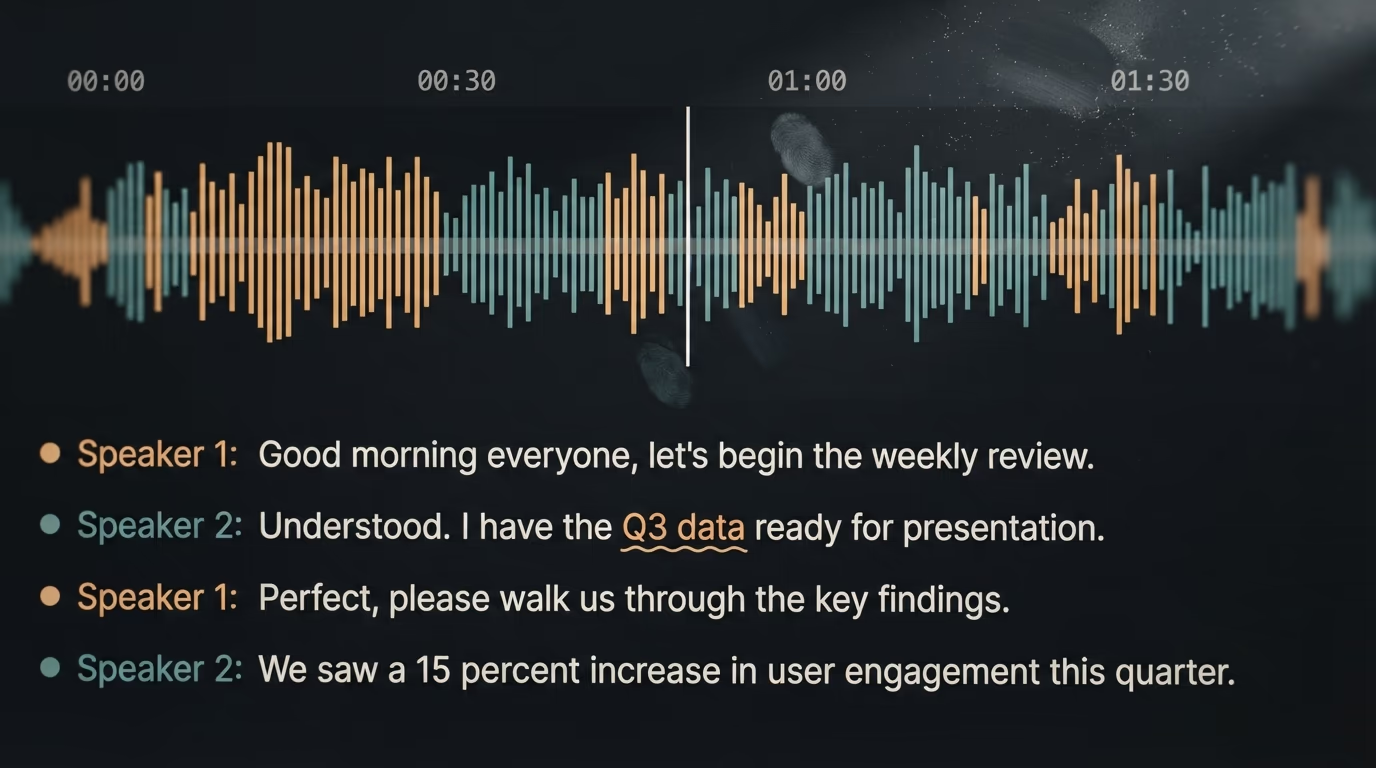
The February model already did most of what people will credit to the new one. Its own announcement says it generates transcriptions with speaker labels and precise start and end times, and that you can hand it a list of your own names and phrases to guide the spelling. Speaker labelling and a custom vocabulary aren't what the extra cents buy, because both shipped in the cheaper release.
What's genuinely new is the conversation machinery. Voxtral 3 notices when a speaker has finished so an agent can answer without the awkward pause, which the February page never mentions, and it arrives beside a voice that reads text back and a kit that joins the listening and the speaking into one stream. Mistral also says the new transcriber is more accurate than the old one, and that claim is the company's own to prove.
Every month somebody announces that running a model got cheaper, and most budgets written this year assume the same job will cost less next year than it does today. Here one company raised the rate on the same task inside a year, on a product line it had been using to win developers over with open weights.
The reverse case deserves saying too. The accurate model costs barely more than the cheap one, so there's no real reason to accept a weaker transcript to save money at small volumes. Pricing a pair of models that close together is a friendly choice, and it's the opposite of the ladder most vendors build, where the good model costs several times what the basic one does.
Can you download Voxtral 3 and run it yourself?
No, and that's a change for Voxtral. Mistral's Hugging Face account carried no Voxtral 3 model when this was written, and the Voxtral 3 announcement never uses the terms open weights, Apache or Hugging Face anywhere on the page.
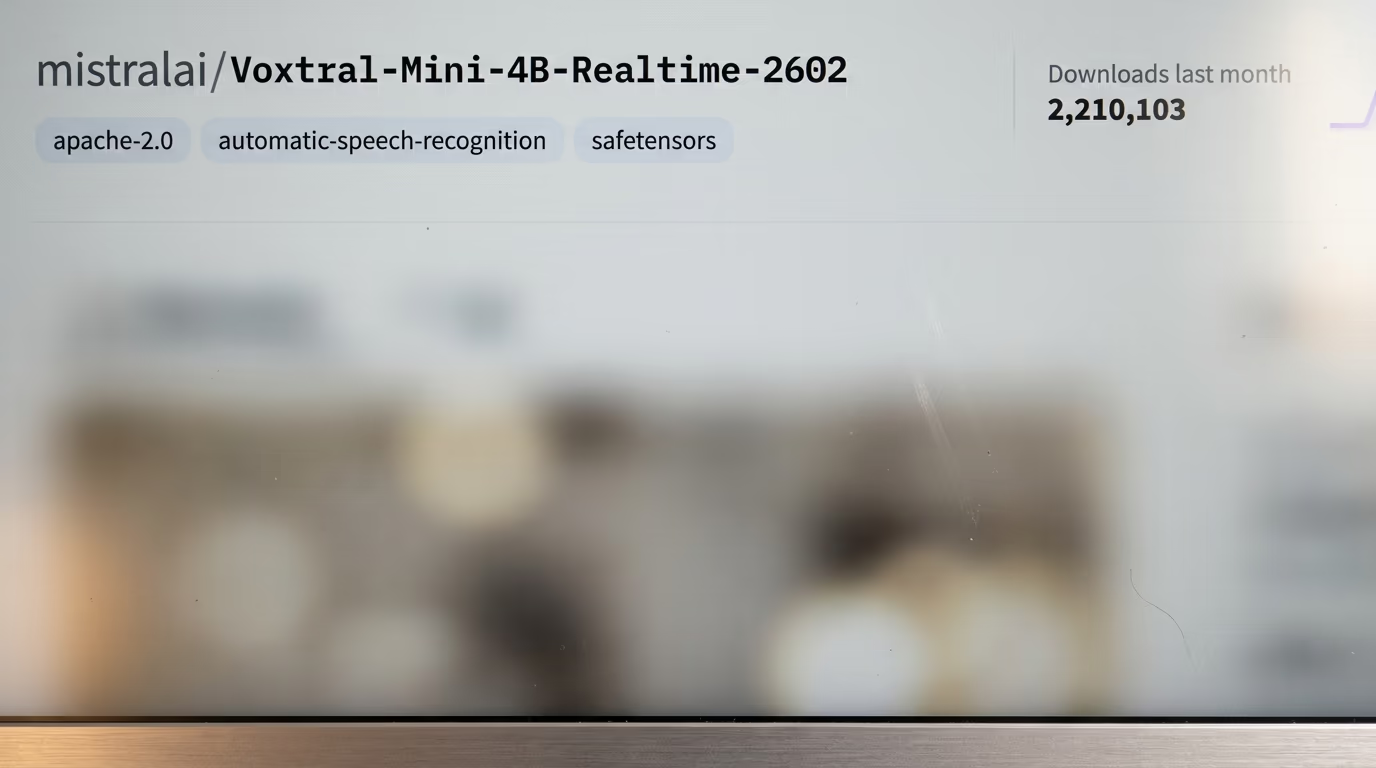
February went the other way, in writing. The Voxtral Transcribe 2 announcement says the company is releasing the model weights under Apache 2.0 on the Hugging Face Hub, and it repeats that the live model ships open so it can run on a device for privacy sensitive work. That model is still up, still carries the Apache licence, and Hugging Face's own counter shows more than 2.2 million downloads of it in the last month.
The older Voxtral pair from the first generation sits beside it under the same licence, which is why so much of the speech tooling people run at home already speaks Voxtral. The exception is the voice that reads text out loud, because Mistral's downloadable speech model carries a Creative Commons non commercial licence, so you can play with it and you can't sell what it makes. That limit was there before this week and has nothing to do with the new release.
What the new announcement offers instead is self deployment, and the page tells you to talk to their team to arrange it. That is an enterprise contract rather than a download, and the difference matters if your plan was the common one, prototype on the API and then move the model in house once the volume makes the bill hurt. Knowing what an open weight model actually gives you is the difference between a plan that works and a plan that stops at a sales call.
None of this makes Mistral a closed company, and the fair reading is that a weights release could still follow. The company has shipped open weights across most of its line, and we went through the same question when Mistral Large 4 was called open weight. What's true today is that the Voxtral 3 page sells access, and the only Voxtral you can hold is the previous one. If the licence is what decides your choice, the open models ranked by what their licence allows is the comparison to read next.
Is Voxtral 3 better than the transcriber you already use?
Mistral says yes and publishes charts to support it, and on one of those same charts a Google model still comes out ahead of its live transcriber. Nobody outside Mistral has measured any of these models yet, so every figure in circulation this week is the vendor describing its own homework.
The claims themselves are specific, which is better than most launches manage. Mistral says its accurate transcriber leads a public multilingual test against Whisper, Google's transcriber and ElevenLabs Scribe, and that handing it a list of your own jargon lifts how often it catches those terms. It says the family covers dozens of languages for transcription and reads text back in dozens more, and that it can clone a voice from about half an hour of recorded audio.
On the live comparison Mistral printed, Google's Gemini 3.5 Realtime Transcribe lands ahead of every live Voxtral setting on the page, and Mistral left it there rather than cropping it out. The accurate offline Voxtral sits at the top of the other chart, where that live Google model is not the thing it is being measured against.
The error figures everyone will quote need translating before they mean anything. The leaders on these charts all sit within a sliver of each other, close enough that a strong accent or a cheap microphone moves your result further than the choice of vendor does. What decides the outcome for you is your own audio, not a leaderboard built on clean recordings read by careful speakers.
A sceptical reader will say that every vendor chart flatters the vendor, and that's the right instinct here. Mistral chose the tests and drew the bars, and the company isn't pretending otherwise. The only test worth your afternoon is the boring one, a few minutes of your own worst recording run through 2 or 3 rows of that table, scored by reading the transcripts and counting what came back wrong.
What should you use tonight if you just want a transcript?
If you want the cheapest transcript of a recorded file tonight, the lowest published rate in that table belongs to OpenAI, and Voxtral 3 earns the extra cents when you need speaker labels or European hosting. If you want to run a speech model on your own machine without paying anybody, the only Voxtral that allows it is February's.
- Cheapest transcript of a recorded file, OpenAI's small transcriber
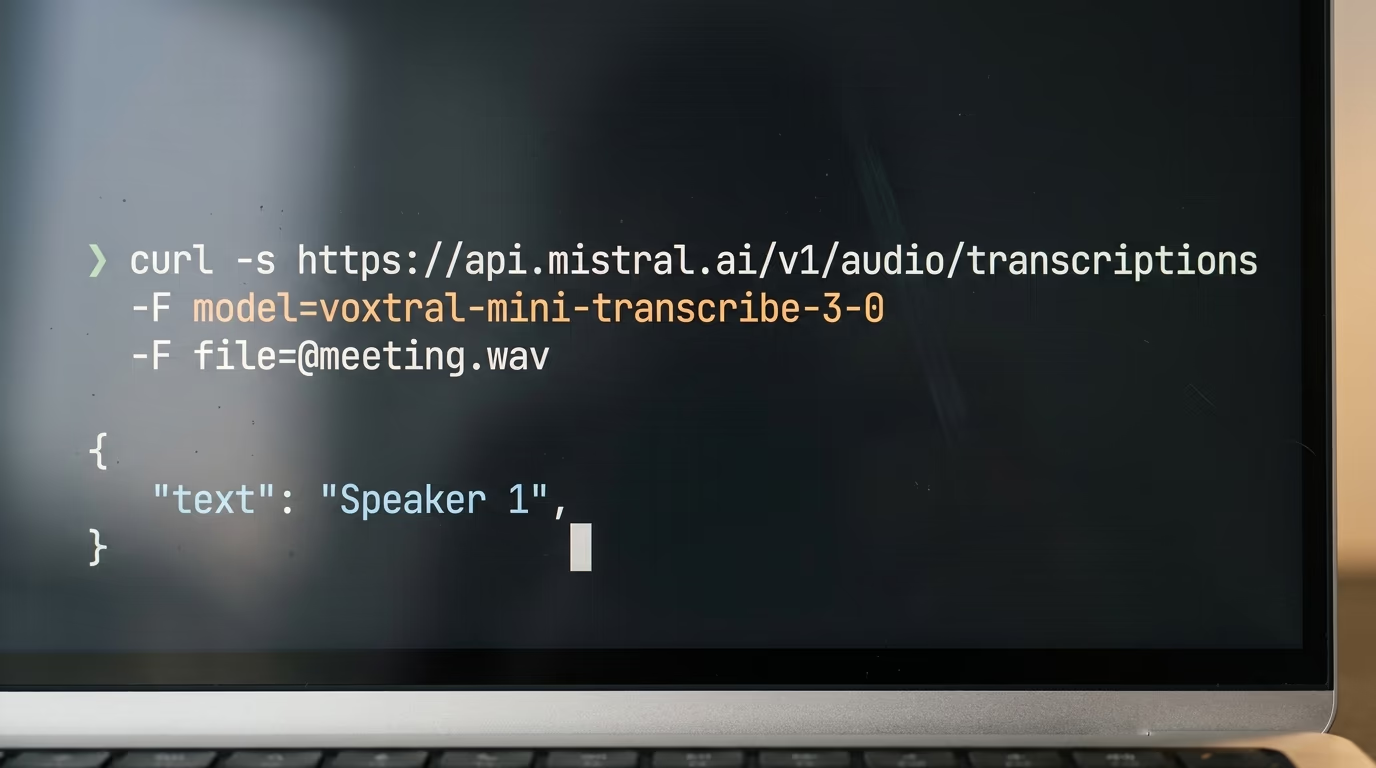
- Speaker labels and timestamps in the same call, Voxtral Mini Transcribe 3
- Audio that has to stay in Europe, Voxtral on Mistral's European endpoint
- A model running offline on your own machine, February's Voxtral under the Apache licence
Trying Voxtral 3 takes a Mistral account and no code at all. The audio playgrounds in the Mistral console accept an uploaded file and hand back a transcript with the speakers already separated, which is enough to judge quality on your own recordings before anybody writes an integration. The audio model list in Mistral's documentation names each model and says what it is for, and the Voxtral 3 announcement carries the rates.
One thing to settle before you start is whether you need the live model at all. Writing captions while somebody talks costs more than twice what the same hour costs after the fact, and a great many jobs people reach for live transcription on, meeting notes and podcast subtitles among them, are perfectly happy waiting a minute for a file to come back.
If the plan does involve a phone line or live captions, settle the metering question first. Ask the vendor whether you pay for the audio or for the open connection, because those 2 answers differ by a lot once an agent sits waiting while a human thinks. We went through the same exercise with the APIs behind the big chat models, and the meter is where the surprises live rather than in the headline rate.
And if this is a side project rather than a product, you may not need any of it. Building a voice agent that costs nothing to run still works, because a free tier plus a downloadable voice gets you most of the way for an evening of tinkering. Voxtral 3 is the paid and tidy version of that, and it earns its money when the thing has to answer a real customer who will not forgive a mangled name.
What we don't know yet about Voxtral 3
Mistral hasn't said whether Voxtral 3 weights will ever be published, and it hasn't explained why the rate per minute went up. Nobody independent has measured the models, and the announcement leaves several practical questions open.
The weights question is the open one. The February pattern suggests a release could follow, and a pattern isn't a promise, so the honest answer today is that nobody outside the company knows. Watch Mistral's Hugging Face account rather than the announcement page, because that is where every previous Voxtral generation appeared first.
No independent measurement exists yet. Every accuracy figure in circulation this week traces back to the charts Mistral drew, and the usual outside leaderboards have not run these models. Expect that to take a week or 2 and expect the ordering to move when it happens, because it usually does once somebody tests on audio the vendor did not choose.
The metering of a live session is undocumented. Mistral prints a rate by the minute and doesn't say whether the clock runs on the audio or on the connection, which is the difference between a bill you can predict and a bill that surprises you at the end of the month.
The self deployment option has no published price. The page invites you to talk to the team, which in practice means a contract shaped around your volume, and it means the line about running Voxtral 3 inside your own infrastructure is not something a small team can act on this week. The same goes for the agent bundle, where Mistral charges one rate when its own small model does the reasoning and double when anything else does, without saying which models fall on the expensive side.
2 things would settle most of this quickly. A weights upload on Hugging Face would make the rise easy to forgive, and an independent leaderboard run would tell us whether the charts hold up on somebody else's recordings. Until one of those lands, the useful move is the small one, run your own worst audio through the playground tonight and judge the transcript with your own eyes.
Questions people ask
How much does Voxtral 3 cost?
Voxtral 3 transcription starts at $0.0035 a minute on Voxtral Mini Transcribe 3 and the more accurate Voxtral Small Transcribe 3 costs slightly more per minute. The live model costs more than twice the cheapest one. Text to speech is billed by the million characters instead, and the bundled voice agent is billed by the minute of conversation.
Is Voxtral 3 open source?
No. Mistral published no Voxtral 3 weights on Hugging Face at the time of writing, and the announcement never names a licence for download. The previous generation is a different story, because Mistral released the February live model under the Apache licence and it is still downloadable today.
Can I run a Voxtral model on my own computer?
Yes, but not the Voxtral 3 family. The live Voxtral model Mistral released in February and the first Voxtral pair before it are published under the Apache licence on Hugging Face, so anybody can download them and run them offline. The downloadable model that reads text out loud carries a non commercial licence instead, so it can't be used in anything you sell.
Is Voxtral 3 cheaper than Whisper?
Yes on the published rates. OpenAI charges more per minute for Whisper than Mistral charges for Voxtral Mini Transcribe 3 while OpenAI's smaller transcriber is cheaper than both of them. The table in this article puts all of them against the same hour of recorded audio.
Does Voxtral 3 know who is speaking?
Mistral says the recorded transcription models label each speaker and stamp each segment with a time. The February release already did both, so speaker labelling is not what the higher rate buys. At AssemblyAI the same labelling is charged as an extra line on top of the transcription rate.
Where does Voxtral 3 process my audio?
Mistral offers European, US and global endpoints for Voxtral 3 and says an organisation can also run the stack inside its own infrastructure. The announcement routes that second option through its sales team rather than a download, so it is a contract rather than something you switch on tonight.