TechAugust 31, 202611 min read
OpenAI cuts off Cursor, what changes on November 12
OpenAI told SpaceX it will stop serving its models inside Cursor on November 12. Cursor says those models carry about 5% of its traffic. Here is what really stops, and what to do first.
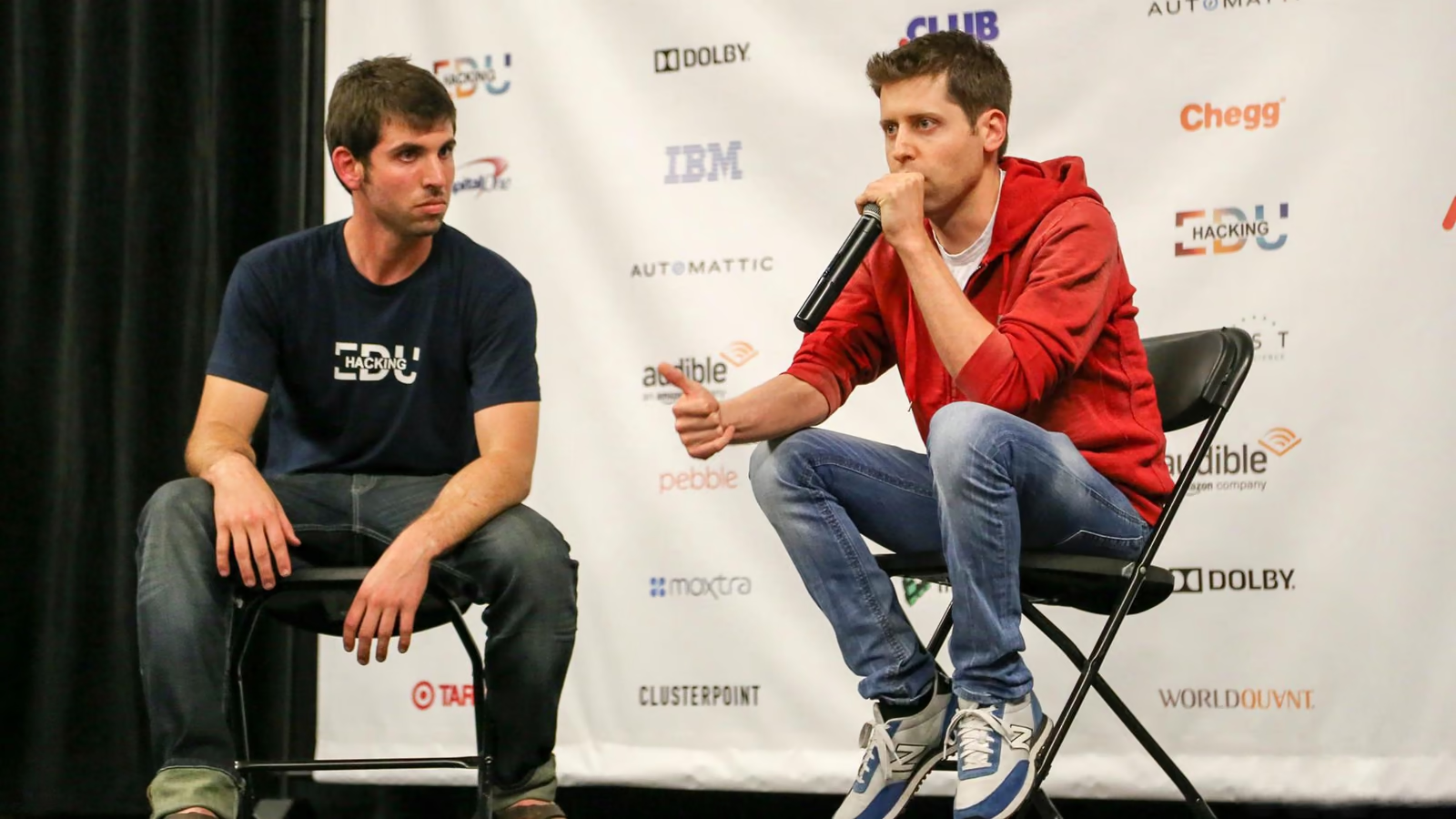
OpenAI has told SpaceX that it will stop serving its models inside Cursor, the AI code editor, and it has proposed November 12 as the shutoff date. SpaceX completed its purchase of Cursor in August, and OpenAI's supply agreement allowed it to cancel within a limited window after a change of ownership.
For most people who open Cursor tomorrow morning, very little breaks on that day. Cursor's chief executive Michael Truell says OpenAI models carry about 5% of what Cursor users send, so the great majority of requests in the editor never touch OpenAI at all. What goes away is the ability to pick a GPT model from the list inside Cursor and let your Cursor plan pay for it. You can still bring your own OpenAI account into the editor, and that road has limits worth understanding now rather than in November.
What did OpenAI actually announce about Cursor?
OpenAI published a short note saying it had notified SpaceX that it intends to wind down the contract supplying OpenAI models to Cursor, with a proposed shutoff date of November 12. CNBC reported the note went up late on Friday 28 August, about 2 weeks after the acquisition closed.

The note runs to 4 paragraphs and it does not hide behind neutral language. OpenAI gives one reason for ending a partnership it describes as nearly 4 years old, and that reason is the new owner rather than anything Cursor built or did.
We are making this choice because we cannot be confident that SpaceX will use our technology within our terms of service, based on our experience with Elon Musk's companies violating contracts.
2 other lines in that note matter for anyone planning around the date. OpenAI says it is giving the maximum notice its contract provides, so developers keep the models for as long as the paperwork allows, and it says it will not hand Cursor any future models while the agreement winds down. The upcoming model it names in that sentence is Astra, which tells you the freeze runs forward as well as backward. Whatever OpenAI ships next, Cursor will not be selling access to it.
The tone of the rest is worth noticing, because it is not the tone of a company burning a bridge with a customer. OpenAI writes that it has enormous respect for the Cursor team and their product, that it knows the people most affected are the developers who rely on its models inside the editor, and that it is ready to go above and beyond to support them through the transition. What that support looks like in practice has not been described anywhere yet, and that gap is the one thing in this story a Cursor user should watch.
Cursor answered the same evening and did not escalate. Michael Truell wrote on X that OpenAI models serve a small share of Cursor user traffic and that his team is speaking with OpenAI to resolve it. He added that Cursor was one of the very first users of OpenAI, that the 2 teams had worked closely for years, and that Cursor had trusted the platform to be neutral infrastructure for its business. CNBC quoted that post the following day, which is the only reason we can read it without an account on X.
Why is OpenAI ending the contract now?
Because SpaceX bought Cursor, and the supply agreement between OpenAI and Cursor carried a clause that allows cancellation for a limited time after the owner changes. SpaceX closed its $60 billion all stock purchase of Anysphere, the company behind Cursor, on 14 August, according to a securities filing cited by CNBC. OpenAI's note says its window to cancel was short and that it chose the latest date available inside it.

OpenAI names 2 earlier episodes as the ground for its distrust. It says that after Musk acquired Twitter, now sitting under SpaceX, the company broke the terms of their contract. It also says that under oath earlier this year Musk admitted that xAI, also now under SpaceX, had violated OpenAI's terms of service. Both statements come from OpenAI's own page, and both link out to outside reporting rather than standing on their own.
Musk answered the next day with a single line on X, saying he could not care less, and repeating a claim about OpenAI's founding that OpenAI disputes. The feud between these people is old and thoroughly documented, and it is the least useful thing in the story for anyone with code to ship this week. The clause sitting underneath the noise is what actually decided the outcome.
A change of ownership clause is ordinary in a supply contract between 2 companies, and it exists for precisely this case. Your model provider signed a deal with a customer it understood, and that customer has since become a division of a competitor. OpenAI also gives a second reason in the same paragraph, saying that as capabilities advance it carries a new level of accountability for how its coming model gets used, which is the safety argument sitting next to the commercial one.
Every serious model contract now carries some version of that escape hatch, which is the sentence to remember long after this particular argument is settled. The models inside any tool you use sit on an agreement you never read and have no standing to influence. Your editor's model list looks like a feature, and it is really a commercial arrangement between other people.
How much of Cursor stops working on November 12?
Cursor itself keeps working exactly as before. Only the OpenAI models leave the list that your Cursor plan covers, and every other model in the editor stays where it is, including Anthropic's Claude, Google's Gemini and the models Cursor now trains itself.
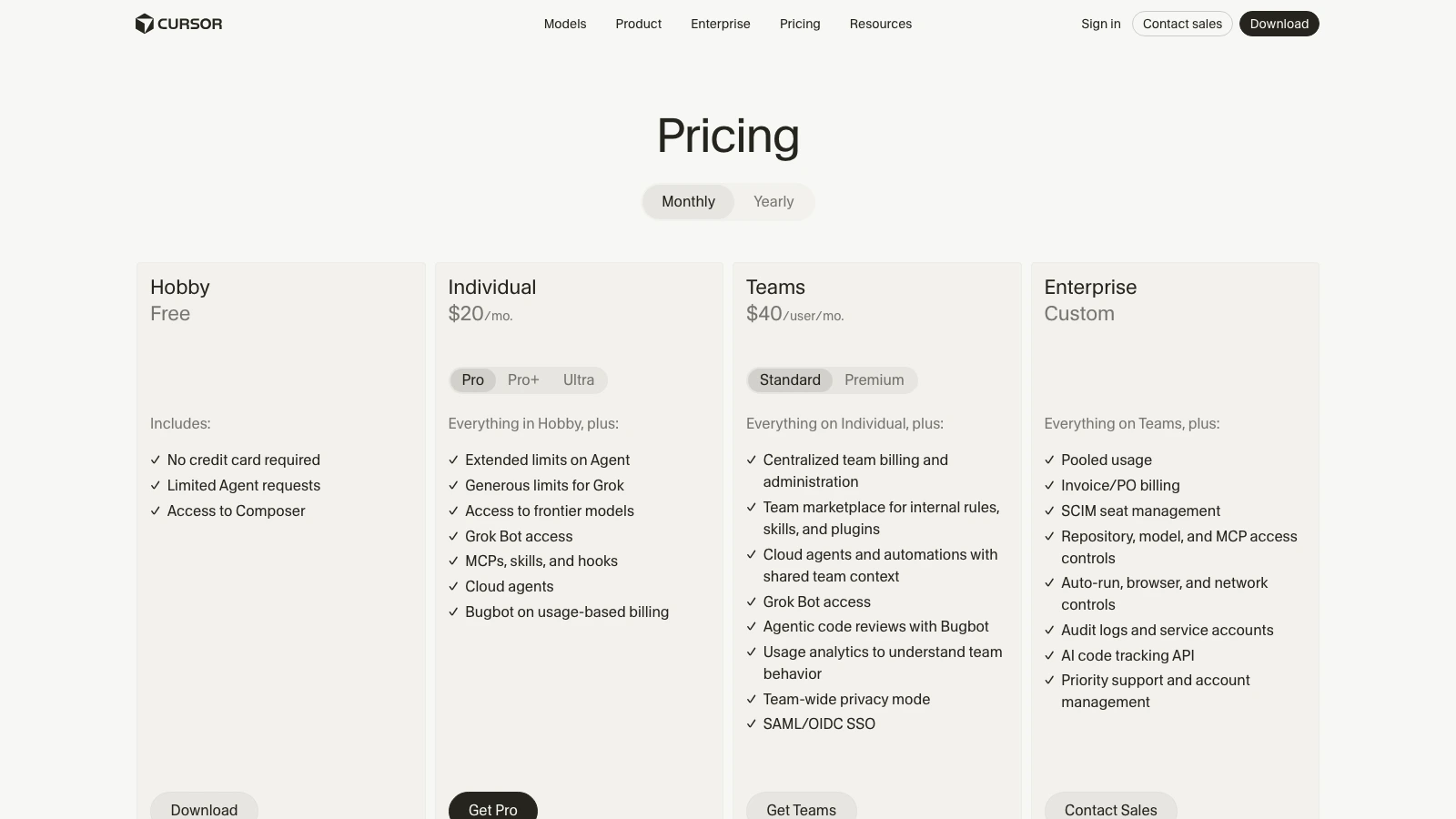
The 5% figure comes from Cursor and nobody outside the company has audited it, so read it as Cursor's own account of its traffic rather than as a measurement. It is entirely believable for a reason you can see on Cursor's site today. Cursor now ships models of its own, Grok and Composer, and its help pages describe Grok as the flagship and as the smartest model Cursor has trained.
I counted the plan descriptions on Cursor's pricing page while writing this. Grok is named 8 times across the plans. OpenAI, Anthropic and Google are named zero times there, and so are GPT, Claude and Gemini, which survive only as the generic promise of access to frontier models. The house model gets the name and the marketing, and that was already true before OpenAI sent its note.
There is one place where the loss is real rather than cosmetic. Cursor's Auto setting routes each request across a small pool of models and an OpenAI model is one of them today. Cursor's own documentation says Grok is required for that router to run at all, and that removing the OpenAI or Anthropic entries lowers the quality of its routing. After the cutoff, the pool has one fewer option to route to, so Auto becomes a narrower choice than it is this week, with nothing on screen to tell you about it.
Teams have one extra thing to check. Cursor's Enterprise plan includes controls that let an administrator allow or block specific models for everyone, and any allow list written months ago may name an OpenAI model that will simply stop resolving. That is the kind of setting nobody remembers configuring until a colleague reports that the editor has gone quiet, so it deserves a look before November rather than after.
Anthropic moved in the opposite direction within a day of the announcement. Its co founder Tom Brown said Anthropic will keep increasing compute for Claude models inside Cursor, as The Decoder reported. If Claude is already your default in that editor, that is the message you wanted to read. If you would rather compare the 2 main coding assistants on the same tasks, our Claude Code and Codex comparison runs the same checks on both.
Can you still use OpenAI models inside Cursor?
Yes, by 2 routes, and both of them move the bill onto you. You can plug your own OpenAI API keys into Cursor so the editor calls the models with your account behind them, or you can install OpenAI's own Codex extension inside Cursor and run it beside the editor's chat.
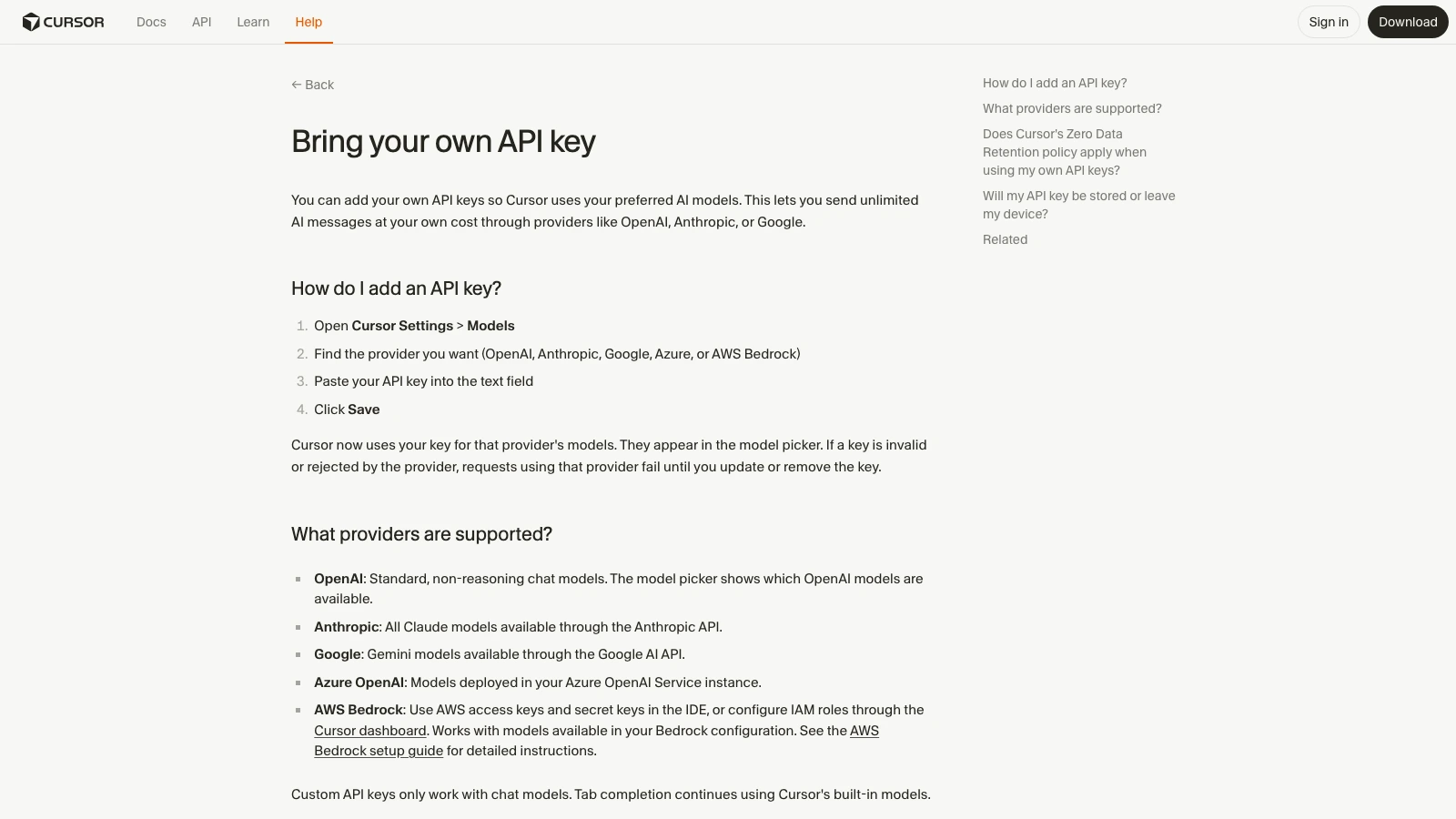
Cursor's help page describes the first route in 4 steps. You open Cursor Settings, go to Models, find the provider you want in the list, paste your own credentials and save. Those models then appear in the picker like any other, and Cursor says the credentials are sent to its backend with every request and are not kept on its servers afterwards. The same screen accepts credentials for Anthropic, Google, Azure and AWS Bedrock, so this is a general escape hatch rather than a favour to OpenAI users.
The limits matter far more than the steps, and Cursor states them on that same page. Custom credentials only work with chat models, while Tab completion carries on using Cursor's own models whatever you paste. For OpenAI specifically, Cursor says the models available this way are its standard chat models rather than its reasoning ones, which is a meaningful difference on hard debugging work. The zero data retention promise also stops applying, because your text is then handled under your provider's privacy policy instead of Cursor's, and that alone rules the route out for some regulated teams.
| Route | What you do | What it costs you |
|---|---|---|
| Your own OpenAI credentials | Cursor Settings, Models, paste, save | You pay OpenAI per request, chat models only, Tab unchanged, no zero data retention |
| OpenAI's Codex extension | Install it inside Cursor, sign in to OpenAI | A second sidebar and a second account, outside Cursor's own chat |
| Another model in Cursor | Pick Claude, Gemini, Grok or Composer | Nothing, your existing Cursor plan already covers it |
OpenAI's documentation lists Cursor by name among the editors its Codex extension supports, alongside VS Code, Xcode and the JetBrains family, which is why that second route works at all. The extension opens in a sidebar, reads the files you have open and reviews its edits in place, so it behaves like a second assistant living next to the first rather than a replacement for the editor's own chat.
Neither route is free, and the second bill is the one people forget about. Cursor Pro is $20 a month, your own OpenAI account bills separately on top of that, and a long agent session consumes tokens far faster than a chat window does, so set a spending cap on the day you paste the credentials rather than at the end of the month. Our comparison of model prices on real jobs gives a decent idea of what that meter actually does when an agent is left running.
Has a model maker cut off a coding tool before?
Yes, and the last time it happened the arrow pointed the other way. In June 2025 Anthropic cut Windsurf's direct access to its Claude models with very little warning, while OpenAI was in the middle of trying to buy Windsurf, and TechCrunch reported it as it happened.
Anthropic's co founder and chief science officer Jared Kaplan explained the decision without any corporate padding, at a TechCrunch event held days after the cut.
I think it would be odd for us to be selling Claude to OpenAI.
What happened to Windsurf afterwards is the more useful lesson for anyone choosing an editor today. The purchase by OpenAI never closed at all. Google hired the founders in a licensing deal, and Cognition, the company behind the Devin agent, bought what remained of the business that July. Open windsurf.com now and the page that loads belongs to Cognition and sells Devin Desktop, which I checked while writing this piece.
The difference in the 2 stories is the notice period, and it is the difference between an inconvenience and a crisis. Windsurf lost its Claude access on days of warning, in the middle of an acquisition, which is the worst possible week to rebuild your model layer. Cursor has until November, published in advance, with the reason written down. That is what a maximum notice clause buys, and it is worth asking whether the tools you depend on have one.
So the same move has now been made twice by the 2 largest model providers, in opposite directions, against 2 different editors. Neither company did anything unusual or underhanded by the standards of commercial contracts, and both said out loud why they were doing it. Your editor's model list is the output of a negotiation between companies that can become rivals overnight, and nobody sends the customers a memo before it changes.
What should you do before the cutoff?
Open Cursor, look at which model is actually selected in the picker, and if it is an OpenAI one, spend this week trying the alternatives on real work instead of on a toy prompt. That single check answers the only question that matters here, which is whether you belong to the small group of people this touches.
- Check the model picker and your recent chats for GPT entries
- Run a real task through Claude, Grok and Composer, back to back
- If you still need GPT models, open an OpenAI account and set a spending cap
- Check any automation, cloud agent or command line job that names a model
Plenty of people set Auto months ago and never opened the picker again, and Auto keeps working with a smaller pool behind it. If that describes you, the honest answer is that you can close this article and lose nothing at all. The developers who need to act are the ones who deliberately chose a GPT model for one particular kind of task, wrote it into a habit or a script, and never revisited the decision afterwards.
The second step is the one most teams skip, and it is where the unpleasant surprises live. A model that feels equivalent in a chat window can behave very differently across a long refactor spanning a whole feature, so test the replacement on something you actually shipped this month rather than on a fresh toy project. Our ranking of the best coding agents and what each one charges covers where each option stops being good enough for the work.
The last item on that list is the one that bites without warning. Cursor now runs cloud agents, automations and a command line tool, and any of those can carry a model name written into a configuration months ago by somebody who has since moved teams. A chat window that loses a model tells you immediately, while a nightly job that loses a model just stops producing anything and waits for someone to notice.
One habit is worth taking from all of this. Keep a second model configured in whatever tool you use, and prefer tools that let you change supplier without a migration project. Holding your own account with one provider costs nothing until the day you actually need it. If you want a setup that no contract can cancel, the models you download and run on your own machine are the only ones with nobody in the middle, and we ranked the local models worth running for coding by how much memory each one needs.
The date itself falls on a Thursday, and for most Cursor users it will pass without any incident whatsoever. It still deserves a line in the calendar, because the reason it exists has nothing to do with the quality of the models and everything to do with who owns the editor you type into. That is now something engineers have to track, sitting next to the price and the feature list. Our explainer on models with open weights covers the version of this problem where there is no supplier left to lose.
Questions people ask
Is Cursor shutting down?
No, Cursor keeps running exactly as it does today. Only the OpenAI models that your Cursor plan currently covers are leaving, on the shutoff date OpenAI proposed. Claude, Gemini, Grok and Cursor's own Composer model all stay in the picker.
Can I still use GPT models in Cursor after the cutoff?
Yes, if you bring your own OpenAI account into the editor. Cursor lets you paste your own API keys under Cursor Settings and Models, and OpenAI's Codex extension can also be installed inside Cursor. Both routes bill you directly, and neither of them changes Tab completion, which always uses Cursor's own models.
Why did OpenAI cut off Cursor?
OpenAI says it cannot be confident that SpaceX will use its technology within its terms of service, based on its experience with Elon Musk's companies violating contracts. Its agreement with Cursor allowed cancellation for a limited window after a change of ownership, and SpaceX completed its purchase of Cursor in August.
Does this affect Claude or Gemini inside Cursor?
No, nothing in OpenAI's note touches another supplier's models. Anthropic said the opposite in public within a day, when co founder Tom Brown said it will keep increasing compute for Claude models inside Cursor, as The Decoder reported.
How much of Cursor's traffic actually uses OpenAI models?
Cursor's chief executive Michael Truell says about 5% of Cursor user traffic goes to OpenAI models. That figure comes from Cursor and nobody outside the company has audited it, so treat it as the company's own account rather than a measured number.
Will Cursor get cheaper without OpenAI models?
Cursor has not announced any price change and its published plans are unchanged so far, with Pro still at $20 a month. Nothing in OpenAI's note or in Cursor's public reply mentions pricing at all.
Is this the same thing Anthropic did to Windsurf?
Very close, and the mechanism is the same one. Anthropic cut Windsurf's direct access to Claude models last year while OpenAI was trying to buy Windsurf, and TechCrunch reported the decision at the time. In both cases a supplier declined to keep serving a tool owned by a competitor.
What happens to my Cursor subscription on the cutoff date?
Your subscription continues and your editor opens normally that morning. If your selected model is an OpenAI one, you pick another model from the list or you add your own OpenAI credentials in settings. Everything else in the plan, including Tab completion and cloud agents, is unaffected by this change.