TechAugust 15, 202612 min read
How much water does one AI prompt use, drops or a bottle
Google measured 0.26 milliliters for the median Gemini text prompt. The bottle everyone quotes comes from a 2023 estimate for GPT-3, where most of the water was never in the data center.
How much water does one AI prompt use depends on who did the counting, which model they counted and whether they included the power station. Google measured its own live service and put the median Gemini Apps text prompt at 0.26 milliliters of water, about 5 drops, alongside 0.24 watt hours of energy. The 500 milliliter bottle that circulates on social media comes from a 2023 academic estimate for GPT-3, and in that same paper a single request on the US average worked out at 16.9 milliliters, of which 14.7 evaporated at the power station rather than inside the data center.
Both figures are honest on their own terms. They describe different models, different years and different boundaries, which is why they sit almost 2000 to 1 apart and why the argument about AI and water goes round in circles. The gap is a boundary problem rather than a scandal, and once you know which boundary a figure uses, the contradiction mostly disappears.
How much water does one AI prompt use in 2026?
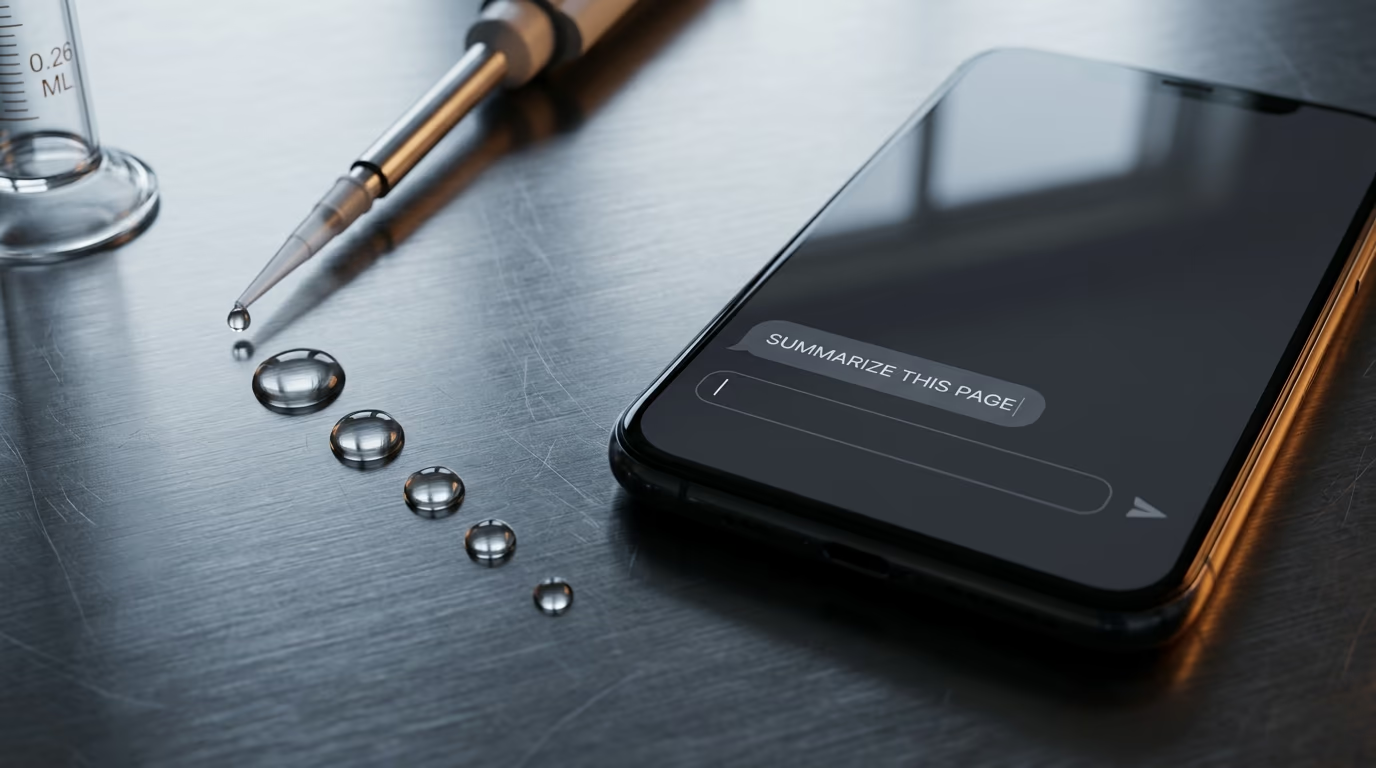
The most precise per prompt water figure any operator has published for its own service is Google's 0.26 milliliters for the median Gemini Apps text prompt. Google published it on 21 August 2025 with 2 companion numbers, 0.24 watt hours of energy and 0.03 grams of CO2 equivalent, and it describes the volume as about 5 drops of water.
The boundary is wider than the one behind most published estimates, which is the reason to take it seriously. Google counts the chips doing the work, the host machine's processor and memory, the idle machines it keeps provisioned for failover, and the cooling and power overhead of the building through power usage effectiveness. It also says out loud what the figure is not. The measurement covers text prompts, it uses data from May 2025, and Google calls it a point in time analysis rather than a promise about every prompt or about the models that come next.
Sam Altman had already put a similar number in public. In The Gentle Singularity, a post on his personal blog, he wrote that the average ChatGPT query uses about 0.34 watt hours and about 0.000085 gallons of water, which he compared to roughly one fifteenth of a teaspoon. Converted, that is 0.32 milliliters, close enough to Google's 0.26 that both companies are describing the same physics. OpenAI has not published the method behind it, so it stands as a claim from the vendor rather than a measurement anyone outside can audit.
Mistral is the third company to publish, and its number is far bigger. In an audit dated 22 July 2025, run with the consultancy Carbone 4 and the French environment agency ADEME, Mistral put a response of 400 tokens from Le Chat at 45 milliliters of water and 1.14 grams of CO2 equivalent, excluding the user's own device. The distance from Google's 0.26 milliliters is a boundary gap rather than a contradiction, since a lifecycle audit of a long answer and the operational water of a median prompt are not the same measurement.
Set the numbers that circulate next to each other and the disagreement stops looking like a disagreement.
| Source | What it covers | Water per request | Energy per request |
|---|---|---|---|
| Google, 21 August 2025 | median Gemini Apps text prompt, water consumed inside its own data centers | 0.26 mL | 0.24 Wh |
| Sam Altman, The Gentle Singularity | average ChatGPT query, no method published | 0.32 mL (0.000085 gallons) | 0.34 Wh |
| Mistral with Carbone 4 and ADEME, 22 July 2025 | a response of 400 tokens from Le Chat, lifecycle audit | 45 mL | not published |
| Li, Yang, Islam and Ren, January 2025 revision | 1 GPT-3 request, US average, cooling plus power station | 16.9 mL | 4 Wh assumed |
| Washington Post with UC Riverside, reported by Business Energy UK | an email of 100 words written by GPT-4 | 519 mL | 0.14 kWh |
Each row answers a different question about the same thing. Google measured a 2025 model on its own hardware and counted the water inside its fence. The UC Riverside team estimated GPT-3 from published efficiency tables and counted the power station too. The 519 milliliter figure, from research by the Washington Post with UC Riverside and reproduced by Business Energy UK, prices a whole email written by GPT-4 rather than one short exchange. None of them is the others' number, and none of them is wrong on its own terms.
Why does an AI data center need water at all?
An AI data center uses water because nearly all the electricity that enters a server leaves it as heat, and evaporating water is the cheapest way to push that heat into the outside air. Nothing about the model or the prompt touches water directly. The water is in the building's air conditioning, at a scale where air conditioning turns into plumbing.
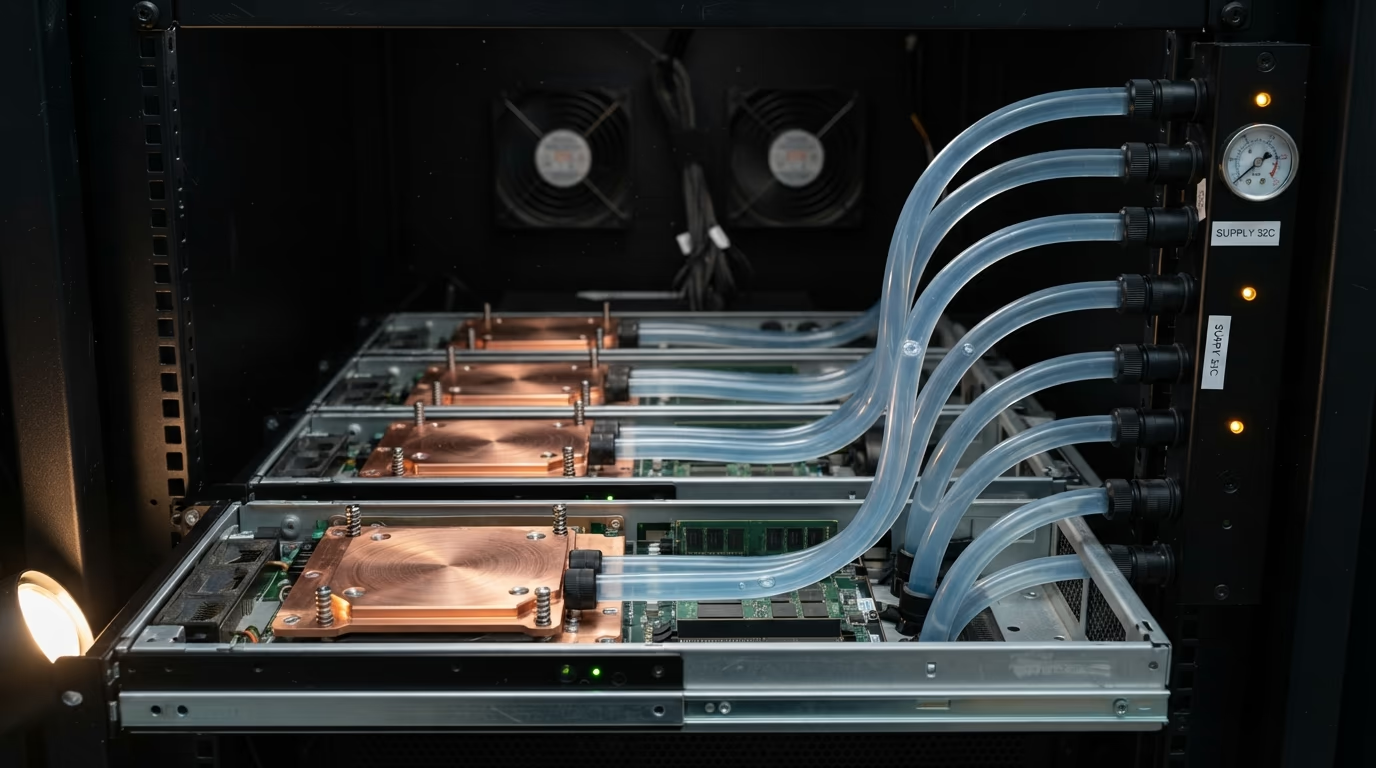
The cooling happens in 2 stages. Inside the rack, heat moves off the chips by air, by cold plates bolted onto the processors with liquid running through them, or by dropping the whole board into a bath of dielectric fluid. None of that evaporates a drop of water on its own, it carries the heat to the edge of the building, where the second stage has to dump it into the environment, and that is where the water goes.
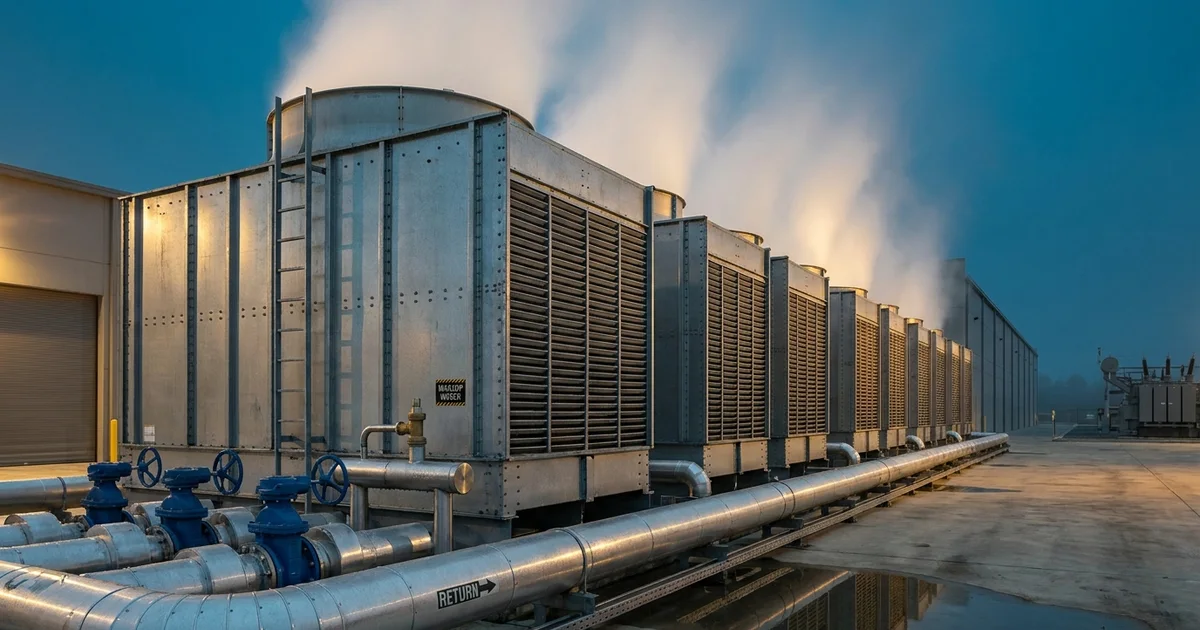
In a cooling tower, warm water is sprayed over a large surface and a fraction of it evaporates, taking the heat with it. What does not evaporate keeps circulating, though the UC Riverside authors note it can only go round 3 to 10 times before dissolved minerals concentrate enough to scale the pipes, so it is discharged and replaced. The replacement is often drinking water, because anything dirtier grows bacteria and clogs the loop, which is how a data center ends up drawing on the same municipal supply as the houses beside it.
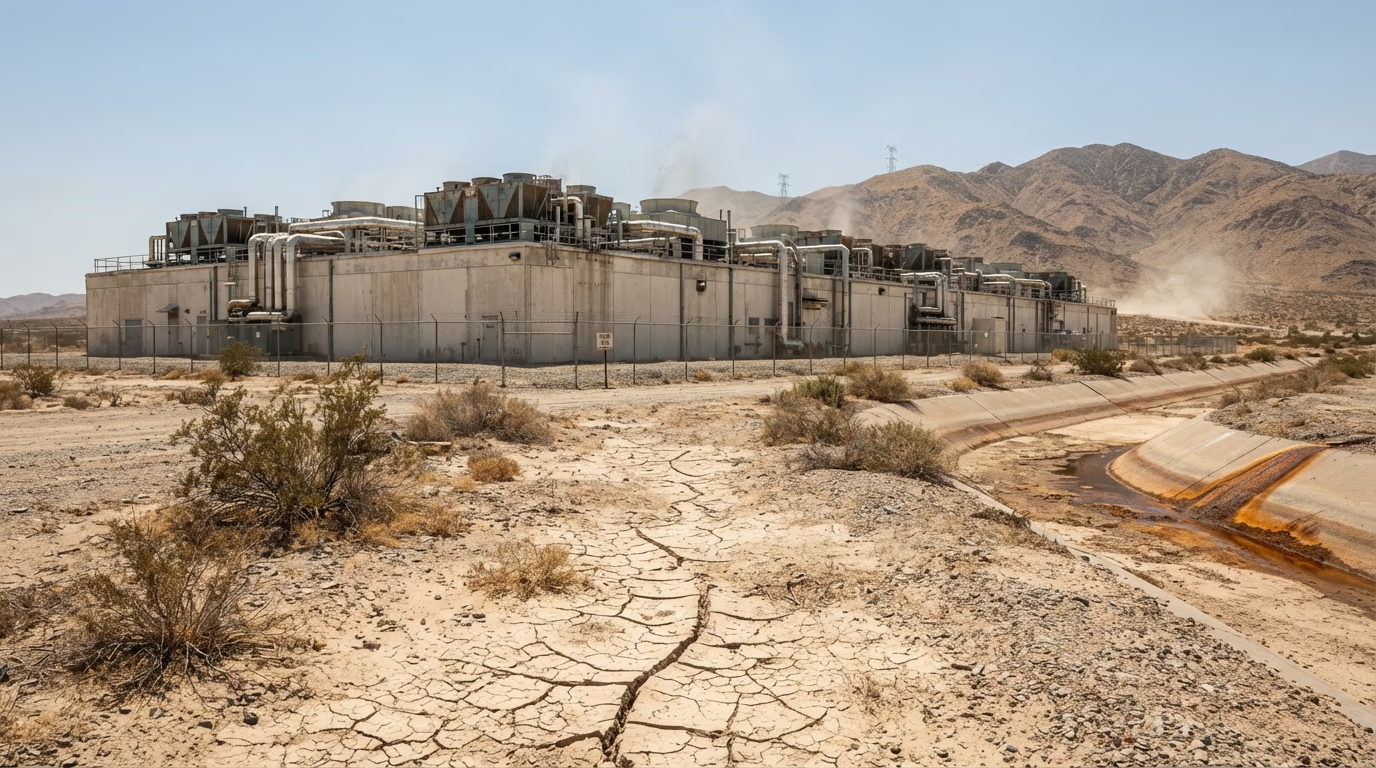
That evaporation has a measurable rate, and the same paper puts it between 1 and 9 liters per kWh of server energy, with 1 liter per kWh quoted as Google's annualized global figure for its own sites and 9 liters per kWh for a large commercial data center during an Arizona summer. The industry calls the ratio water usage effectiveness, and it is simply the liters consumed for every kWh delivered.
Some operators skip evaporation entirely with dry coolers, which reject heat through a radiator and consume no water on site all year. They pay for it in electricity, and since generating electricity also consumes water, a dry site can move its water bill into somebody else's watershed instead of removing it. That trade sits underneath almost every claim about a waterless data center.
Where does the bottle of water claim come from?
The 500 milliliter bottle comes from Making AI Less Thirsty, a paper by Pengfei Li, Jianyi Yang, Mohammad A. Islam and Shaolei Ren of UC Riverside and UT Arlington, first posted in April 2023, with the figures here taken from its January 2025 revision. Its abstract says GPT-3 has to consume a 500 milliliter bottle of water for roughly 10 to 50 responses of medium length, depending on when and where the model runs.
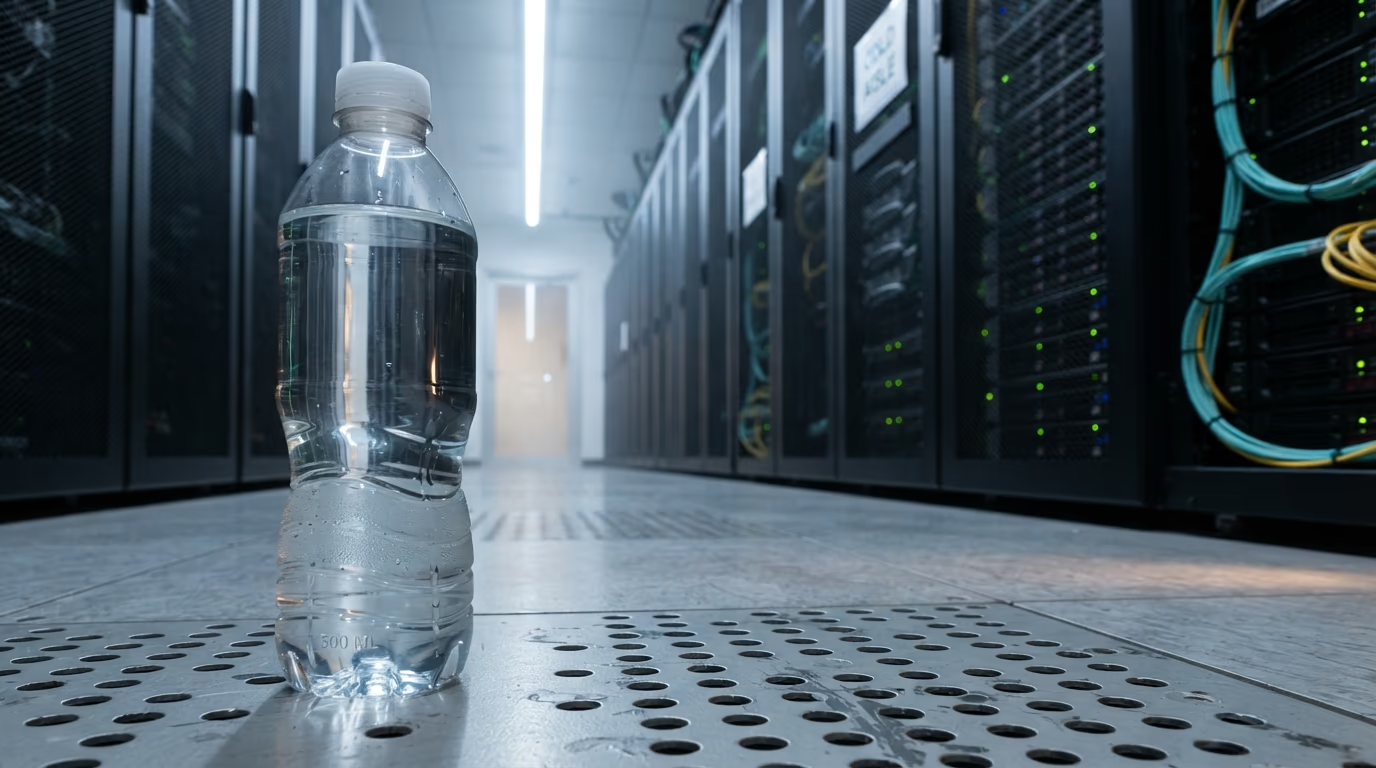
Read that sentence again, because the internet dropped the second half of it. The bottle covers 10 to 50 responses, so one response costs between 10 and 50 milliliters on those assumptions rather than 500. The 519 milliliter figure people also quote is a separate calculation for a different model, GPT-4 writing a whole email of 100 words, and the 2 numbers get mixed together constantly.
Table 1 of the paper prices a single GPT-3 request in 8 US states and 9 other countries, and the spread is the interesting result. On the US average row it is 16.9 milliliters, and the final column says a 500 milliliter bottle covers 29.6 requests. Texas comes out at 7.6 milliliters and Ireland at 7.1, while Washington state reaches 47.5, of which 43.7 sits off site, and the paper does count evaporation from hydropower reservoirs in its off site numbers.
The training figure in the same paper travels better than the inference one. The authors estimate that training GPT-3 in Microsoft's US data centers directly evaporated 700,000 liters of clean freshwater on site, and 5.4 million liters once the electricity behind it is counted. That is a single upfront cost for a model that then answered requests for years, which is why the argument moved to inference in the first place.
The authors are candid about the softness of their own inference estimate. They call it conservative and say the real figure could be several times higher, because they assumed 0.004 kWh per request from an official GPT-3 estimate, while a production serving stack on Nvidia DGX H100 hardware needs around 0.010 kWh for a comparable request with Llama-3-70B and about 0.016 kWh with Falcon 180B. An estimate that can be several times off in one direction is not a measurement.
How much of that water is used at the power plant?
Most of the water behind an AI prompt is consumed at the power station rather than inside the data center, on the paper's own numbers. On the US average row of Table 1, 14.7 of the 16.9 milliliters behind a GPT-3 request were consumed off site to generate the electricity, and only 2.2 milliliters evaporated in the data center's own cooling towers. The data center is where the story gets told, and the power station is where most of the water actually goes.
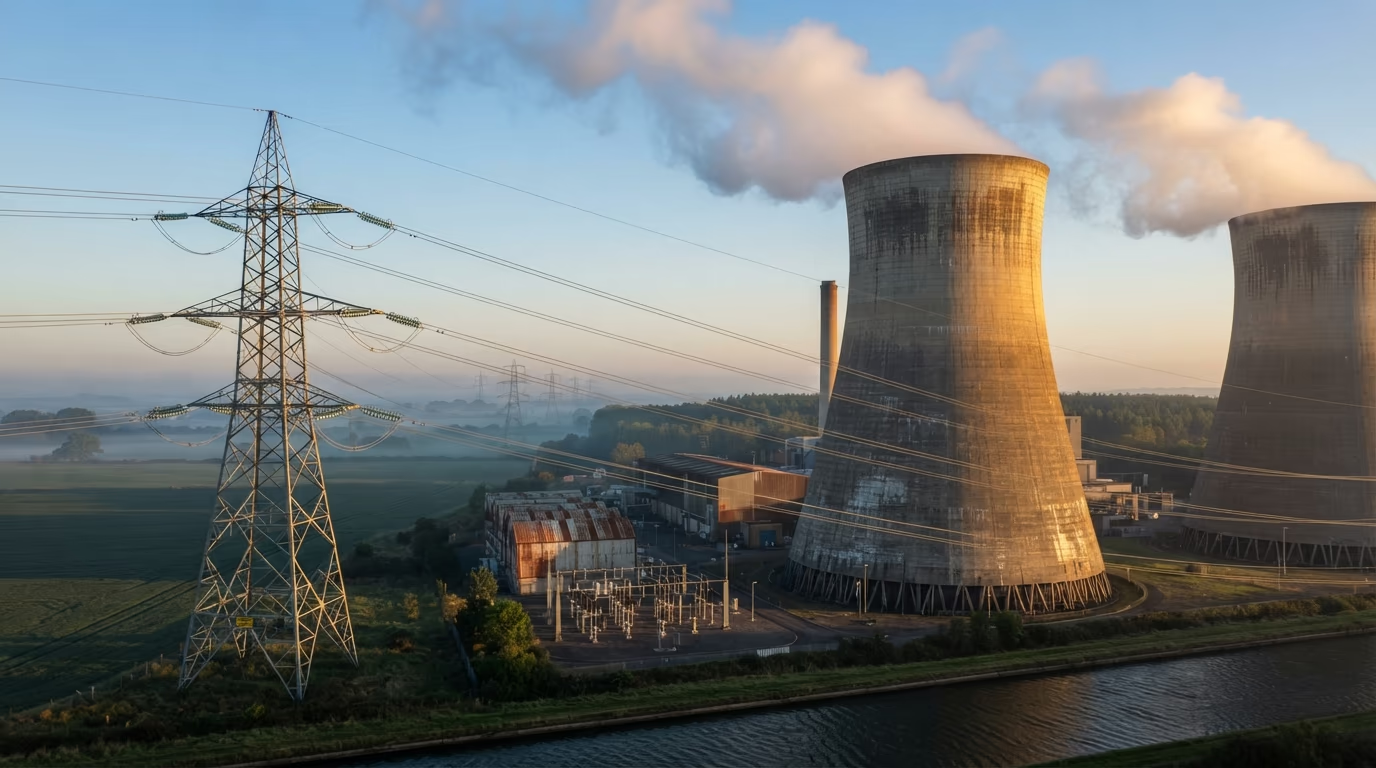
The paper splits AI's water into 3 scopes. Scope 1 is what evaporates on site for cooling. Scope 2 is what power stations consume to generate the electricity the site draws, mostly through evaporation at thermal plants and from hydro reservoirs. Scope 3 is the water used to make the chips and the servers, which is large and badly documented, and Apple reports its own supply chain as 99% of its total water footprint.
For scope 2 the authors use 3.14 liters per kWh as the US average consumption, taken from World Resources Institute guidance, and they note that the Department of Energy's more recent figure is higher at 4.35. Meta self reported 3.7 liters per kWh across its global fleet in 2023, from 55,475 megaliters of water against 14,975,435 MWh of electricity. Withdrawal is a different quantity again, and the US national average there is 43.8 liters per kWh.
Run Google's measured energy through that conversion and a median prompt stops looking like 0.26 milliliters. 0.24 watt hours at 3.14 liters per kWh is 0.75 milliliters consumed at the power station, on top of the 0.26 milliliters Google reports inside its own buildings, so the total lands near 1 milliliter with roughly 3 quarters of it spent somewhere Google does not own. That arithmetic is mine rather than Google's, and a national grid average is a blunt substitute for the actual mix feeding any given site, so read it as an order of magnitude and not as a meter reading.
1 milliliter is impossible to picture, so scale it up. 1,000 prompts is about 1 liter, and a shower head at the United States federal cap of 2.5 gallons per minute moves 9.5 liters every minute, which means it delivers that same liter in about 6 seconds. That comparison does not mean the total is harmless, because a fleet behaves nothing like a single prompt.
Why do the estimates differ by so much?
4 choices decide how much water a published estimate assigns to an AI prompt, and every figure in circulation makes them differently.
- Model and year move the figure more than anything else, since Google says the energy behind its median prompt fell 33 times in the 12 months to May 2025.
- The boundary decides what gets counted, whether that is cooling water on site, the power station as well, or the chip factories too.
- Withdrawal is not consumption, because water borrowed from a river and returned is not water evaporated into the sky.
- Location and weather change the rate, since the same rack evaporates 1 liter per kWh on a cool annual average and up to 9 in a desert summer.
The distinction between withdrawal and consumption is the one that flips headlines. The paper defines withdrawal as freshwater taken from the ground or from a surface source, and consumption as the share that evaporates or is otherwise removed from the immediate environment. A site can withdraw a great deal and consume little, or the reverse, and with good water quality the authors estimate that roughly 80% of a cooling tower's withdrawal ends up evaporated.
The last difference is who did the counting. Google measured its own fleet with its own telemetry and published the method behind it. Everybody else built a model from public efficiency tables, an assumed energy per request and a grid average, then multiplied. A model that starts at 4 watt hours per request lands 17 times higher than one that starts at 0.24, before anyone has argued about a single cooling tower.
What remains missing from all of this is disclosure. Model cards report accuracy and increasingly report carbon, almost none of them report water, and that is the first recommendation the UC Riverside team put in their own conclusions. Until vendors publish figures per model the way Google did for Gemini, everyone outside is modeling, and the open weight models you can download and run yourself are no more transparent about water than the closed ones.
Does one person's prompt actually matter?
One prompt at roughly 1 milliliter does not move anything, and the number that decides whether an AI data center strains a town's supply is the design of that site and the grid behind it. The individual lever is close to zero. The lever at site level is large, and it belongs to the operator and the local authority rather than to the person typing.
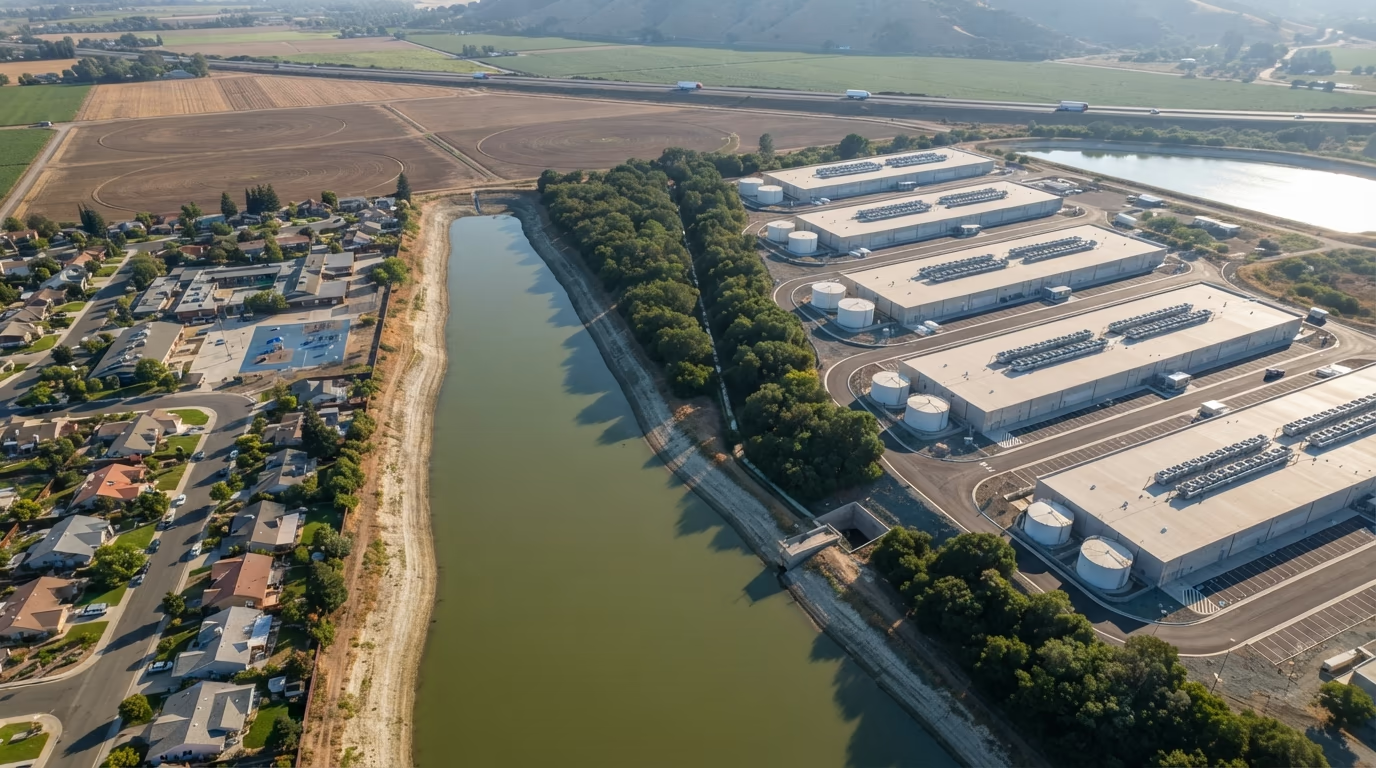
The totals get large because the count is large. Reading Google's environmental reporting, the UC Riverside authors say Google's self owned data centers withdrew 29 billion liters in 2023 and consumed more than 23 billion of them for on site cooling, with nearly 80% of that being potable water. They put Google's growth at about 20% from 2021 to 2022 and about 17% from 2022 to 2023, and Microsoft's at about 34% and about 22% across the same 2 periods.
Their global projection is the figure that ended up in the headlines. They estimate AI demand at 4.2 to 6.6 billion cubic meters of water withdrawal in 2027, which they compare to the annual withdrawal of 4 to 6 countries the size of Denmark, or half of the United Kingdom. It rests on electricity projections for AI published in 2023, and Google's 33 times drop in a single year is a good reason to treat it as a ceiling rather than a forecast.
Operators have started designing the evaporation out. Microsoft said in December 2024 that every new data center design since August 2024 uses a closed loop that consumes zero water for cooling, filled once during construction and then circulated between the servers and the chillers. It puts the saving at more than 125 million liters per year per data center, with pilots in Phoenix and Mt Pleasant in 2026 and those sites coming online in late 2027.
Running a model on your own machine does not delete the water either, it relocates it. Your desktop draws from a grid with its own water intensity, and a consumer card serving one person is far less efficient per request than a rack serving thousands, so running a local model for coding is a reasonable choice for privacy or for cost and a poor one for water. What does move the total is how many calls sit behind each thing you ask for.
A coding agent is where the arithmetic changes. One instruction to a coding agent like Claude Code or Codex can fire hundreds of model calls before it reports back, and a scheduled pipeline runs while you sleep, so the honest unit of measurement is the workflow rather than the prompt. The same compute bill decides how AI companies make money, which is why efficiency work gets funded long before anyone asks about a watershed.
What to check before you repeat a water number
Before repeating any AI water figure, check 5 things, and most numbers in circulation fail at least 2 of them. Each check takes a minute and changes the answer by orders of magnitude.
- Which model and which year, because efficiency moved by more than an order of magnitude between 2023 and 2025.
- Which boundary, cooling water on site only or the power station counted as well.
- Withdrawal or consumption, since one counts water borrowed and the other counts water evaporated.
- Measured by the operator with a published method, or modeled from public tables by somebody outside.
- Which location, because the same hardware can evaporate 9 times more during a desert summer.
Apply the list to the bottle and it survives in one place while it dies in another. As a training figure it holds up, since 700,000 liters evaporated for GPT-3 is a real estimate built on a documented energy total. As a per prompt figure it fails 3 of the 5 checks at once, being the wrong model generation, the wrong boundary and modeled rather than measured, and it has been repeated so widely that Google felt the need to publish a method in order to answer it.
The milliliter is not the number that decides anything locally. Whether a specific campus sits on a stressed aquifer, whether it cools by evaporation or through a closed loop, whether the grid behind it burns water to make electricity, and whether the operator publishes any of that at site level, those 4 questions decide the local answer, and none of them is settled by how often you open a chat window.
The useful precedent from 2025 is the method rather than the figure. Google put a boundary, a date and a number in public where anyone can attack them, and being attackable is exactly what makes a figure worth using. Until the other labs do the same, the honest answer is roughly 1 milliliter for a short text prompt, with a wide error bar and a footnote about where you happen to live.
Questions people ask
How much water does one AI prompt use?
Google measured 0.26 milliliters of water for the median Gemini Apps text prompt in May 2025, counting the water consumed inside its own data centers. Adding the water consumed at the power station, using the US average of 3.14 liters per kWh, brings a single short prompt to roughly 1 milliliter in total.
How much water does one AI prompt use compared with a shower?
About 1 milliliter against 9.5 liters a minute. A shower head at the United States federal cap of 2.5 gallons per minute uses as much water in 6 seconds as roughly 1,000 short text prompts. The comparison covers short text prompts only, since Google's measurement excludes image and video generation.
Does ChatGPT really use a bottle of water for every email?
No. The 500 milliliter bottle comes from a 2023 paper about GPT-3, in which a bottle covered 10 to 50 responses rather than one. The Washington Post, working with the same UC Riverside researchers, later priced an email of 100 words from GPT-4 at 519 milliliters, a figure that counts the power station and a far heavier model than the ones serving chat today.
Do AI data centers use drinking water?
Many of them do exactly that. Cooling towers need clean water to avoid scale and bacterial growth, so a lot of sites draw on the same municipal supply as the houses around them. Reading Google's environmental reporting, the UC Riverside authors say nearly 80% of the 29 billion liters Google's own data centers withdrew in 2023 was potable water.
Is the water gone forever once a data center uses it?
Not all of it, but the evaporated share leaves the local watershed. Withdrawal is water taken from a river or an aquifer, and consumption is the share that evaporates and does not come back nearby. In a cooling tower with good water quality, the UC Riverside authors estimate that roughly 80% of what is withdrawn ends up evaporated.
Does running an AI model on my own computer use less water?
No, it mostly moves the water somewhere else. Your machine draws electricity from a grid that consumes water to generate it, around 3.14 liters per kWh on the US average, and a consumer graphics card serving one person is far less efficient per request than a data center rack serving thousands.
What is water usage effectiveness?
Water usage effectiveness, usually shortened to WUE, is the liters of water a data center consumes for every kWh of energy it delivers. The UC Riverside paper quotes 1 liter per kWh as Google's annualized global figure for its own sites, and up to 9 liters per kWh for a large commercial data center during an Arizona summer.
Does a longer prompt use more water than a short one?
Yes, because water tracks energy and energy tracks the amount of computation, which grows with the tokens read and generated. Google's 0.26 milliliters is a median across text prompts rather than a fixed price, and Mistral's much larger 45 milliliters is quoted for a response of 400 tokens under a full lifecycle audit.