TechOctober 26, 202611 min read
Your Samsung TV screenshots the screen twice a second, if you agreed
Samsung Ads tells advertisers its televisions capture the screen every 500 milliseconds. Samsung's support page tells owners it does not watch the screen. Both of those sentences are published.
A Samsung smart television with Viewing Information Services switched on takes a picture of whatever is on the screen every 500 milliseconds, turns each capture into a fingerprint and matches it against a library to work out what you are watching. That description doesn't come from a leak or from a critic. It comes from Samsung Ads, in a guide for advertisers published through IAB Canada in 2022, which calls the captures glass level screenshots.
Samsung's own support page for television owners, live on samsung.com today, tells a different story in a single sentence, that Samsung does not record or watch any of the content displayed on your Smart TV. Both sentences are published by the same company, and both are defensible in their own terms, because a fingerprint is not a saved video and no employee sits behind the glass watching your living room. Nobody this week has put those 2 sentences side by side, which is what this piece does, with the independent measurement that shows which switch actually stops the traffic.
The reason everybody is talking about Samsung televisions this morning is a thread from a reverse engineer who got inside a recent set and started posting what the code does. Those claims go further than anything Samsung documents, nobody has replicated them, and Samsung has not answered them. Keeping the 3 layers apart, what is documented, what has been measured and what is still one person's reading of a decompiler, is the only way to end up with something true.
Does a Samsung TV really take a screenshot of what is on the screen?
Yes, on a Samsung set where the owner agreed to Viewing Information Services, and the plainest account of it belongs to Samsung Ads rather than to any critic. The guide for advertisers says the technology takes what it calls glass level screenshots twice a second on its opted in televisions, converts them into unique patterns and compares those patterns against a matching library.
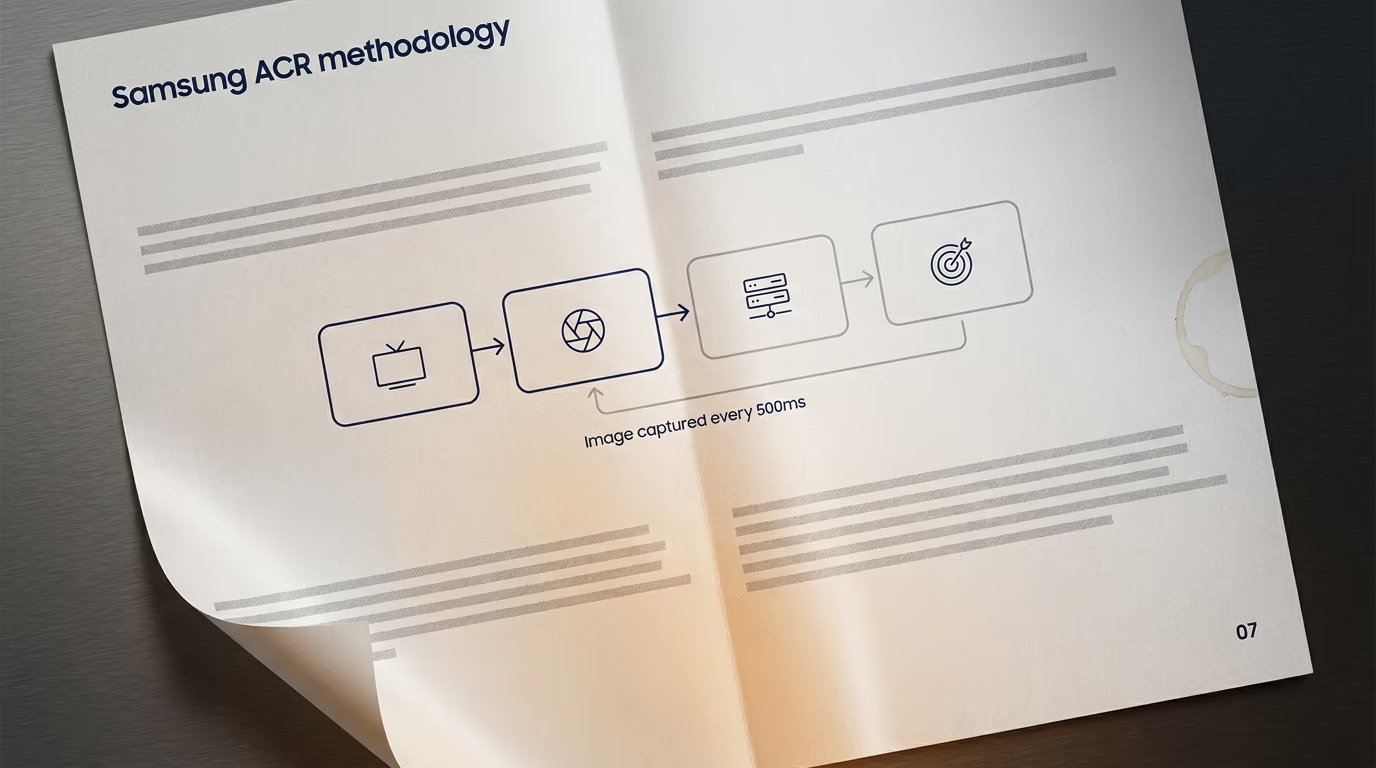
The industry name for this is automatic content recognition, usually shortened to ACR, and the guide explains why the data gets called glass level. The capture happens in software inside the television with no step between what you see and what is measured, so the reading is taken at the last moment before the picture reaches your eyes. The library it is matched against covers linear channels, the advertising inside them, video games and Samsung TV Plus, which is the free streaming service sitting on the home row of every recent Samsung set.
The same guide is also careful about what a fingerprint is. It says the fingerprints are encoded representations of what is on screen and that no human can identify what a fingerprint relates to. Your holiday photos aren't being mailed to an advertiser. The screen is being turned into a number, twice a second, and the number goes to a server that knows which show that number belongs to.
A second Samsung document goes further than the advertiser guide does. The SmartTV supplement published on samsung.com says that when SyncPlus or other marketing features are enabled, Samsung provides video or audio snippets of the program you are watching to third party providers, which use them to send back content or advertising matched to what is on your screen. Those are Samsung's own words about Samsung's own televisions, published years before anybody got a shell on one.
Read next to that, the sentence on Samsung's consumer page is narrower than it first sounds. Samsung does not record or watch the content, in the sense that no recording is kept and no person looks at it. The capture still happens, and the result still describes what was on your screen and when.
What did a reverse engineer find inside his own TV this week?
A reverse engineer posting as log4j says they took a root shell on their own 2025 Samsung television and found code for detailed telemetry, audio categorization, screenshots and a cross device advertising ID, which Tom's Hardware reported on 25 October 2026. Their first post went up on 21 October, after they noticed that the advertising on the set was oddly well aimed.
The route in explains why nobody had read this code before. log4j says the firmware is encrypted, with no keys available short of taking the set apart and soldering onto its debug pins, so they used software flaws to get a shell instead. Tizen, the system on the other side of that shell, is Samsung's own Linux based platform for its televisions, and almost nobody outside Samsung ever sees its insides.
What they describe finding is a small model running on the television itself. Tom's Hardware reports a region specific convolutional neural network, which is the kind of AI that looks at pictures, tracking which videos get watched, which advertisements get skipped and how far through a video somebody stops. Models that small run on the chip inside a television through runtimes like Google's LiteRT, previously called TensorFlow Lite, and they are the same class of software that spots a face in a phone camera. None of it needs a data center, which is exactly why a television can afford to run one, and it is the opposite end of the scale from the machines people buy to run AI models at home.
The claim that traveled furthest is about sound. log4j says a set with no microphone of its own looks for a connected device that has one, a soundbar or a Bluetooth speaker, and records through that. One outside reader went looking for that behavior on their own set. ngxson, an engineer at Hugging Face, watched for radio activity with a Flipper Zero and saw the television open the microphone for exactly 5 seconds and then stop, with nothing further for hours, and noted that their own set was already rooted with several settings turned off, so it isn't a clean comparison with a television out of the box.
At the end of the thread log4j wrote that they had finally found a company that truly listens to its customers. It's a good joke, and it's also the trouble with a story told through screenshots of a decompiler. A promised write up has not appeared yet, so no second pair of eyes has read the same code, and the comment threads under the coverage already hold readers calling the whole thing invented.
Has anybody independent measured what a Samsung TV sends out?
Yes, and the measurement is 2 years old. Researchers from University College London, the University of California Davis and Universidad Carlos III de Madrid put Samsung and LG televisions on a monitored network and published the results at the ACM Internet Measurement Conference in Madrid in November 2024, in a paper titled Watching TV with the Second Party.
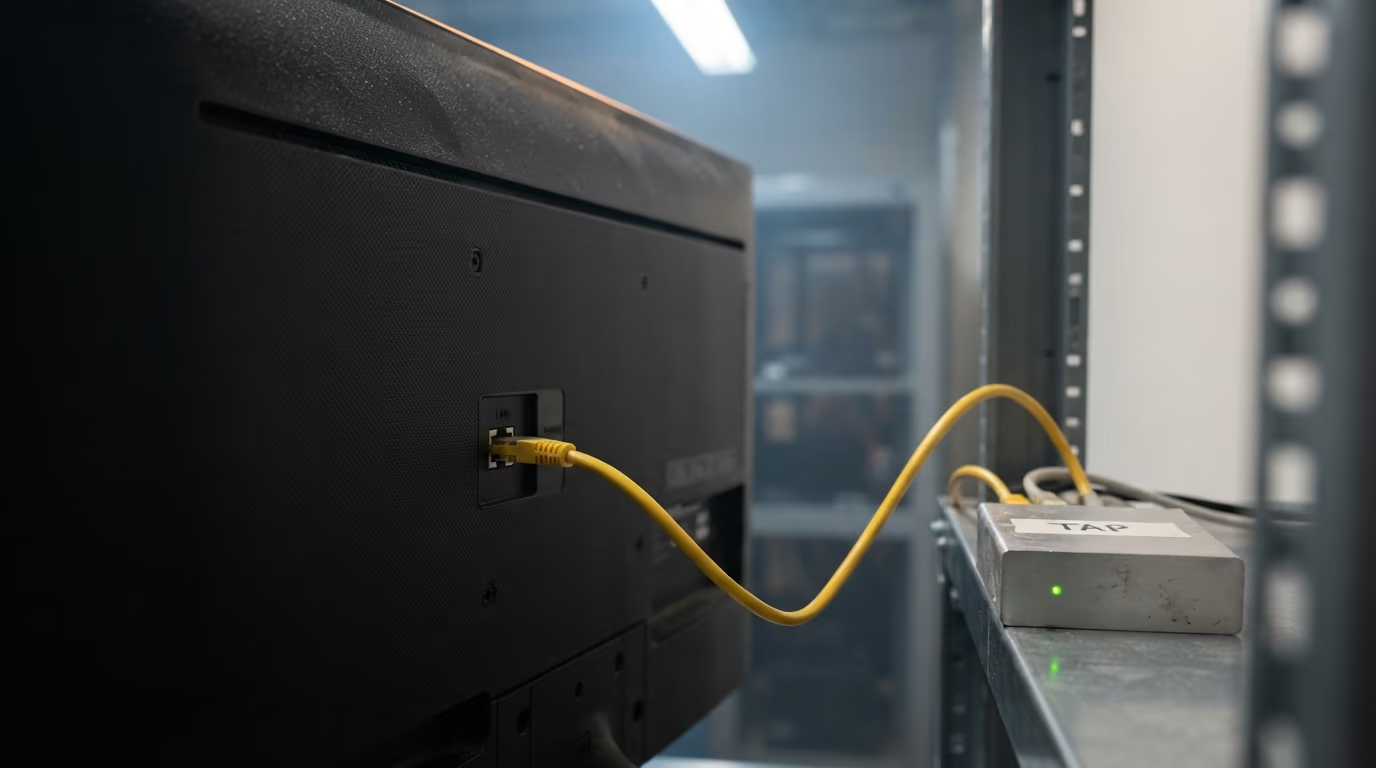
Their Samsung set contacted Samsung's recognition servers once a minute. The team also notes that Samsung's own documentation describes captures twice a second, which suggests the television collects them continuously and sends a batch every minute, and the paper is explicit that it is assuming which of the named Samsung domains carries the fingerprints.
3 findings in that paper matter more than its traffic graphs. The recognition kept running while the television was used as a plain external display over HDMI, so a laptop or a games console plugged into a Samsung set was being identified too. Being signed out of a Samsung account made no measurable difference, which means the tracking rides on the television's advertising ID and its address rather than on who is logged in. And when the researchers declined the advertising and viewing agreements in the menus, communication with every recognition domain stopped completely, with no new domains appearing in their place.
One detail cuts the other way and deserves saying. Traffic dropped sharply while the team streamed from a third party app, and the paper's own reading is that content rights and the streaming services themselves restrict recognition, citing Netflix's stated preference to keep it switched off during its own streaming. Linear channels and HDMI carried no such restriction.
Those 3 bodies of evidence are not equally solid, and the table below keeps them apart.
| What is claimed | Who says it | How solid it is today |
|---|---|---|
| The television captures the screen twice a second | Samsung Ads, 2022 guide for advertisers | Samsung describing its own product |
| Recognition traffic leaves the set once a minute, HDMI included | Peer reviewed measurement, Madrid, November 2024 | Independent and published |
| Declining the agreements stops that traffic entirely | The same measurement | Independent and published |
| A model on the set tracks skipped ads and video progress | log4j, reported by Tom's Hardware | One person, not replicated |
| A television without a microphone records through a soundbar | log4j, reported by Tom's Hardware | One outside test, inconclusive |
| Samsung does not record or watch your screen content | Samsung's own ACR support page | The company's own wording |
Why does a television maker want to know what is on your screen?
Because the viewing data is a product and Samsung sells it. Samsung Ads says on its own site that it reaches 3 in 4 United States television households, and pairs that reach with what it calls deterministic data, meaning readings from actual televisions rather than from a survey panel.

The advertiser guide is blunter about the scale than any consumer page is. It calls Samsung Ads the largest continuously growing ACR footprint globally, on the strength of Samsung being the world's number one television maker. The case studies on the company's site name the brands that bought the targeting, among them Crumbl, Jersey Mike's and Marriott Bonvoy, each written up as a campaign that found the right households on the biggest screen in the house.
That is the business a television is now in, and it explains the advertising that set off this whole story. A television sold once keeps earning for years afterwards if it can tell an advertiser which households saw a commercial and which skipped it, which is the same logic that runs underneath the way AI companies make their money on the software side.
Collecting it without asking has a documented price. In February 2017 the Federal Trade Commission and the state of New Jersey settled with Vizio for $2.2 million over software that collected a selection of pixels from the screen every second and matched them against a library of television, film and advertising on millions of sets, without telling the people who owned them. The order forced Vizio to disclose the collection clearly and to get express consent before doing it again, which is why every television you buy now opens with a wall of agreements.
How do you switch the tracking off, and what stops working?
You switch it off on the television itself, in the screen that lists the agreements you accepted when you first set it up, and Samsung's own advertiser guide says a set with those services declined still works normally. On recent models the route is Settings, then All Settings, then General and Privacy, then Terms and Privacy. On older sets the same screen sits under Settings and then Support.
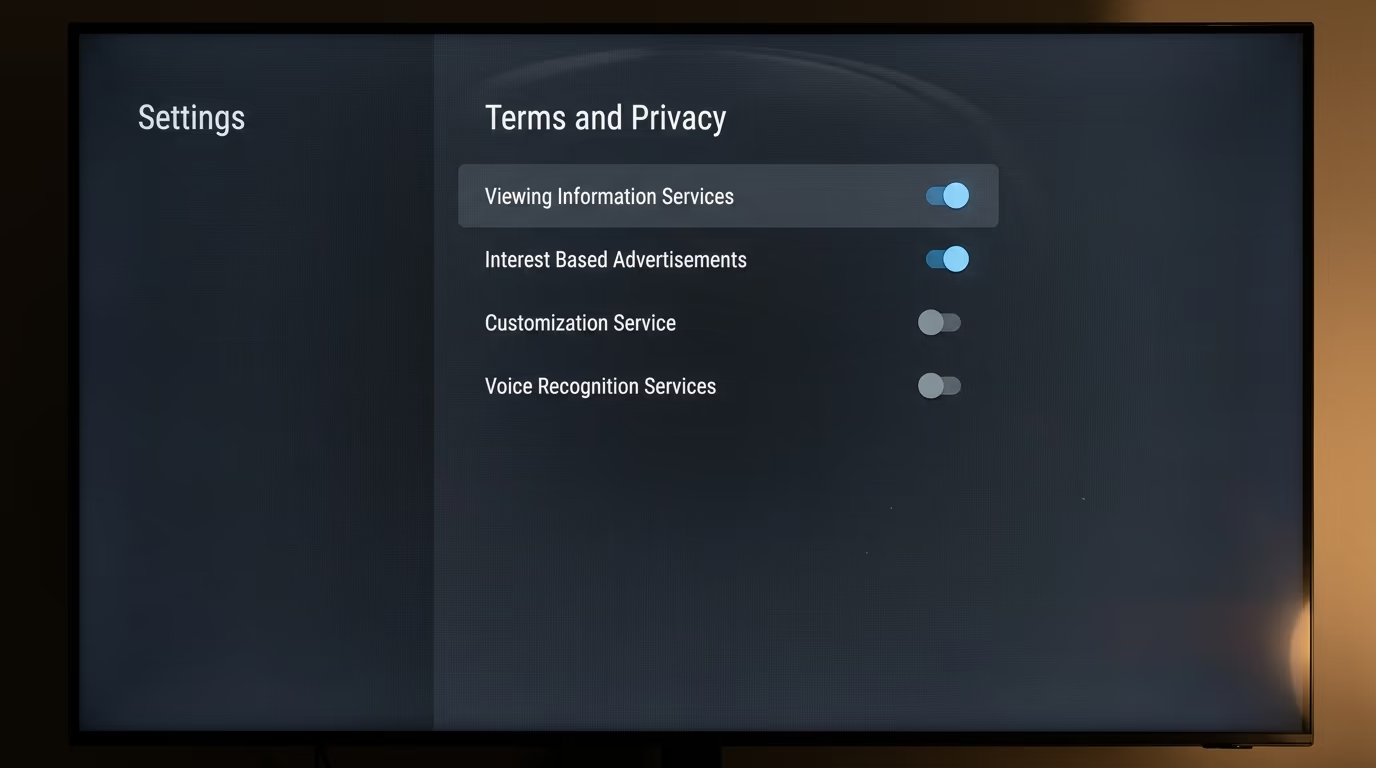
Samsung's own ACR page names no menu at all. It says you have always had the right to opt out of ACR and that you should simply go to the Settings menu and adjust your preferences, which is true and nearly useless to somebody holding a remote control. The researchers in the Madrid paper listed exactly what they switched off on the Samsung set, and that list is the most reliable map anybody has published:
- I consent to Viewing Information Services on this device
- I consent to interest based advertisements
- Customization Service
- Improve personalized ads
- Do not track, which is the one you turn on rather than off
Samsung's guide for advertisers states the cost of refusing, in its own words. A viewer who does not opt in, or who withdraws consent later, is not affected in their use of the television, though interest based advertising and recommendations may stop working, and generic advertising still arrives. The picture, the apps and the remote all behave the same afterwards. You lose the personalized suggestions on the home row and you keep the adverts, now aimed at nobody in particular.
What the measurement adds is the only proof that the switch does something. After the researchers declined those agreements, recognition traffic disappeared from their capture entirely, which is a stronger result than any vendor promise. It covers the documented recognition and nothing else, so it says nothing about the behaviors claimed this week, which nobody has tested against the settings. The same instinct applied to the machine you actually work on is worth an evening, starting with what the programs on your laptop are allowed to see.
Why did an AI tool refuse to help him look inside his own TV?
log4j says OpenAI banned their account for cyber abuse while they were reverse engineering a television they own, and says the work was local analysis rather than an attack on anybody, which Tom's Hardware reported alongside the rest of the thread. They put the ban down to a crude classifier rather than to a person reading what they were doing.
This article can't quote OpenAI's rules on the question. Both openai.com and chatgpt.com refused requests from this machine today, so the usage policy was not read at source, and no public statement about this account exists to read either. What remains is one person's account of one email, which is exactly how it is reported here.
The wider problem is real whatever happened in that inbox. The tools that are good at reading firmware are the same tools trained to refuse anything that smells like offensive security, and a classifier can't see the difference between somebody attacking a stranger's device and somebody auditing a television in their own living room. There is a defensible reason for the caution, because the same skill pointed at hardware you do not own is a crime, and the labs have spent a year watching AI assisted flaw hunting find real holes in software everybody runs, as it did with the PHP flaw patched this month.
The cost of that caution falls on the one kind of security work a consumer benefits from directly, which is a person checking what they already paid for. Nothing in Samsung's documentation would ever have reached a reader without somebody willing to open the set, and the documentation is the solid half of this story.
What we do not know yet about the Samsung TV claims
Samsung itself has said nothing at all. No statement from the company appears in any of the coverage read for this article, and nothing on samsung.com mentions the claims, so every sentence attributed to Samsung here comes from documents it published long before this week.
Nobody has replicated the audio findings either. The only outside test so far saw a microphone open for 5 seconds and then stay shut, on a television that had already been modified, and the promised write up that would let other engineers read the same code has not been published. Until it is, the sound sensor is a claim with screenshots attached rather than a measurement anybody can repeat.
How widely any of it applies is unknown. The model was described as region specific, no firmware version has been named publicly, and nobody can say today which Samsung televisions in which countries behave the way this one did. Whether declining the agreements stops the behaviors claimed this week is equally untested, since the Madrid measurement covered the documented recognition traffic and was carried out long before these claims existed.
Even Samsung's own paperwork is older than its televisions. The SmartTV supplement a reader finds on samsung.com still names Nuance Communications as the service that turns voice commands into text, which dates it to a different generation of hardware, while the main privacy policy carries an effective date in July 2026. Somebody reading those pages tonight is not reading a document about the television in their living room.
Questions people ask
Does my Samsung TV take screenshots of my screen?
On a Samsung television where Viewing Information Services was accepted, yes. Samsung Ads' guide for advertisers says the technology takes what it calls glass level screenshots twice a second and turns each one into a fingerprint matched against a library. Samsung's support page adds that no recording is kept and that no person watches the content.
Does a Samsung TV listen through my soundbar?
That claim comes from one reverse engineer and has not been confirmed. log4j says a television without its own microphone looks for a connected device that has one, and the single outside test saw a microphone open for 5 seconds and then stop, on a set that had already been modified. Samsung has not answered the claim.
How do I stop my Samsung TV from tracking what I watch?
Open Settings on the television, then All Settings, then General and Privacy, then Terms and Privacy, and decline Viewing Information Services along with the interest based advertisements and the Customization Service. On older sets the same screen sits under Settings and then Support. Researchers who declined those agreements in the Madrid study recorded no further recognition traffic from the set at all.
Does turning off Viewing Information Services break the TV?
The television keeps working the same way. Samsung's own guide for advertisers says a viewer who declines or later withdraws consent is not affected in their use of the television, while interest based advertising and recommendations may stop working. Generic advertising still reaches the screen.
Does my Samsung TV still track me when I use it as a monitor?
Yes, according to the peer reviewed measurement published at the ACM Internet Measurement Conference in Madrid. Recognition kept running while the television was used as a plain external display over HDMI, so a laptop or a games console plugged into the set was identified as well.
Has Samsung responded to the October 2026 claims about its TVs?
Samsung had not commented publicly when this article was published. No statement from Samsung appears in the coverage read for it, and the company's own ACR and privacy pages make no mention of the claims. Everything quoted from Samsung here was published before the thread appeared.