AIOctober 30, 202613 min read
Mistral Large 4's license is not Apache 2.0, and Large 3's is
Mistral put the weights of its 1 trillion parameter model online on 29 October. You can sell what you build with it, unless your group already sells access to models.
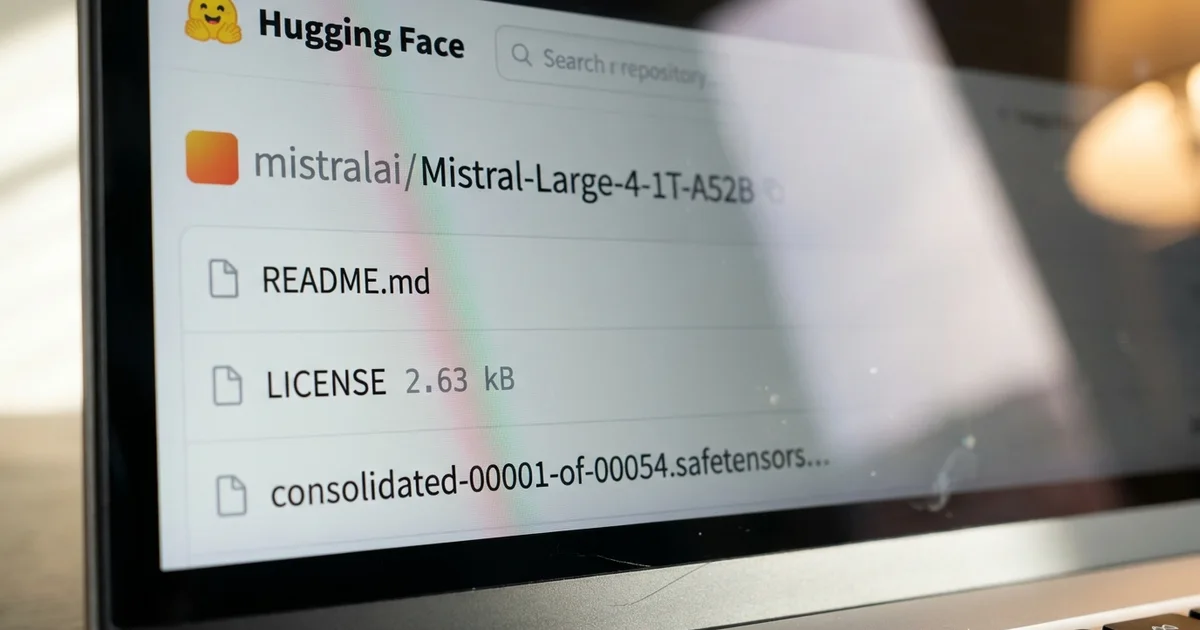
Mistral put the full weights of Mistral Large 4 online on 29 October, under a license it wrote itself rather than the Apache 2.0 that still covers the Mistral Large 3 this model replaces. The new terms let anybody use, change, fine tune and sell what they build with the model, with one condition aimed at a single category of company, the businesses that sell other people access to models. Mistral calls it a modified MIT license and names that condition in its announcement. The file sitting in the repository reaches a little wider than the summary does, and this piece reads both of them against each other.
What did Mistral put online on 29 October?
Mistral published the complete weights of Mistral Large 4 on Hugging Face on 29 October, so anybody with the hardware can now run the model on machines they control instead of calling Mistral's servers. The repository holds the model split across dozens of files plus a short license and a long model card, and the file sizes Hugging Face publishes for it add up to 1,060.6 GB. That is more storage than most laptops contain in total, and it arrives as a single indivisible lump.
The 2 timestamps do not quite agree, which tells you how tight the morning was. The announcement carries a published time of midday UTC, while the repository's own record says its files stopped changing almost 3 hours afterwards. Anybody who read the post the minute it appeared and clicked straight through to download arrived at an upload that was still running.
The release had been promised in writing. When Mistral opened the public preview earlier in October, the same blog said "We will release the weights by the end of the month", and when this blog checked at the time there was nothing on Mistral's Hugging Face account at all, which is why the piece ran under the title Mistral Large 4 is open weight, and your laptop can't run it. The promise was kept with days left on the clock. Mistral's own speech model arrived earlier this month with no weights at all, so the question was a fair one to ask.
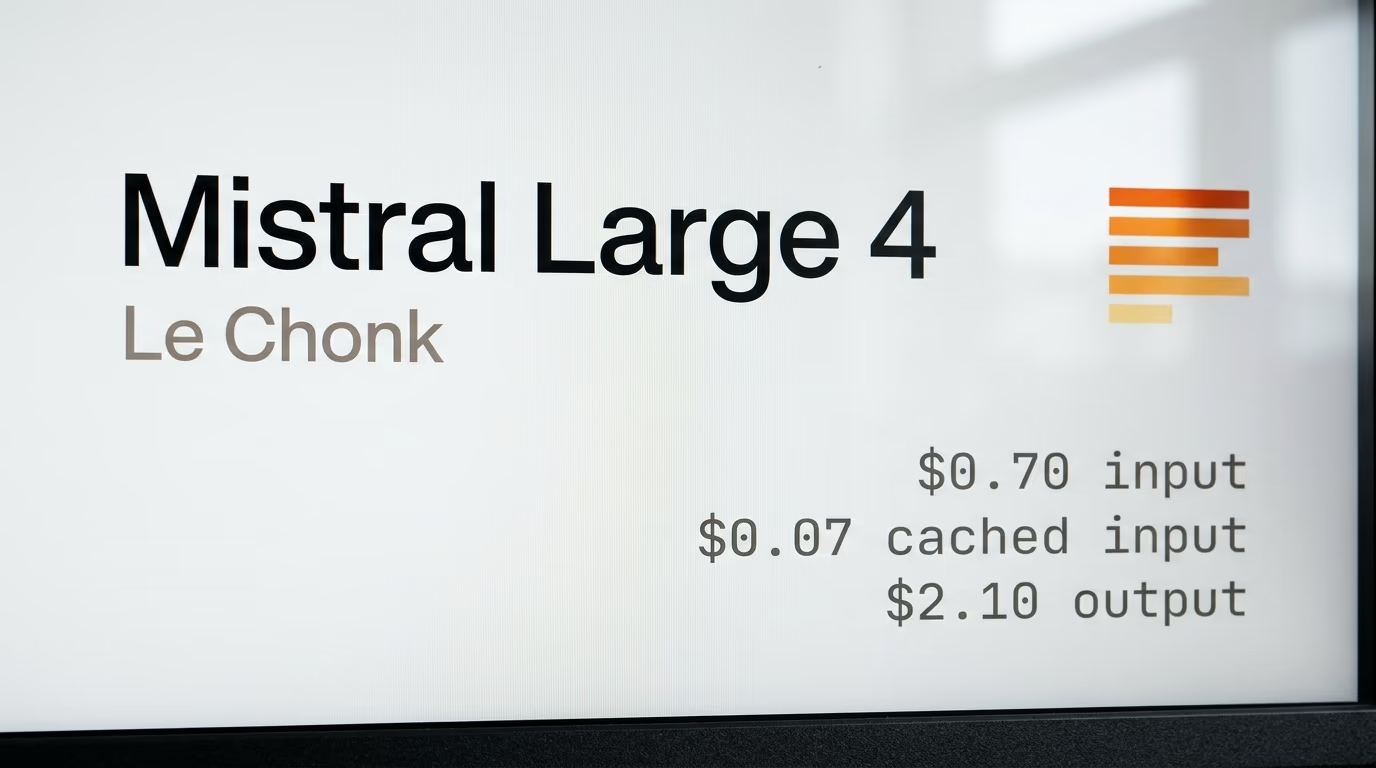
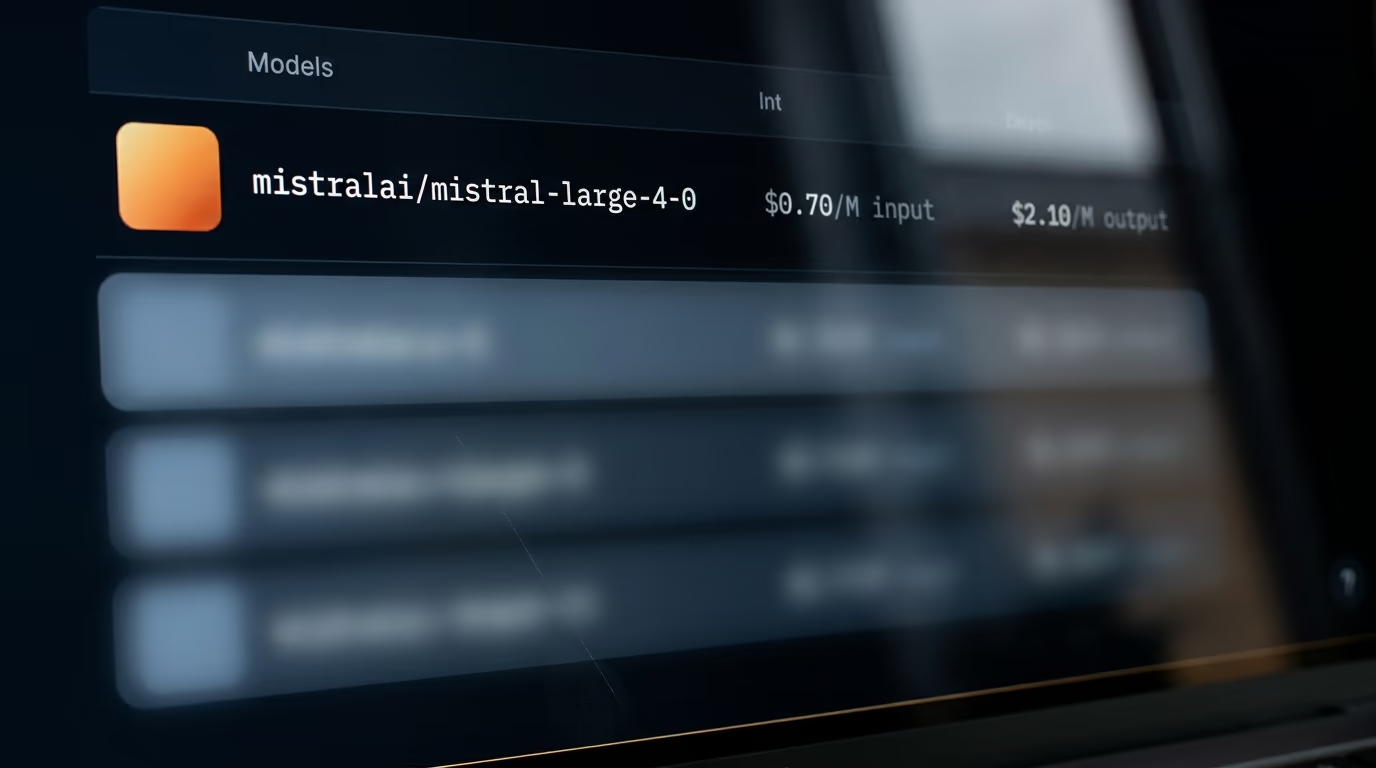
Calling the model through an API costs what it cost before. Mistral's rate card prices the hosted version at $0.70 per million tokens of input and $2.10 per million of output, and OpenRouter, which resells access to it, lists the same 2 figures to the cent. A million tokens is roughly 700,000 words, so reading a long novel costs a few cents and the download costs nothing. Everything around the weights, the machines and the electricity and the engineers, is where the money actually goes.
Mistral says the model is its best for writing code and for defensive security work, and the scores on the announcement page are the ones Mistral measured itself, including the ones carrying an outside company's benchmark name. No independent evaluation of the shipped weights existed when this piece went out. The company also says the model reads images as well as text, holds roughly as much text in one conversation as a long book series, and speaks every official language of the European Union.
What does the Mistral Large 4 license let you do?
The license Mistral attached to Mistral Large 4 lets you use, copy, change, merge, publish, sell, deploy and further train the model, and build derivative works from it, which is close to what an ordinary open source project allows. Mistral describes it as a modified version of the MIT license, and the file opens with almost the same grant of rights that MIT has used for decades. You can read the whole thing in a couple of minutes at the license file in the model repository.
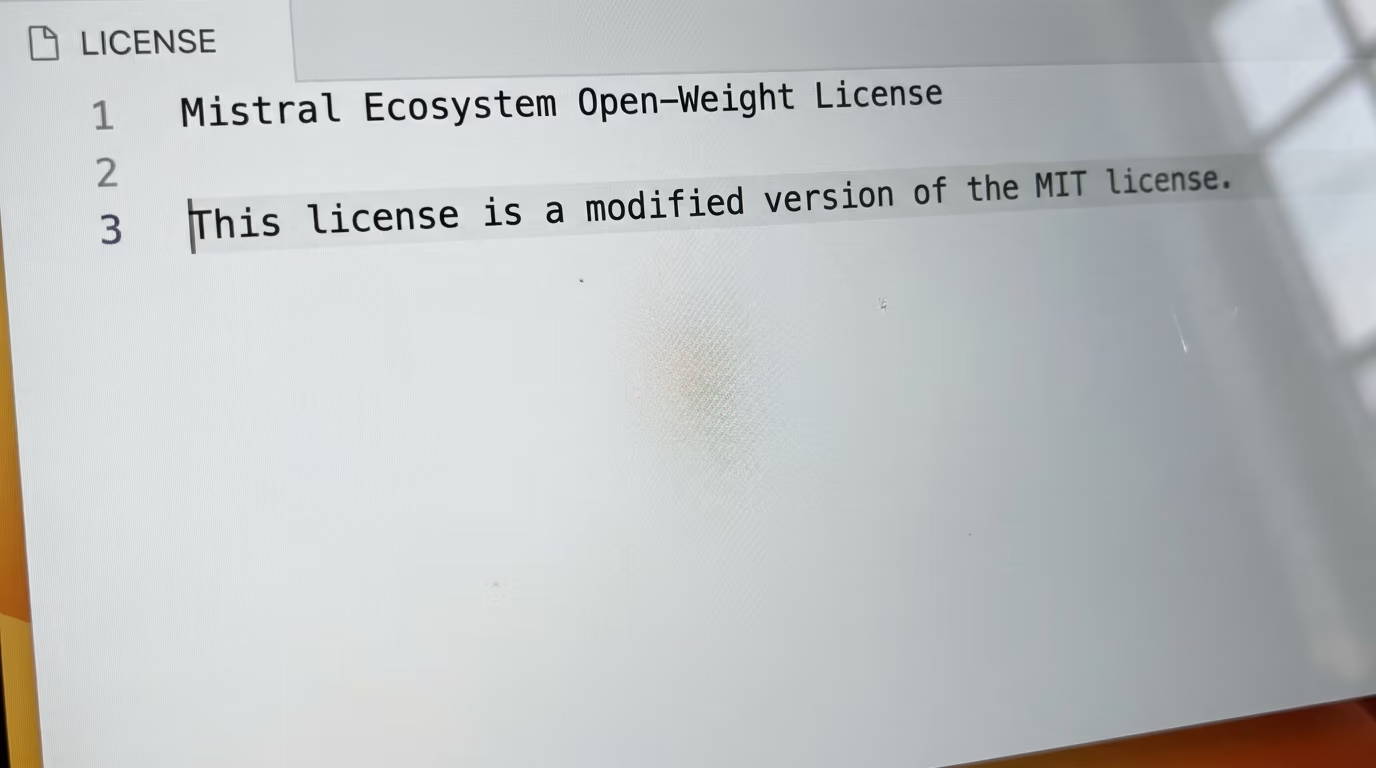
Read it and the familiar shape is obvious. Permission is granted free of charge to any person obtaining a copy, and Mistral widened the definition so the weights, the parameters, the configuration files and the documentation all count as the thing being licensed. There is no research only clause, no ceiling on how many users your product may have, and no acceptable use policy stapled to the end, which are the devices that usually make a supposedly open model unusable inside a real company.
The duty that comes with it is the one MIT always carried. You keep the copyright notice and the license text in every copy or substantial portion of the model you pass on, which is why the community copies of the weights all carry the full license text in their own repositories. The file closes with the usual capitalised disclaimer saying the model and anything it produces are provided as is, with no warranty of any kind, and that Mistral is liable for nothing.
The file also leaves out several clauses that other labs put in. There is no clause letting Mistral revoke your rights later, no reporting requirement, no obligation to name Mistral in your product, and no restriction on which countries you may operate in. The model card adds one sentence outside the license, saying you must not use the model in a way that infringes anybody else's rights, and that sentence is guidance rather than a condition with teeth.
If you have never had to care about any of this, a plain explanation of what an open weight model is is the right place to start, because the term covers 2 very different situations. Some labs publish files anybody may download and do anything with. Others publish files you may download and then may not use for the thing you actually wanted. Mistral Large 4 sits far closer to the first than the second, and the single condition decides which camp you personally land in.
Who has to call Mistral before selling anything built on it?
A company has to agree separate commercial terms with Mistral if it, or any company affiliated with it, runs a business that gives other people access to models. Mistral's announcement calls this a single condition and describes it as applying to businesses that operate a Model as a Service offering, which is the industry term for selling model access by the token.
The file states it with more reach than the summary does. Condition 2 says that if the licensee or any of its affiliates operates a Model as a Service business, the licensee must enter into a separate commercial license with Mistral before using the model or its derivative works for any commercial purpose. The trigger is what the corporate group does, not what the particular product in front of you does, and that distinction is the one the blog post leaves out.
Condition 3 pulls most of that back again. The requirement does not apply to internal use, which the file defines as any use that does not make the model available to anybody outside, and it does not apply to using the model through Mistral's own products. A bank that runs the weights on its own hardware for its own staff is in the clear whatever else that bank happens to own, and so is a studio using Mistral's hosted service in the normal way.
Mistral also writes down what does not count as selling model access, which is the useful half for anybody building a product. Putting the model inside a feature of an application you sell is not Model as a Service. Relaying a request to a copy somebody else hosts is not Model as a Service either. What is caught is giving a customer meaningful control over the inputs, the settings or the training data, which is a fair description of what an inference provider sells for a living.
For a solo developer or a small studio, none of this changes anything at all. You can ship a product with Mistral Large 4 inside it, charge money for that product, and never speak to anybody at Mistral. The condition was written for the companies that would resell the model itself, and those companies already employ people whose job is reading clauses exactly like this one. A license can still say free to download and refuse you the one thing you wanted to do with it, which has been the common shape all year.
Why does it matter that Mistral Large 3 is still Apache 2.0?
The Mistral Large 3 that this model replaces carries Apache 2.0 on Mistral's own documentation table, and Mistral Large 4 is the only entry anywhere on that table carrying the new license name. The difference is not really about what you may do today, because the new terms are generous. A license written by the company that ships the model can be rewritten, reinterpreted and enforced by that same company, and a standard license cannot.
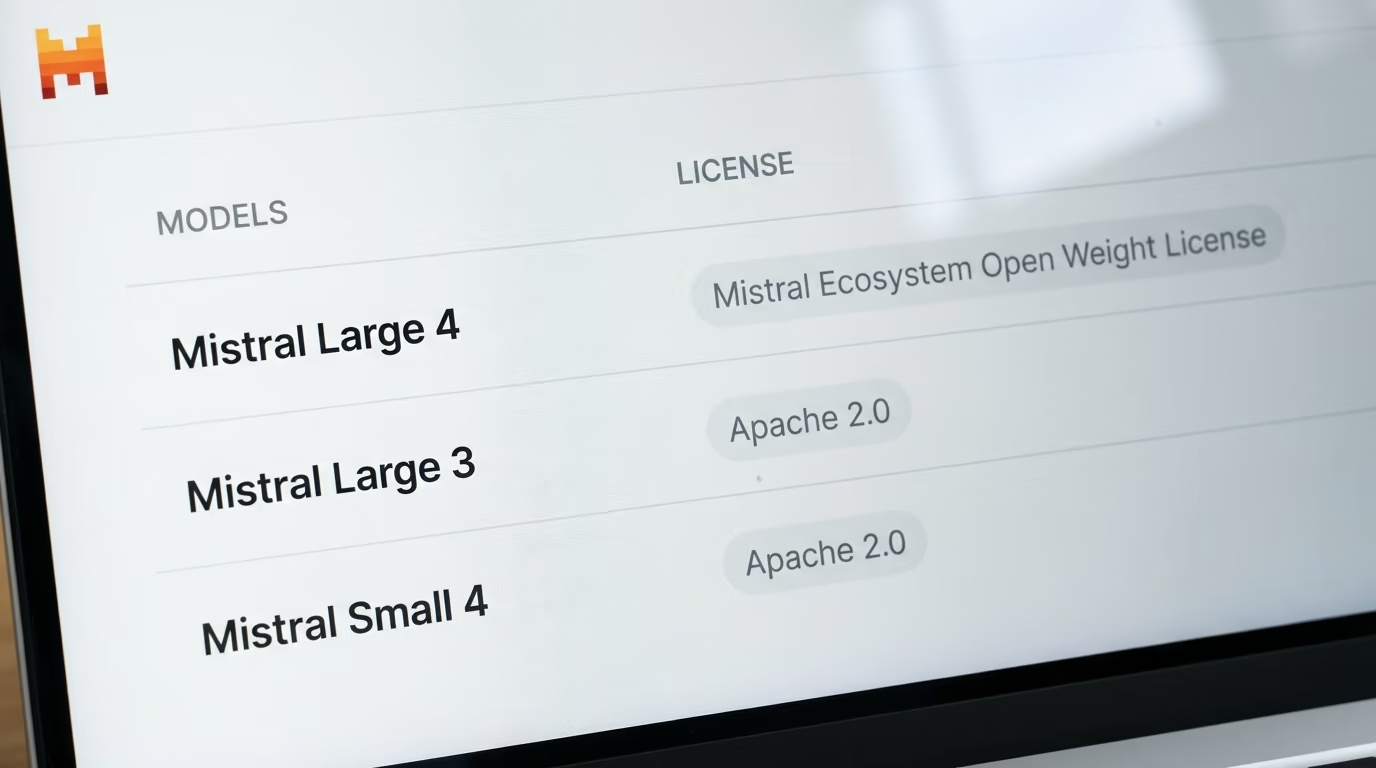
| Model on Mistral's own table | License it carries |
|---|---|
| Mistral Large 4 | Mistral Ecosystem Open-Weight License |
| Mistral Large 3 | Apache 2.0 |
| Mistral Small 4 | Apache 2.0 |
| Ministral 3, in all three sizes | Apache 2.0 |
| Mistral Medium 3.5 | Modified MIT |
The table shows where Mistral is heading. Every small and medium sized model Mistral ships for download still carries a standard license, and the one that moved is the big one, the one with commercial value to a reseller. Mistral Medium 3.5 already carried a label reading Modified MIT before this release, so the company had tried the shape before. The flagship is where the company has now applied it.
A standard license is old, boring and widely understood, which is most of its value to a buyer. Any company can build a paid service on an Apache licensed model without asking the author, and that is precisely the freedom the new condition removes for one category of customer. Nothing in the new terms is unusual by the standard of what the large American labs ship with their open models, and it is still a step away from what Mistral itself shipped with the previous version. We ranked the open models by their licenses earlier this year and the direction of travel across the industry has been the same one.
One contradiction sits on Mistral's own money page rather than in a forum thread. The pricing page asks whether you can self host Mistral's models and answers that open weight models are Apache licensed for research or individual use, while commercial deployments require a Mistral license with separate terms. That answer does not match the license shipped with the new model, which allows commercial use outright. Somebody trying to settle whether they may use this at work gets 2 different answers on the same website, and only one of them is the actual license.
Can you download Mistral Large 4 and run it tonight?
You almost certainly cannot run Mistral Large 4 at home, because the smallest copy anybody has published is still measured in hundreds of gigabytes and the official full set is larger than a terabyte. Running it needs a row of server cards rather than a computer you own, and Mistral's own serving instructions assume a machine holding several of them. For anybody outside a data center this is a model you rent rather than a model you keep.
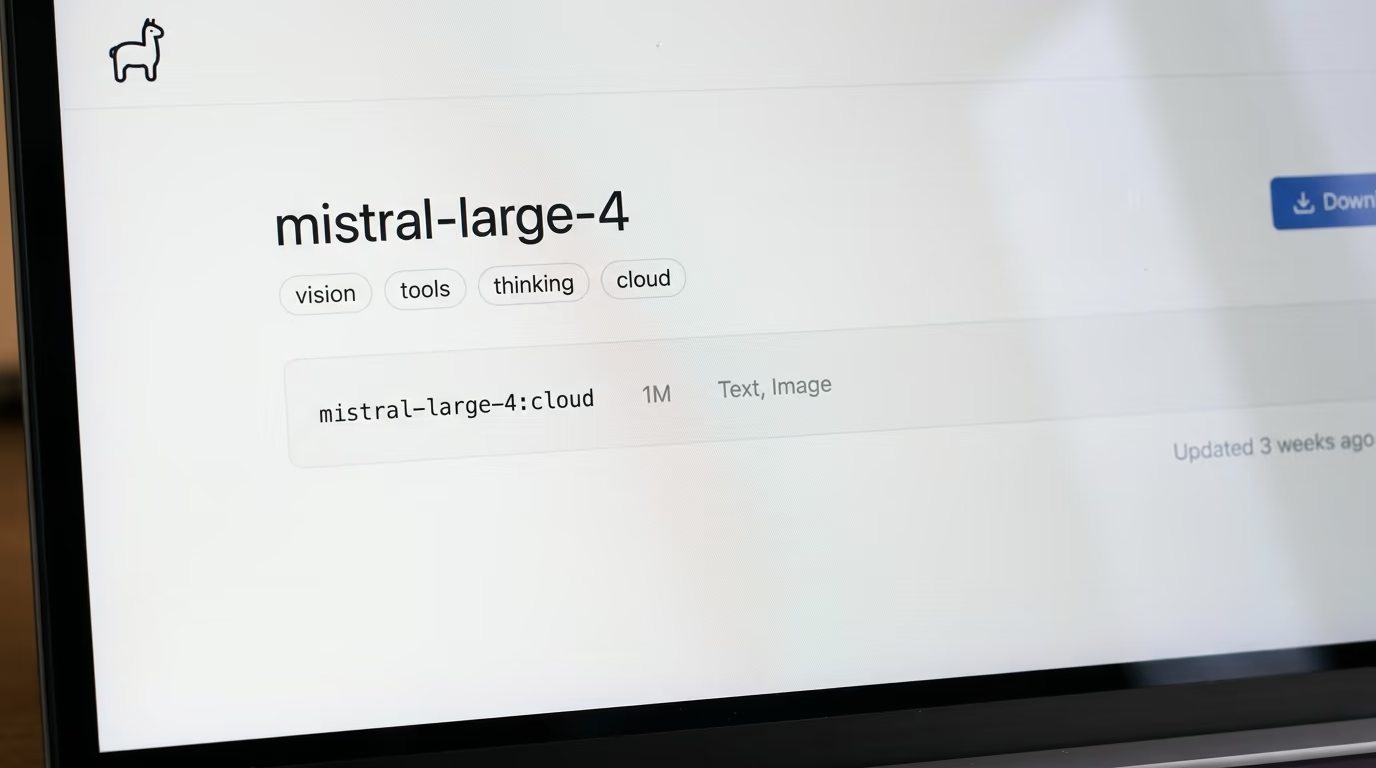
The easiest route a normal person uses is not open yet either. Ollama, the app most people install to run a model on their own machine, lists exactly one tag for the new model and it is the cloud tag, which sends your request to somebody else's hardware and bills you for it. Its page says it was last updated 3 weeks ago, which puts that update before the weights existed. There is nothing on Ollama to download at all.
Compression brings the size down a long way and still not far enough. Unsloth published a run of squeezed copies within hours of the release, and even the most aggressive of them, which throws away a lot of the model's precision to save room, weighs 233 GB. The ggml project published its own set the day before the weights landed and its smallest copy is bigger still. Set that against what a gigabyte of memory costs on a machine you can actually buy and nothing on that list comes close.
| Route | What you get | Size or rate | Published by |
|---|---|---|---|
| Mistral API | Hosted calls, nothing to install | $0.70 in and $2.10 out per million tokens | Mistral |
| OpenRouter | Hosted calls through a reseller | $0.70 in and $2.10 out per million tokens | OpenRouter |
| Hugging Face, full weights | The complete model, dozens of files | 1,060.6 GB | Mistral |
| Hugging Face, smaller official copy | A compressed copy for recent NVIDIA cards | 610.1 GB | Mistral |
| Hugging Face, community copies | Compressed copies for llama.cpp | From 233 GB upwards | Unsloth and ggml |
| Ollama | A cloud tag only, no local file | Nothing to download | Ollama |
For the company that does have the hardware, the supported routes are named on the model card and they are the ordinary ones. Mistral recommends vLLM and publishes a ready made container for it, SGLang has its own recipe, Hugging Face's own library works from the development branch, and llama.cpp reads the community copies. Fine tuning is covered by Axolotl, Unsloth and TRL. None of that is unusual, and all of it assumes a server rather than a desk.
The honest advice for a reader at home is to call the model rather than keep it. Mistral's own service, OpenRouter and Microsoft Foundry all serve it today, and the published rate is low enough that an evening of experimenting costs less than a coffee. Downloading the weights is a decision for a company with a data center and a reason to own the thing outright, which is exactly who Mistral wrote this announcement for.
What does Mistral say about the risk of its own open weights?
Mistral wrote in the same announcement that it sees "a potential for uplift to conduct real attacks" and that it is modifying its guardrails accordingly. That sentence sits a few screens above the link that lets anybody download the weights. Mistral published the warning itself, on its own launch page, and nobody forced the disclosure.
The full passage is careful and worth reading as written rather than summarised. Mistral says it monitored cybersecurity related use in its live traffic after the preview opened, that it observed the model refusing to comply with black box attacks against live targets, and that it nonetheless sees a potential for uplift to conduct real attacks. The company says it is modifying its guardrails accordingly and will keep updating them in the months to come.
Guardrails only reach the copy the company controls. A model served through an API can be changed overnight and the next request gets the new behaviour. Once the weights are sitting on somebody else's disk, no update reaches them, the refusal behaviour that shipped that morning is the behaviour that copy keeps, and further training can remove it on purpose. Mistral does not claim otherwise and the announcement does not discuss it either way.
Mistral also split the release in 2. The general model is a free download for anybody with the bandwidth to take it. A separate version tuned for penetration testing, vulnerability assessment and red teaming goes only to enterprise design partners such as Orange Cyberdefense, under what Mistral calls rigorous vetting and contractual safeguards, with testing restricted to systems the customer owns or has written permission to touch. The version tuned for offensive work needs a contract and a lawyer, while the general one needs a download.
Mistral is not alone in that shape and the quotes on its own page show who the release is aimed at. Executives from Booz Allen Hamilton, Cisco, Cloudflare, CrowdStrike, Fortinet and the European Union's cybersecurity agency all appear on the announcement arguing that defenders need models they can run and inspect themselves. That argument is a real one and a serious one. The counter argument is printed on the same page, in Mistral's own sentence about uplift, and Mistral is the company that put it there.
What we do not know yet about Mistral Large 4
Several things about Mistral Large 4 are still unsettled on the public record this morning, and naming them is more useful than guessing at them. Each one can be checked at a primary source later rather than argued about now, and each will change what a buyer should do.
Whether the hosted rate just went up. The announcement prices input at the rate quoted above and says that rate starts today, while this blog read Mistral's documentation earlier in October and found the same model listed at $0.68. Neither page mentions a promotion ending, neither explains the difference, and the gap is small enough that nobody will notice except the companies buying tokens by the billion.
Whether the preview label still means anything. Mistral's documentation page for Mistral Large 4 carries a Public Preview badge dated the day the preview opened, while the announcement says the model is ready to deploy and customize today. No page anywhere says what leaving preview would change for somebody who is already paying, or when that happens.
What the scores mean for anybody outside Mistral. Every figure on the announcement page is reported by Mistral itself, including the ones that carry an outside company's benchmark name, and no independent evaluation of the shipped weights had been published when this piece went out. Mistral says a full technical report is coming, and that document is where the architecture claims can finally be checked by somebody else.
Whether condition 2 is ever enforced. A license means only as much as somebody's willingness to argue about it in public, and no dispute exists yet. The affiliate test would be awkward to apply to a large cloud company that sells model access through one division and builds products in another, and nobody has had to find out how Mistral would read it.
If you build products, the license is fine and you can stop thinking about it. If your company sells access to models, read conditions 2 and 3 in the file yourself before planning anything, because the summary on the blog is shorter than the file and the file is the one that binds you. And if you were hoping to run this at home tonight, the answer is a flat no, so call it through somebody's API instead and spend the evening on the prompt rather than on the download.
Questions people ask
What license is Mistral Large 4 released under?
Mistral Large 4 ships under a license Mistral wrote itself, which the company describes as a modified version of the MIT license. It allows commercial use, modification, further training and redistribution, with one condition for companies that sell other people access to models. The full text sits in the model repository on Hugging Face and runs to about a page.
Can I use Mistral Large 4 commercially?
Yes, unless you or an affiliated company operates a business that gives outside parties access to models for inference or further training. If that describes your group, the license says you must agree separate commercial terms with Mistral first. Internal use that never reaches anybody outside your company is exempt, and so is using the model through Mistral's own products.
Is the Mistral Large 4 license the same as Apache 2.0?
No. Mistral Large 3 carries the Apache license on Mistral's own documentation table, while Mistral Large 4 carries the newer license Mistral wrote for it. The practical difference lands on companies that resell model access, who could build on the older model without asking anybody and now have to negotiate terms first.
How big is the Mistral Large 4 download?
The files Mistral published add up to more than a terabyte, which is larger than the storage in most laptops. Mistral also published a smaller official copy aimed at recent NVIDIA cards, and volunteers published compressed copies that start in the low hundreds of gigabytes. None of them fits on an ordinary computer.
Can I run Mistral Large 4 on my own computer?
Not on a laptop or a desktop, because even the most compressed copy anybody has published needs more memory than a high end workstation holds. Mistral's own serving instructions assume a server with several graphics cards in it. The realistic route for an individual is to call the model through Mistral, OpenRouter or Microsoft Foundry and pay by the token.
Does Ollama support Mistral Large 4?
Ollama lists Mistral Large 4 but offers only a cloud tag, which sends your request to remote hardware rather than running anything on your machine. Its page was last updated before the weights were published. For a local run today the route is llama.cpp with a community compressed copy, or vLLM and SGLang on server hardware.